Studying in Baden-Württemberg, Germany
Heidelberg
Germany's oldest university, on a river below a castle, with a fifth of its students from abroad and a dense ring of research institutes.
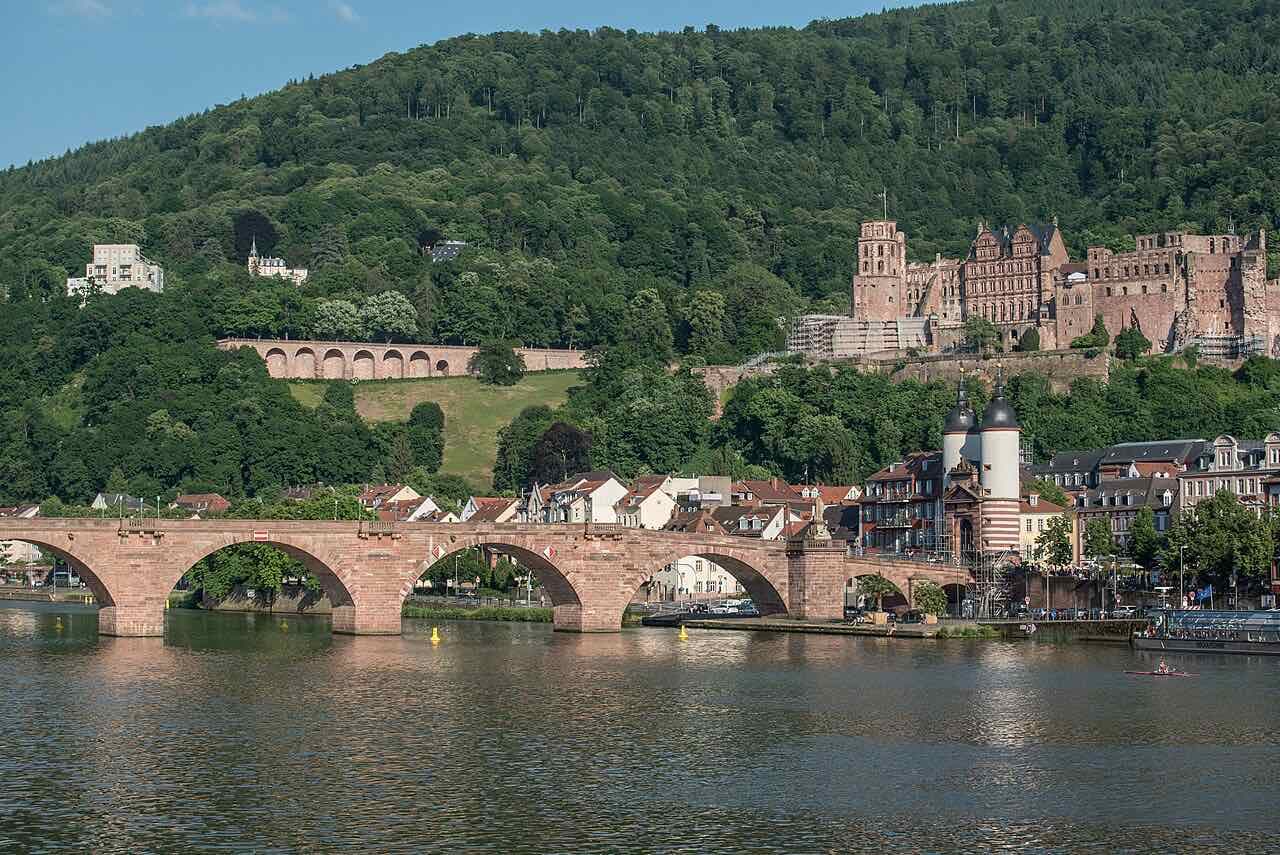
Heidelberg is a town of about 156,000 people on the Neckar, where the river leaves a wooded valley for the flat Rhine plain. Its university was founded in 1386, and roughly a quarter of the residents are students, so the old town, the bookshops, the canteens and the riverside lawns are shaped by them. More than 30,000 students are enrolled at Heidelberg University and 6,633 of them, about one in five, come from abroad. Around the university sit the German Cancer Research Center, EMBL, several Max Planck institutes and a private theory institute, which is why so many English-language master's programmes, PhD programmes and student jobs in science exist in a town this small. The price of that is housing: only about 15 percent of students get a place in a Studierendenwerk hall, and private rooms start well above what dorms cost. Frankfurt Airport is about an hour away.
- Population
- 156,092 (31 Dec 2025), on 108.83 km2
- Main station to the old town
- about 10 minutes by tram or bus
- Semester contribution (Heidelberg University)
- 189.80 EUR per semester, no semester ticket included
- Student hall rents (Studierendenwerk)
- from 243 EUR to 797 EUR a month in Heidelberg, most between about 250 and 460 EUR
- Blocked account for a student visa
- 11,904 EUR per year (992 EUR a month)
Part 1
Living in Heidelberg
A town that grew around its university
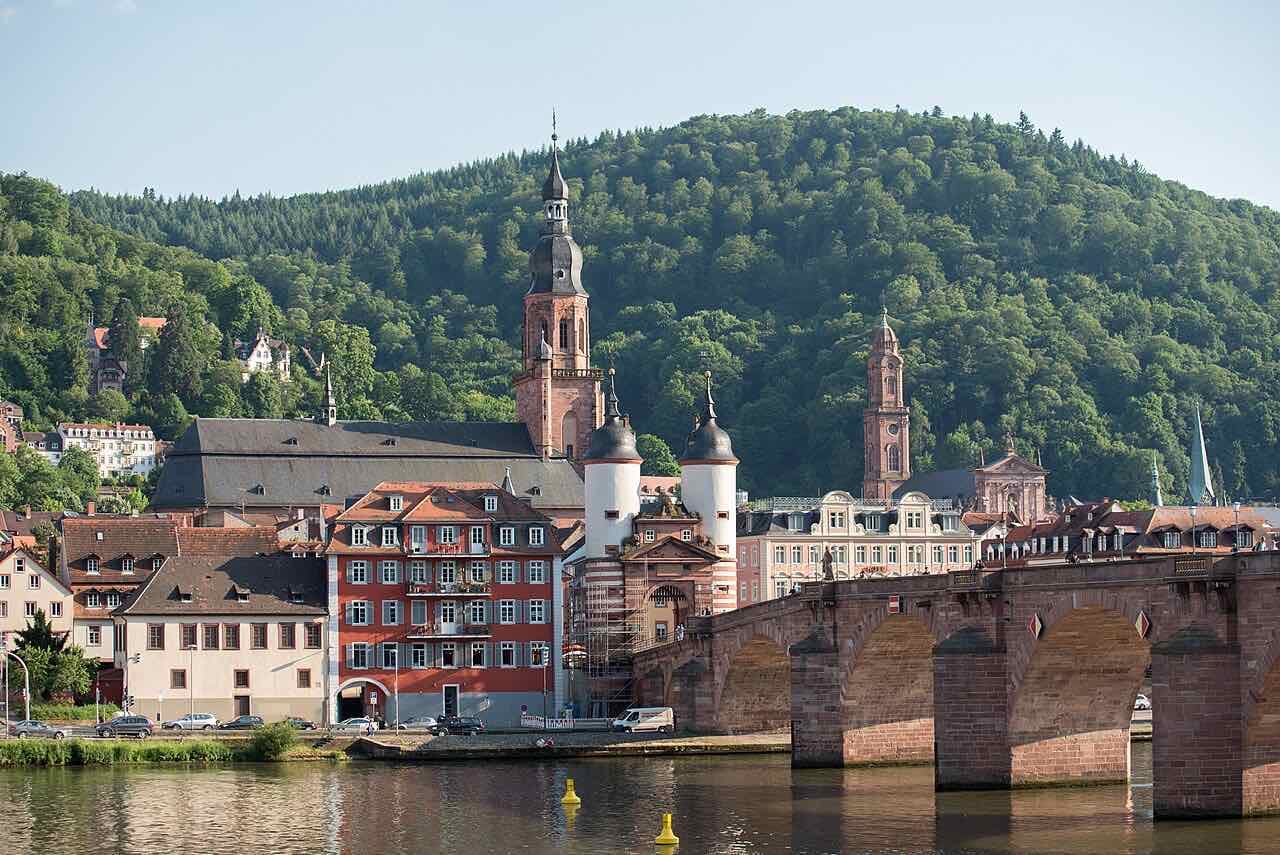
Heidelberg is first mentioned around 1196, and the university followed in 1386, which makes it the oldest in present-day Germany. The first castle building went up between 1398 and 1410 and was extended for two centuries. Then the town was hit again and again: Catholic League troops took it in 1622, French troops burned and mined the castle in 1689 and 1693, and lightning destroyed rebuilt sections in 1764. The stone Old Bridge was finished in 1788. Heidelberg then passed to Baden, and in 1945 the town was spared Allied bombing.
What you get today is a small university city with a big international footprint. Of the people living here in the 2011 census, 16.1 percent held a foreign passport, with Turkey, the United States, Italy, Poland and France the largest groups, and 38 percent had a migration background in 2016. The university and its hospital together are the largest employer, with more than 15,000 jobs. You will hear English in labs and lecture halls, but daily life, from the Bürgeramt to the flat viewing, runs in German.
Be realistic about the climate. It is oceanic, with mild winters and warm summers, about 724 mm of rain a year and 1,633 hours of sun. The recorded extremes are 39.5 degrees in summer and minus 26 in winter, so pack for both a warm Neckar valley in July and some cold weeks in January.
What to see and do
Most of the famous sights are within a walk or a short tram ride of the old town, and several of them have student prices.
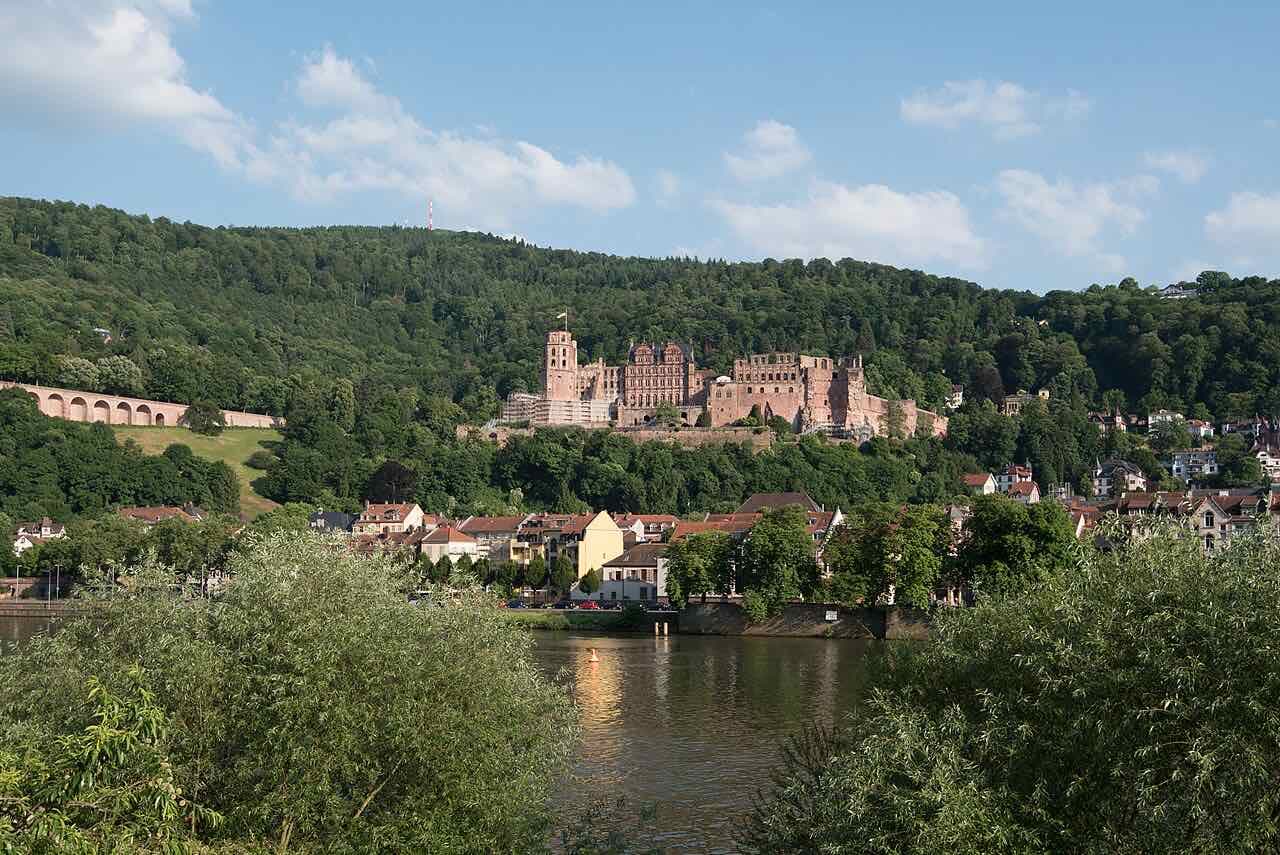
Ruined Renaissance and Gothic castle on the hillside, about 80 metres above the old town. The palace ticket costs 11 EUR, or 5.50 EUR reduced for school and university students up to age 28 with a student ID, and it includes the funicular. The grounds open daily, 9:00 to 18:00, and the castle holds a barrel building with a 220,000-litre wine barrel and the German Apothecary Museum.
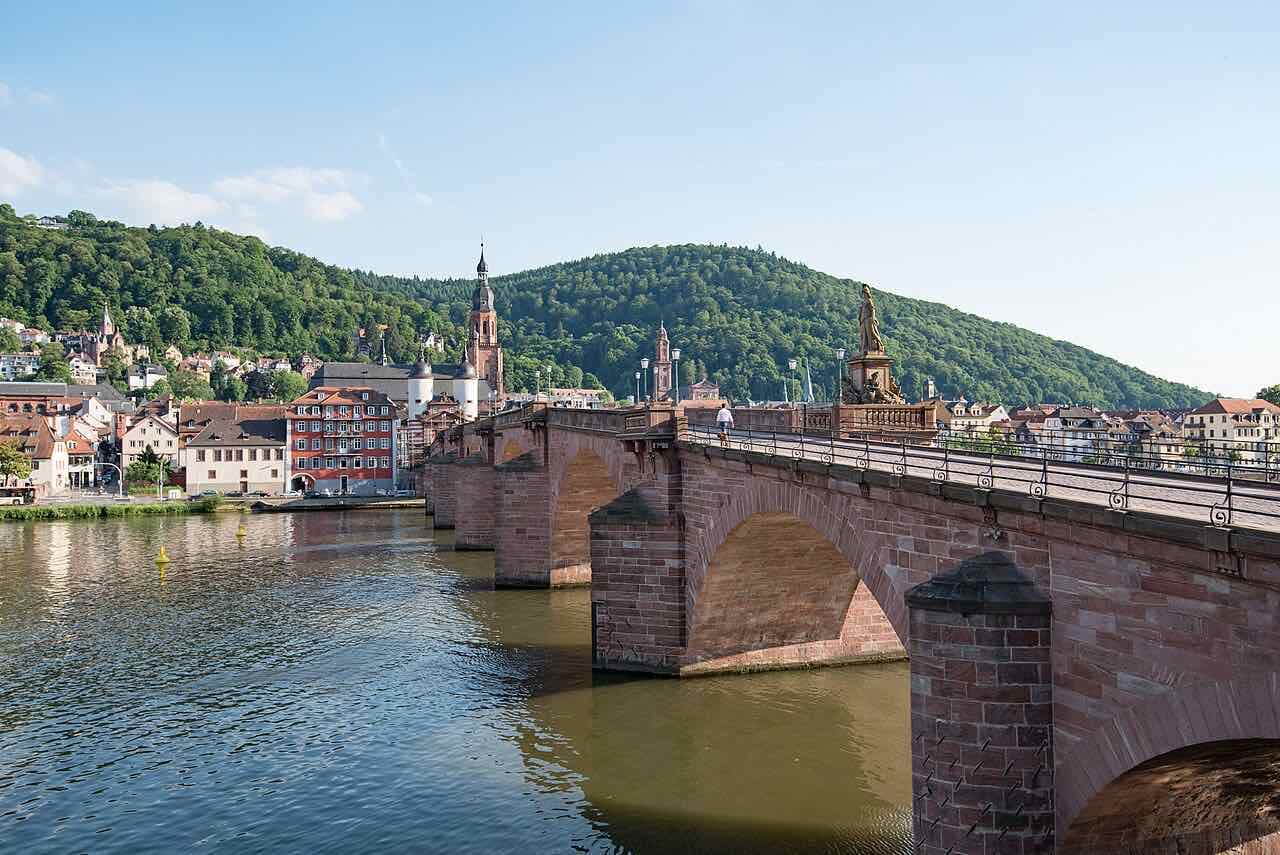
Built in sandstone between 1786 and 1788, about 200 metres long, and the ninth bridge on the site. A monkey statue stands on it again since 1979. The medieval bridge gate sits at the old-town end.
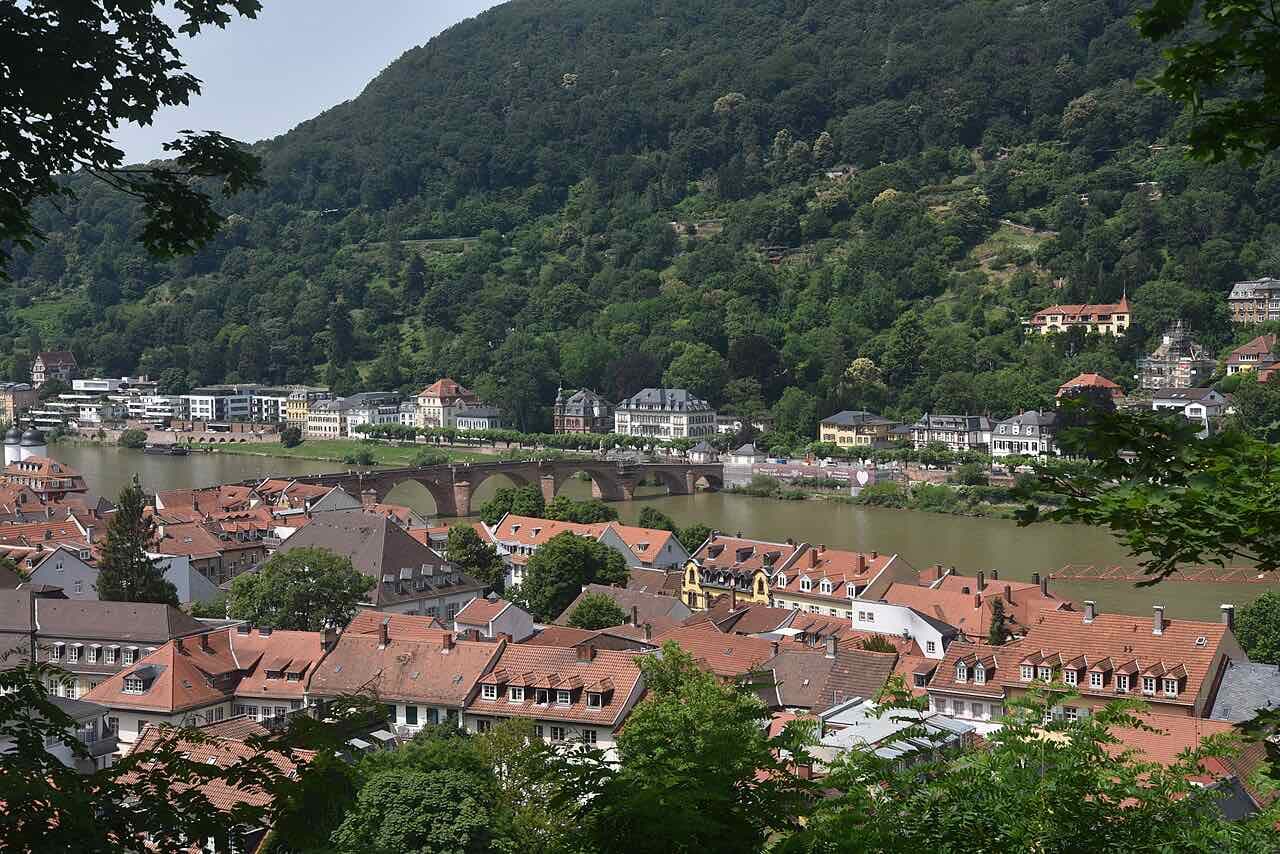
A path on the Heiligenberg slope on the north side of the river, with views across the Neckar to the old town. The university's own description counts it among the most spectacular hillside promenades in Europe.
The mountain railway runs up past the castle to the Königstuhl, the hill above town.
The Neckar meadow, a riverside lawn that the tourist office lists among the town's main sights.
Listed by the tourist office among the town's main attractions.
The castle illumination, listed by the tourist office for 10 July and 4 September 2027.
Christmas market and ice rink ↗
The Christmas market runs 23 November to 22 December 2026, and the ice rink is open 23 November 2026 to 10 January 2027.
Castle, river and bridge
Getting around, and getting out
The main station has ICE, intercity and regional trains with fast connections to Frankfurt, Stuttgart, Karlsruhe and Mannheim, and it is about ten minutes by tram or bus to the old town. Frankfurt Airport is about an hour away by train with a change in Mannheim, or by shuttle bus. City Airport Mannheim is the nearest at about 18 km. Trams and buses are run by RNV, which also covers neighbouring Mannheim and Ludwigshafen.
One thing to know before you budget: since the winter semester 2023/24 Heidelberg University students can no longer buy a semester ticket, and the old rule that let them ride the VRN network free in the evening and at weekends has been cancelled. Your options are the Deutschlandticket or the Baden-Württemberg youth ticket for under-27s, which the Student Council's page lists, with prices that change, so check both before you buy. The semester contribution does include a small bike-share levy for nextbike.
What it costs
- Semester contribution at Heidelberg University
- 189.80 EUR per semester: 80.00 administration, 95.00 Studierendenwerk, 10.00 student body, 2.30 nextbike, 2.50 theatre flat ratesource
- Check before you go: tuition fee for most non-EU students
- 1,500 EUR per semester at Baden-Württemberg universities, with exemptions; the Student Council's page was last updated in 2021, so confirm the current amount with the universitysource
- Check before you go: blocked account for the student visa
- 11,904 EUR per year, withdrawals up to 992 EUR a monthsource
- Studierendenwerk hall room
- 243 to 797 EUR a month; examples: Holbeinring 243 to 385 EUR, Internationales Max Kade Haus 330 to 355 EUR, Walpergenhaus 295 to 395 EURsource
- Private room or flat
- the university says private rents start at a minimum of 400 to 500 EUR a month, and landlords usually want a deposit of two to three months' rentsource
- Castle ticket for students (up to age 28)
- 5.50 EUR including the funicularsource
- Minimum wage for a student job
- 13.90 EUR an hour since January 2026; a minijob up to 556 EUR a month is tax-freesource
Rent is the main cost. Check the two flagged items before you go.
Where the work is
The largest employer is the university with its hospital, with more than 15,000 jobs, and the research institutes below hire students for lab, data and admin jobs and offer PhD places. None of this is a promise of a job, but it shows where internships and student assistant posts come from.
German Cancer Research Center (DKFZ) ↗
Germany's largest biomedical research institution, on the Neuenheimer Feld campus at Im Neuenheimer Feld 280. It advertises an International PhD Program, more than 500 PhD students and a Major Cancer Biology master's.
The headquarters of the European Molecular Biology Laboratory at Meyerhofstraße 1, with five research units, core facilities and an advanced training centre. EMBL employs more than 1,800 people across its six sites.
Max Planck Institute for Astronomy ↗
Three departments (planet formation and exoplanets, galaxies and cosmology, atmospheric physics of exoplanets), which also runs a PhD programme (IMPRS).
Heidelberg Institute for Theoretical Studies (HITS) ↗
A non-profit institute funded by the Klaus Tschira Foundation, at Schloss-Wolfsbrunnenweg 35, working on machine learning, astroinformatics, molecular modelling and natural language processing.
The German Wikipedia names Heidelberger Druckmaschinen, Heidelberg Materials, SAP, SAS Institute, Prominent and ABB Stotz-Kontakt among the firms based in the city, plus the Sparkasse Heidelberg and two Volksbanks.
Part 2
Student life in Heidelberg
Where you can study
Ruprecht-Karls-Universität Heidelberg ↗
Founded in 1386, the oldest university in present-day Germany. More than 30,000 students, of whom 6,633 (20.6 percent) are international, and 9,343 doctoral candidates. It is one of Germany's universities of excellence. The central administration is at Grabengasse 1 in the old town, and the natural-science and medical campus is the Neuenheimer Feld. Its English-language master's programmes include Data and Computer Science, Molecular Biosciences, Matter to Life, Molecular Systems Science and Engineering, Biomedical Engineering, Translational Medical Research, International Health, Transcultural Studies, English Studies, and Development, Environment, Societies and History in South Asia. Check each programme's language of instruction before you apply.
International office ↗Pädagogische Hochschule Heidelberg ↗
The university of education, at Keplerstraße 87, with more than 4,200 students according to the city. It trains teachers and runs degree programmes in educational science, with additional programmes in sustainability, democracy education and sign language.
International office ↗SRH University, Campus Heidelberg ↗
One of the oldest and largest private universities in Germany, on the Neckar in Wieblingen at Ludwig-Guttmann-Straße 6, with its own student housing, labs and a cafeteria. It teaches in short thematic blocks (the CORE principle) and offers Bachelor's, Master's, MBA, dual and part-time study. Programmes tagged English on its Heidelberg page include Applied Artificial Intelligence, Computer Science, International Business Administration, and master's in Applied Data Science and AI, Information Technology, Digital Health and Architecture. Several are listed across more than one site, so check that your programme runs in Heidelberg.
International office ↗Hochschule Fresenius, Campus Heidelberg ↗
A private university with a site at Sickingenstraße 63-65. Programmes shown on its Heidelberg page include Media Management and Digital Marketing (B.A.), Real Estate (B.A.) and Business Psychology (B.Sc.). Ask which programmes run in English and in Heidelberg before you apply.
Hochschule für Jüdische Studien Heidelberg (HfJS) ↗
At Landfriedstraße 12, run by the Central Council of Jews in Germany and funded by the federal and state governments. Jewish Studies can be studied here in more variety than at any other university in Europe, according to the city. Bachelor's programmes are Jewish Studies, Jewish Studies teacher training and Jewish Social Work. Master's programmes include Jewish Studies, Jewish Civilizations, Jewish Museology, History of Jewish Cultures, Medieval Studies, Middle Eastern Studies and Interreligious Studies. It welcomes students of any origin or religion, and some events run in English.
Hochschule für Kirchenmusik der Evangelischen Landeskirche in Baden ↗
A church music college at Hildastraße 8 whose predecessor, the Evangelisches Kirchenmusikalisches Institut, was founded in 1931. It trains church musicians in organ, choral conducting, singing and theory. Its website is in German.
European Molecular Biology Laboratory (EMBL), Heidelberg ↗
The main laboratory of the intergovernmental life-science organisation, at Meyerhofstraße 1. It runs advanced training through its International Centre for Advanced Training.
German Cancer Research Center (DKFZ) ↗
A Helmholtz centre at Im Neuenheimer Feld 280 with an International PhD Program, more than 500 PhD students and a master's in Cancer Biology.
Max Planck Institute for Astronomy ↗
Researches planet formation, galaxies and cosmology and operates telescopes including the Large Binocular Telescope. It has a PhD programme (IMPRS) and the public Haus der Astronomie. The university also lists Max Planck institutes for Medical Research, Nuclear Physics and Comparative Public Law and International Law as local research partners.
Heidelberg Institute for Theoretical Studies (HITS) ↗
Founded in 2010 by Klaus Tschira and his foundation. Research groups work on astroinformatics, machine learning, computational statistics, molecular and cellular modelling, natural language processing and stellar physics.
Student unions, services and groups
Studierendenrat (StuRa) of Heidelberg University ↗
The student council of the Verfasste Studierendenschaft, at Albert-Ueberle-Straße 3-5. It offers legal and tenancy advice, BAföG and social advice, an emergency grant, equipment loans and a bicycle workshop, and has departments for international students, anti-racism, culture and sport and many more.
StuRa Referat for international students ↗
Advice on the Deutschlandticket, visa problems, residence permits and tuition fees, by email appointment at internationales@stura.uni-heidelberg.de. It also runs a monthly Stammtisch and takes part in the Alliance of Cultures.
Studierendenwerk Heidelberg, services for internationals ↗
Housing application help, a service package for internationals, dormitory tutors, canteen and dormitory dictionaries and a PDF list of leisure activities and groups. Student Services for Internationals is at ServiceCenter Altstadt, Grabengasse 12.
University sports (Hochschulsport) ↗
Run by the Institute for Sport and Sport Science at Im Neuenheimer Feld 700, with recreational and competitive sport, family offers and stand-up paddling on the Neckar.
Erasmus Student Network Heidelberg ↗
The local ESN section: a buddy scheme, social activities and excursions for exchange and international students.
Evangelische Studierendengemeinde (ESG) ↗
Protestant student community at Plöck 66 with a choir, chamber music circle, big band, dance, Bible study and pastoral care. The website is in German.
Katholisches Universitätszentrum (KUZ) ↗
The Catholic university centre at Neckarstaden 32 for students of the university, the PH and the HfJS. Mondays in term the Edith-Stein-Haus is open as a quiet study space, with a soup evening and Taizé prayer. The site has an English version.
Muslimische Studierendengruppe Heidelberg (MSG) ↗
The only Muslim student group on the Student Council's list of groups.
A European students' association among the international groups on the Student Council's list.
All registered student groups ↗
The Student Council keeps a list of 128 Hochschulgruppen, grouped into international, religious, cultural and others, including Vietnamese, Polish, Kurdish and Armenian student groups.
Three campuses and a lot of English
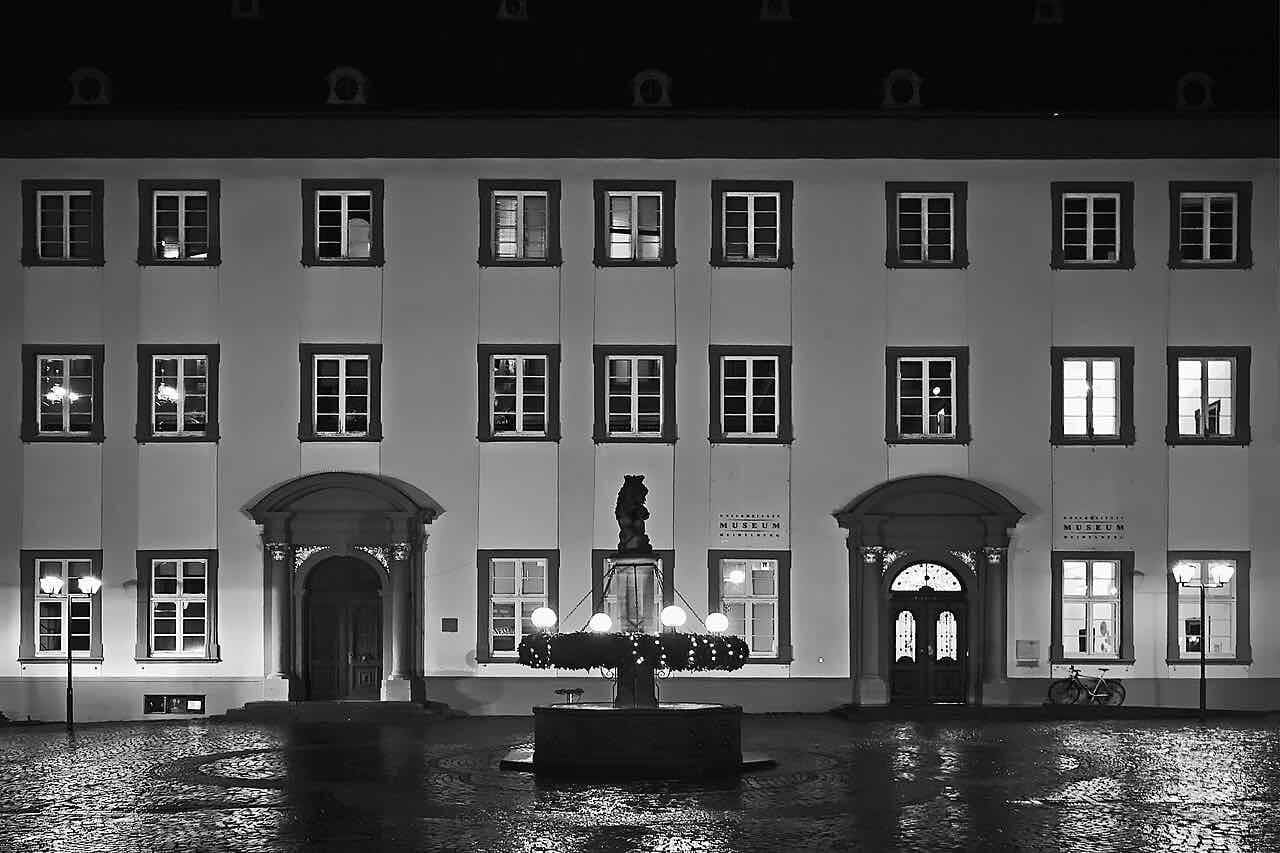
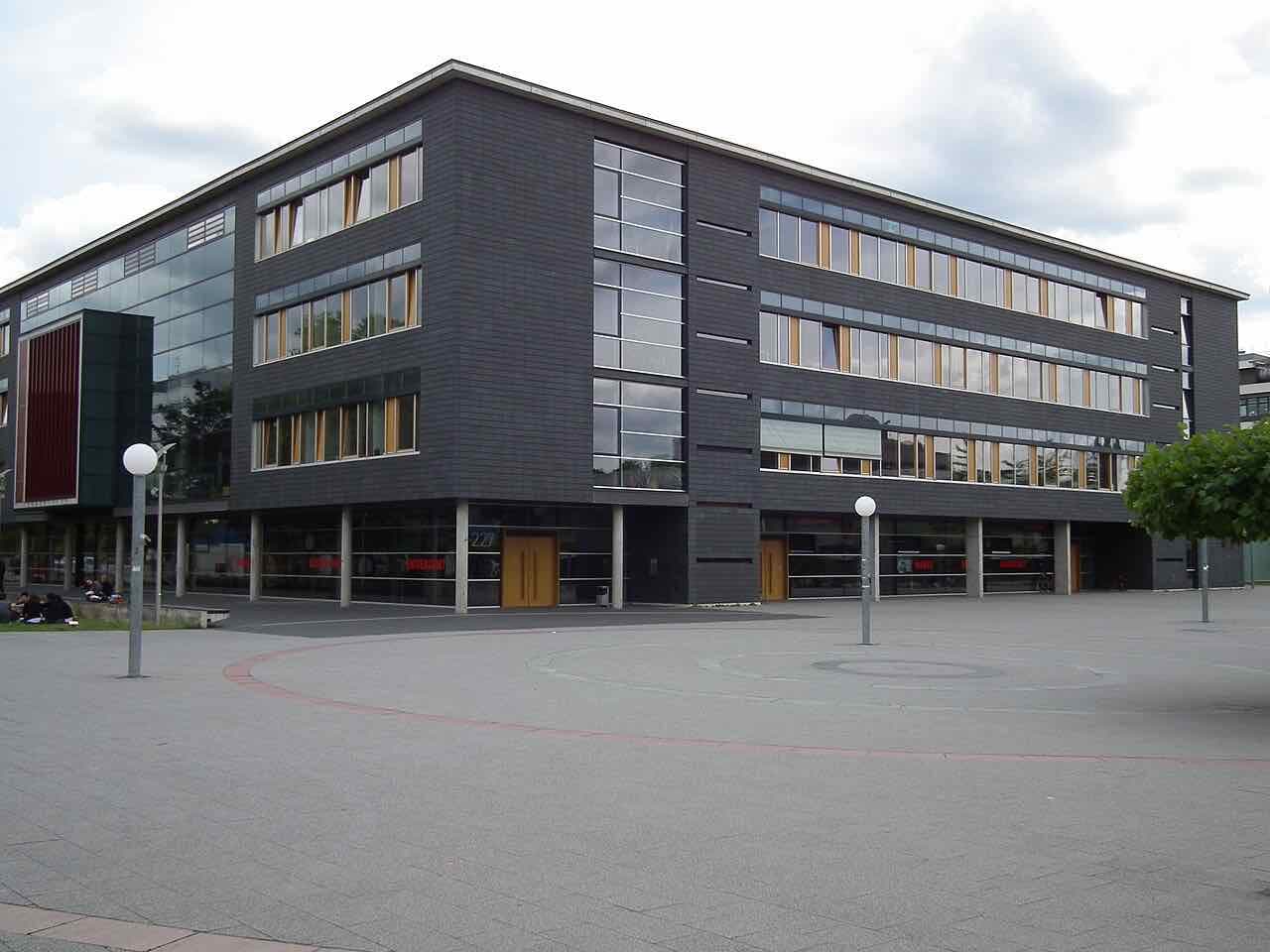
Heidelberg University is spread over a few areas. The old town campus has the Old University, the central administration, the Seminarstraße and Fischmarkt offices and a Triplex canteen at Grabengasse 14. The Neuenheimer Feld on the north bank is the science and medicine campus, with the Zentralmensa at Im Neuenheimer Feld 304, institute buildings and halls. A third area is Bergheim, with a Mensa at Bergheimer Straße 58.
Study culture is research-driven. The university brochure counts 9,343 doctoral candidates next to the 30,000 students, and cooperation with the local institutes (DKFZ, EMBL and several Max Planck institutes) runs through the master's and PhD programmes. If you come for an English-language master's, ask the department early what happens in the first semester, because many programmes mix English and German teaching.
Housing
Rooms are the hard part of Heidelberg. Start searching before you arrive, and arrange a bed for your first nights.
The Studierendenwerk lists 28 halls in Heidelberg, from Altstadt houses such as the Europahaus and Sibley-Haus to the Neuenheimer Feld blocks and the Fasanerie settlement in Leimen at 224 to 265 EUR. Rents run from 243 EUR (Holbeinring) to 797 EUR (Herrenmühle). Most rooms are in shared flats of two to four people, or on floors with shared kitchens, and the university notes that Altstadt halls have no direct university internet connection.
The university says only 15 percent of Heidelberg students can be housed in student residences, so you should plan for the private market as well.
Accommodation service for international students ↗
Run by the university. Office hours are Tuesday 14:30 to 16:30, Thursday 13:30 to 15:30 and Friday 10:00 to 12:00, at Seminarstraße 2 (Serviceportal, room 33) and online. Phone +49 6221 541 2759, email aaazimmer@zuv.uni-heidelberg.de. The same page points to a page on housing scams that you should read first.
Phone 06221 54-5400 or info@stw.uni-heidelberg.de, Monday to Thursday 9:00 to 17:00 and Friday 9:00 to 15:00. The BAföG hotline is 06221 54-5404.
Canteens and food
The Studierendenwerk runs eight canteen points, and a CampusCard or student ID pays cashless across campus. Opening hours are Monday to Friday.
Im Neuenheimer Feld 304, 11:15 to 14:00.
Grabengasse 14 in the old town, 11:00 to 14:00, with a PastaBox and a [kœri]werk stall in the same building.
Bergheimer Straße 58, 8:00 to 15:00.
Keplerstraße 87, 9:00 to 15:00, at the PH Heidelberg.
Sport, clubs and what to do in the evening
The Student Council's list has 128 student groups, so there is a group for almost any interest: choirs and big bands, a theatre group, a riding group, Law and business societies, AEGEE and ESN, and country groups such as the Heidelberg Vietnamese Student Association. University sport sells courses and has a box office for remaining places, and stand-up paddling on the Neckar is one of the listed examples.
The semester contribution carries a small theatre flat rate, so you pay 2.50 EUR a semester towards cheaper tickets. In summer the Neckarwiese is the common meeting place, and in winter there are the Christmas market and the ice rink. The rest depends on your group: there is no single student quarter, so most social life runs through your department, your hall and the societies above.
Your first weeks
- 1
Before you travel
Book a bed for the first nights and read the university's page on housing scams. The accommodation service for international students holds weekly office hours and answers at aaazimmer@zuv.uni-heidelberg.de.
- 2
Within two weeks of moving in
Register your address at the Bürgeramt. Book an appointment at termin.heidelberg.de or by phone on 58 13 333. The main office is at Bergheimer Straße 69, and district offices such as Altstadt, Neuenheim and Handschuhsheim handle appointments or walk-ins on set days.
- 3
In your first month
Contact the Ausländerbehörde at the International Welcome Center, Bergheimer Straße 147 (Landfriedgebäude), by email zuwanderung-post@heidelberg.de or phone (06221) 58-1 75 20. It shares the building with the Interkulturelles Zentrum, so you can also ask about local associations there.
- 4
First semester
Pay the semester contribution of 189.80 EUR, get your student ID and CampusCard, and sort out transport, because there is no semester ticket. The StuRa international referat can help with the Deutschlandticket and visa problems.
- 5
When you want a job
Non-EU students may work 140 full days or 280 half days a year. Student assistant jobs at the university are an exception, though you still tell the foreigners' office.
Working alongside your studies
Students from outside the EU may work 140 full days or 280 half days a year. More than that needs permission from the Agentur für Arbeit and the Ausländerbehörde, and academic assistant jobs are the exception to the day limit, though you must still inform the foreigners' office. The minimum wage is 13.90 EUR an hour since January 2026, and a minijob up to 556 EUR a month is tax-free. EU students may work without restriction, with social contributions after 20 hours a week.
In Heidelberg specifically, the research institutes are the natural first place to ask: DKFZ, EMBL, the Max Planck institute for astronomy and HITS all publish jobs, and the university hospital is part of the biggest employer.
Where you come from matters here
Pick your home country: food, faith, community groups and the consulate that serves you, checked 21 October 2026.
🇮🇳 Living in Heidelberg as an Indian student
Heidelberg has a German-Indian society and a university centre for South Asian studies, but no Indian student association with its own website that the city or the university lists. The consulate that serves Baden-Württemberg is in Munich, not Frankfurt.
Consulate General of India, Munich ↗
Covers Baden-Württemberg and Bavaria: passports, OCI, visas, attestation and registration of Indian nationals. The site links the office timings and how to reach the consulate.
Deutsch-Indische Gesellschaft Heidelberg ↗
Lectures, music, dance and theatre on contemporary Indian culture, including a Diwali celebration in the Marktstraße parish hall in Heidelberg in 2023. The society's postal address is in Ludwigshafen, so check the site for where the next event is.
🇳🇬 Living in Heidelberg as a Nigerian student
Neither the city's list of meeting points nor the university's list of student groups includes a Nigerian association. The embassy is in Berlin. The Christian student groups, such as KUZ and ESG, are open to all students.
Neue Jakobstraße 4. Passport appointments are booked free on the Nigeria Immigration website, and visa applications go through the authorised provider at Zimmerstraße 68. All consular applicants pay a 30 EUR administrative charge.
Katholisches Universitätszentrum (KUZ) ↗
Catholic centre at Neckarstaden 32 with an English version of its site, a free soup evening, prayer and a KAAD scholarship group.
🇻🇳 Living in Heidelberg as a Vietnamese student
There is a Vietnamese student association at Heidelberg University. The embassy is in Berlin.
Heidelberg Vietnamese Student Association (HDVSA) ↗
A student group on the university's list of country-based groups, reachable on Instagram.
The embassy's consular section publishes consular procedures and fees, and warns about scammers who impersonate embassy staff by phone.
🇵🇰 Living in Heidelberg as a Pakistani student
The university lists one Muslim student group, and Heidelberg has two mosques: an independent one on Kurpfalzring and a DITIB mosque run by a Turkish association. Pakistan's embassy is in Berlin.
Muslimische Studierendengruppe Heidelberg (MSG) ↗
The Muslim student group on the Student Council's list.
Yavuz-Sultan-Selim-Moschee (DITIB Heidelberg) ↗
Mosque and cultural centre of the Türkisch-Islamische Gemeinde at Hatschekstraße 20, with five daily prayers, Friday prayers and tours for students. Its site and services are in German.
🇺🇸 Living in Heidelberg as an American student
Heidelberg has a long American connection: the United States is among the largest groups of foreign residents, the town was under US Army occupation after 1945, and the university has a Center for American Studies.
Deutsch-Amerikanisches Institut (DAI) Heidelberg ↗
A cultural house at Sofienstraße 12 with a library, a language school and a public programme of talks, some of it in English, plus language courses aimed at research and university life.
The binational commission in Berlin funds US students and researchers in Germany, including an Open Study/Research Award for post-Bachelor, Master's and PhD students, with applications from April to October.
🇨🇳 Living in Heidelberg as a Chinese student
The Chinese consulate general in Frankfurt covers Baden-Württemberg. In town, the Confucius Institute runs courses and exams, and the university teaches East Asian studies, but no Chinese student association with a site of its own is on the university's list of groups.
Consulate General of China in Frankfurt ↗
Its consular district includes Baden-Württemberg, Hesse, Rhineland-Palatinate and Saarland. The site lists consular services and links to the Frankfurt visa application centre.
Konfuzius-Institut Heidelberg ↗
A Chinese language and culture centre at Am Bahnbetriebswerk 5, run by a registered association at the university. It offers group and private Chinese courses, HSK exams, a library and cultural events, and describes itself as open and independent.
English-taught programmes in Heidelberg
Soonest open deadline first. Every entry links to its official source.
- Max Planck School Matter to Life – MSc to PhD Direct Track ProgrammeHeidelberg University · HeidelbergmasterNo tuition01 Dec 2026Closing soon
- Master's in Mathematics of Machine Learning and Data ScienceHeidelberg University · Heidelbergmaster15 Mar 2027Open
- Molecular Biosciences MScHeidelberg University · Heidelbergmaster15 Mar 2027Open
- Molecular Systems Science and Engineering (MSSE)Heidelberg University · Heidelbergmaster15 Mar 2027Open
- Master of Science in Scientific ComputingHeidelberg University · Heidelbergmaster15 Jun 2027Open
- South Asian StudiesHeidelberg University · Heidelbergmaster30 Sept 2027Open
- International Business (BA) with Specialisation in International ManagementHochschule Fresenius - University of Applied Sciences · HeidelbergbachelorRollingApply anytime
- SAP Engineering & Analytics (MSc)Hochschule Fresenius - University of Applied Sciences · HeidelbergmasterRollingApply anytime
- Electrical Engineering (BEng)SRH University · HeidelbergbachelorRollingApply anytime
- Architecture – Design for the Built Environment (MA)SRH University · HeidelbergmasterRollingApply anytime
- Music Therapy (MA)SRH University · HeidelbergmasterRollingApply anytime
- Mechanical Engineering (BEng)SRH University · HeidelbergbachelorRollingApply anytime
- Applied Computer Science (MSc)SRH University · HeidelbergmasterRollingApply anytime
- Applied Data Science and Artificial Intelligence (MSc)SRH University · HeidelbergmasterRollingApply anytime
- Information Technology (MEng)SRH University · HeidelbergmasterRollingApply anytime
- Information Technology and Business TransformationSRH University · HeidelbergmasterRollingApply anytime
- International Business and Engineering (MEng)SRH University · HeidelbergmasterSee sourceCheck source
- Water Technology (MEng)SRH University · HeidelbergmasterSee sourceCheck source
- Business Engineering (BEng)SRH University · HeidelbergbachelorSee sourceCheck source
- Master of Arts in Transcultural StudiesHeidelberg University · HeidelbergmasterSee sourceCheck source
- International Business and Engineering (MEng)SRH University · HeidelbergmasterSee sourceCheck source
Is Heidelberg right for you? Ask us. Free.
Tell us your passport, grades and budget. We compare Heidelberg with the other places you could study, then apply for you. You never pay us.
Get my free plan