Studying in Baden-Württemberg, Germany
Karlsruhe
A planned city built as a fan around a palace, with an Excellence University, the highest courts and a media-art centre.
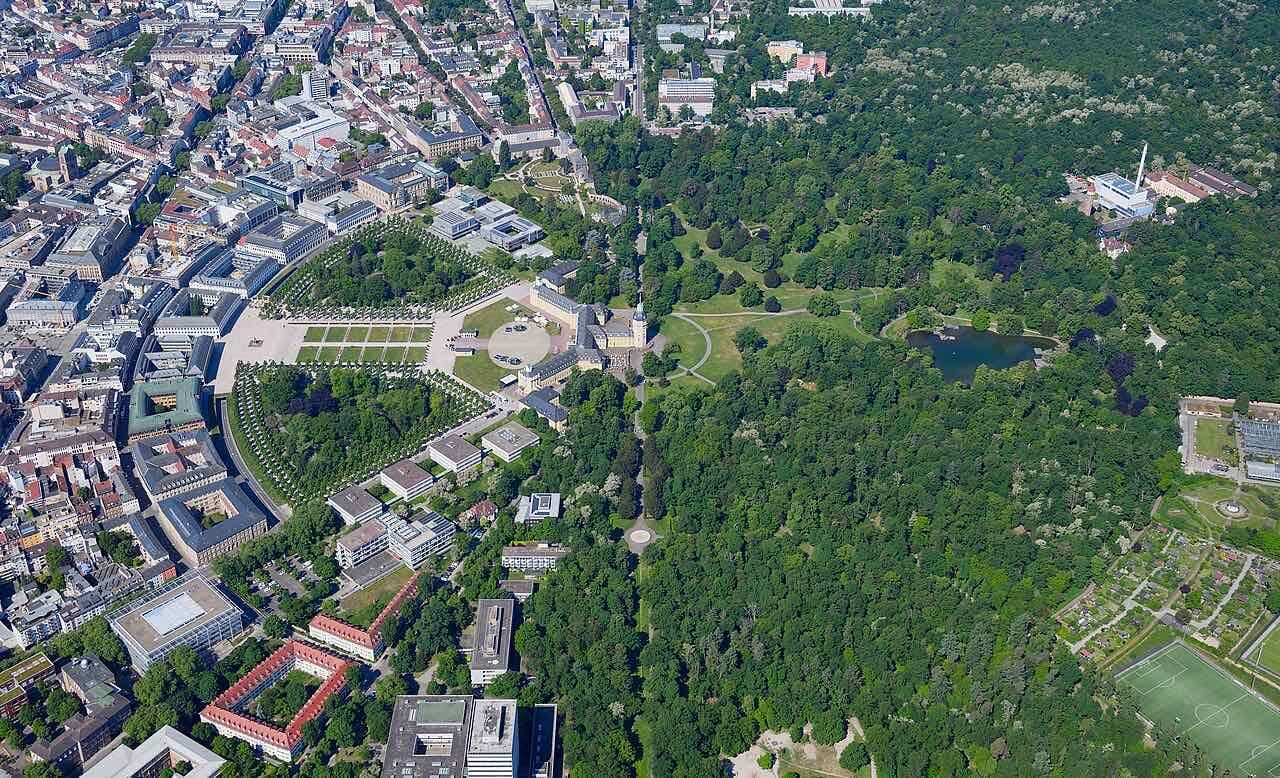
Karlsruhe has about 309,000 residents and is the third-largest city in Baden-Württemberg. It was drawn on a drawing board in 1715: 32 streets run out from the palace like the ribs of a fan, which is why people call it the Fächerstadt. About 37,000 students study here, most of them at the Karlsruhe Institute of Technology (KIT), one of Germany's eleven Excellence Universities, and the rest at a university of applied sciences, a dual university, art, design and music schools and a private business university. The city is also where Germany's Federal Constitutional Court and Federal Court of Justice sit, and UNESCO named it a City of Media Arts in 2019. The palace garden is a lawn you can read on, the Rhine is on the western edge, and the Black Forest hills start in the east of the city. A student room in the Studierendenwerk halls starts under 200 euros a month.
- Population
- 309,247 (31 Dec 2025), third-largest city in Baden-Württemberg after Stuttgart and Mannheim
- Dorm rent (Studierendenwerk Karlsruhe)
- single rooms from 192 EUR to 644 EUR a month, depending on the residence
- Blocked account for a student visa
- 11,904 EUR per year (992 EUR a month)
Part 1
Living in Karlsruhe
A city drawn on a drawing board
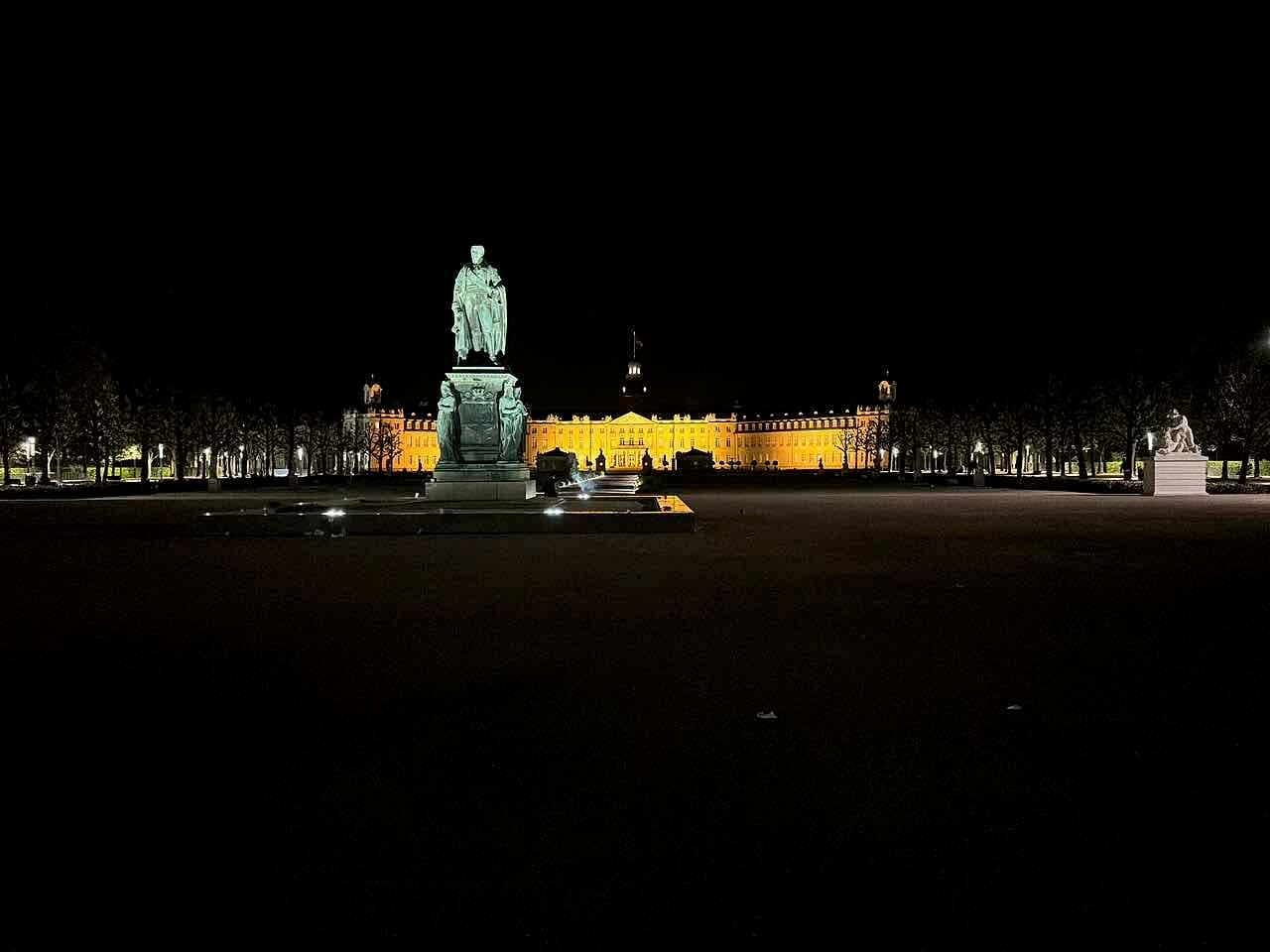
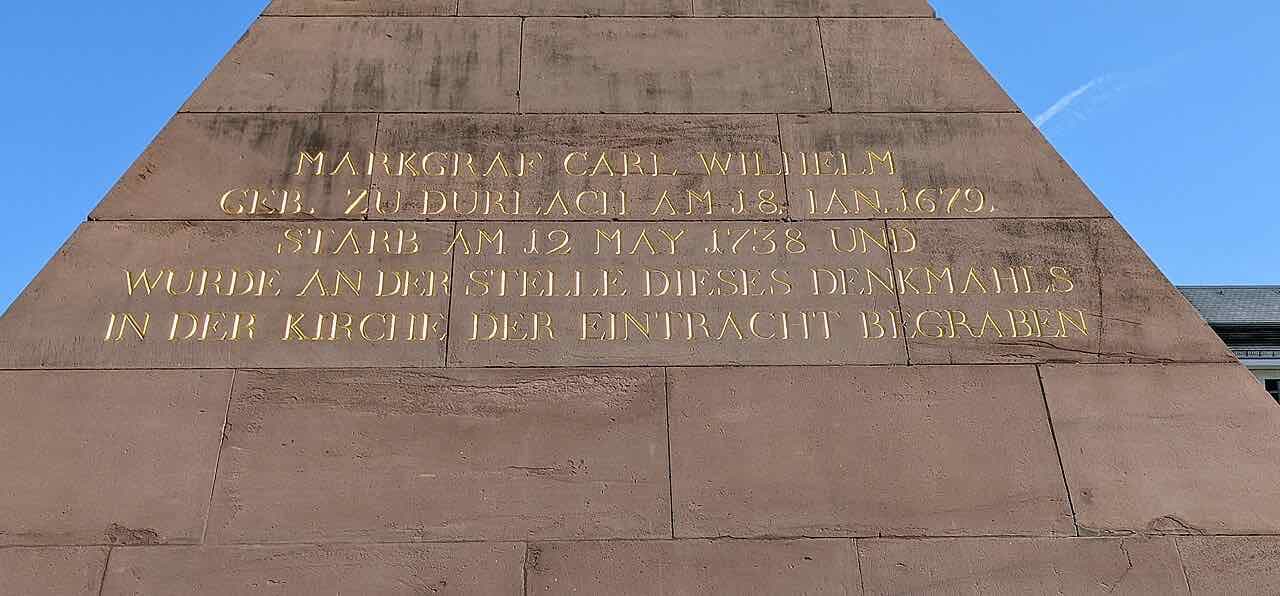
Karlsruhe is one of the few big German cities with a birthday you can name: 17 June 1715. Margrave Karl Wilhelm of Baden-Durlach fell out with the citizens of nearby Durlach and built a new palace in the forest instead, then laid out streets in a fan around its tower. The pyramid on the Marktplatz marks his grave. Until 1945 the city was the capital of Baden.
That plan is still what you walk through. The streets radiate from the palace, so the centre is easy to read on a map. Durlach, the older town the margrave left, is now a district on the eastern edge and has its own station and a hill, the Turmberg, with a lookout tower.
Karlsruhe is the home of the highest German courts: the Federal Constitutional Court, the Federal Court of Justice and the Federal Public Prosecutor General all sit here. For a student that means a small, calm city centre where law, technology and art overlap. The weather is among the mildest in Germany, with summers that can reach 35 degrees and winters milder than in most German cities.
What to see and do
Most of these are a short tram or bike ride from the campuses. Check each site for current opening hours and student prices.
ZKM | Center for Art and Media ↗
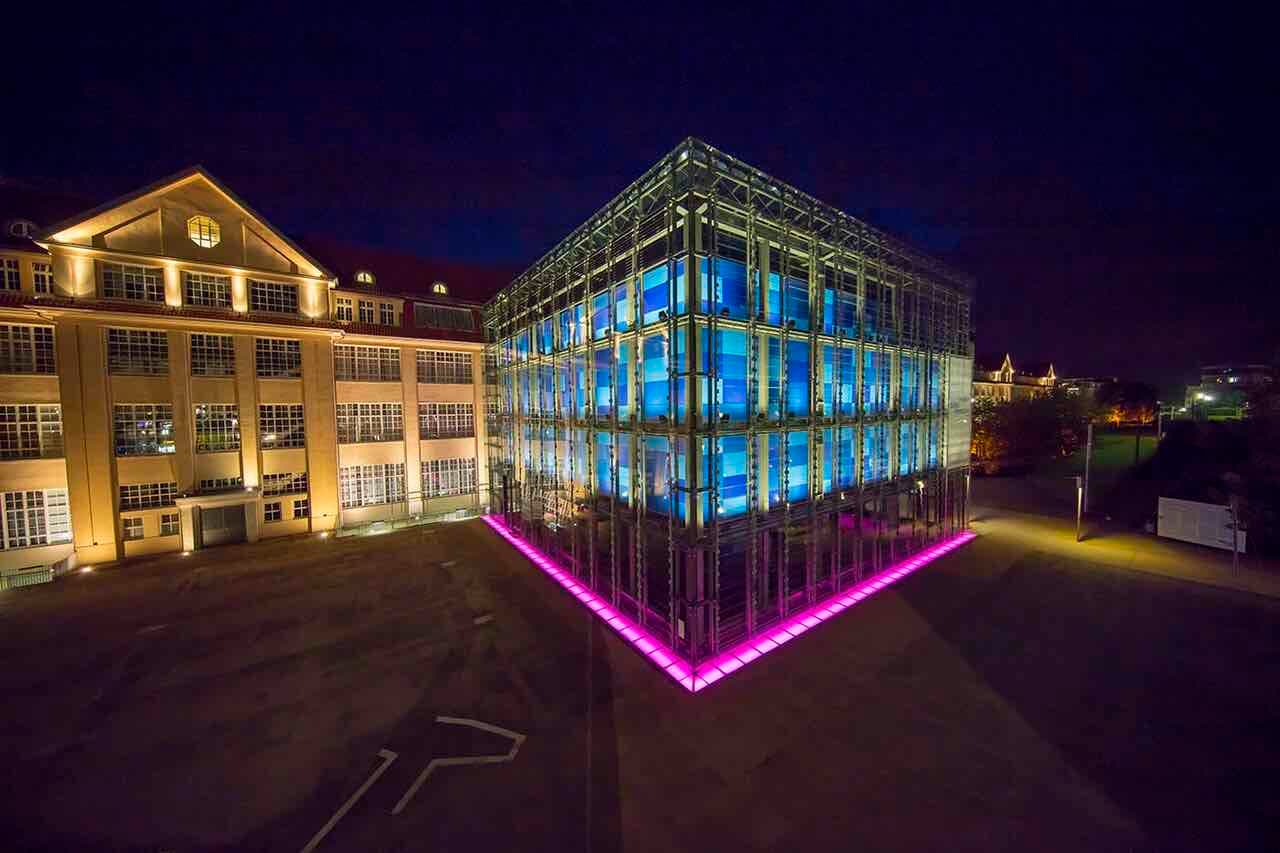
Lorenzstraße 19, in a former ammunition factory hall that it shares with the Karlsruhe University of Art and Design (HfG) and the Staatliche Kunsthalle. Exhibitions on video, digital and media art, plus guided tours in several languages.
The state museum of cultural history is housed in the palace, and it offers guided tours in several languages.
Staatliche Kunsthalle Karlsruhe ↗
The state art gallery, in a building from 1846, with exhibitions in the Hallenbau at the ZKM.
The state theatre and opera house.
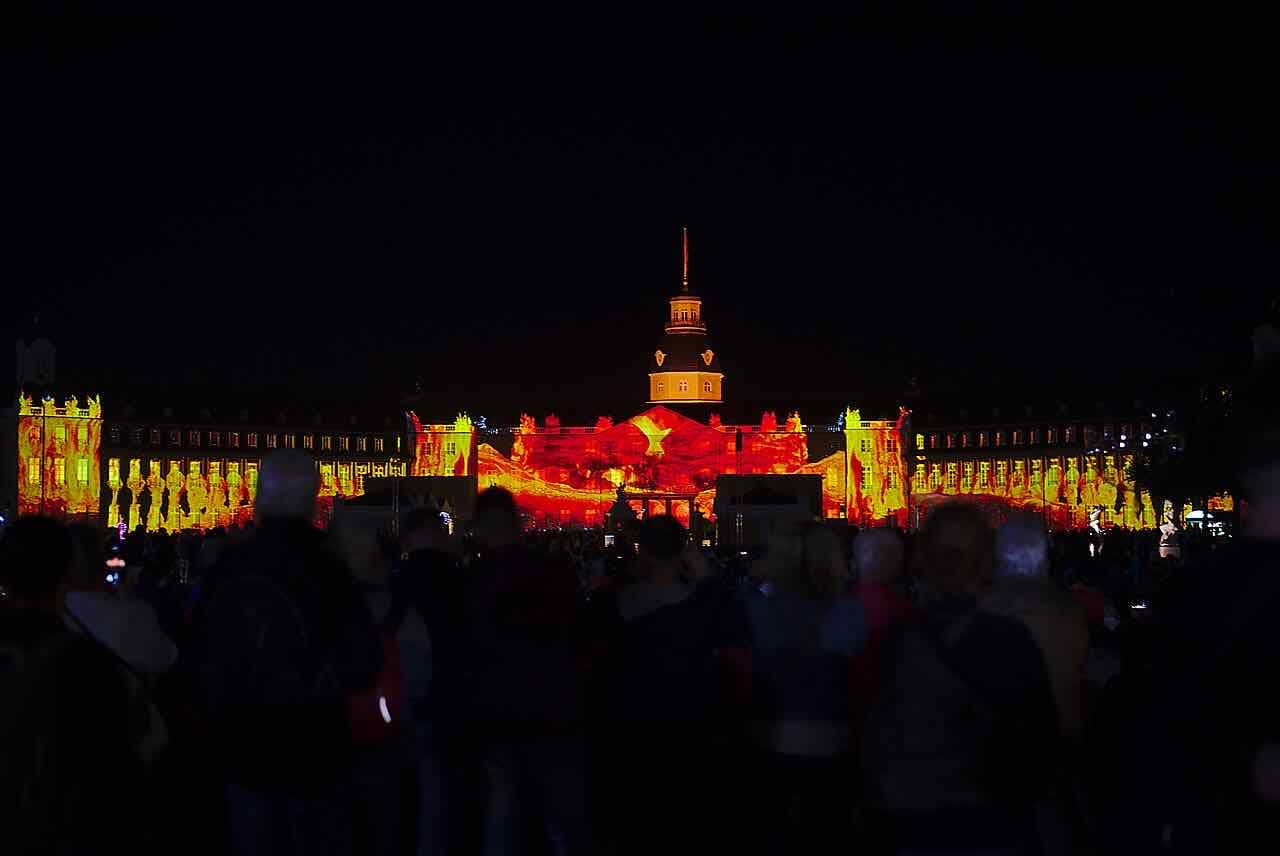
A free light festival that projects moving images onto the palace facade. It started in 2015, and the 2027 edition runs from 12 August to 13 September.
A four-day open-air festival, billed as southern Germany's largest family festival. In 2027 it runs 22 to 25 July; the main stage needs a ticket, but more than 70 percent of the programme is free. It includes the India Summer Days.
A hop-on hop-off bus from the tourist information, starting from 24 EUR, with a stop at the Turmberg in Durlach. The tourist office page also lists current exhibitions.
Around the city
Weekends: garden, Rhine and hills
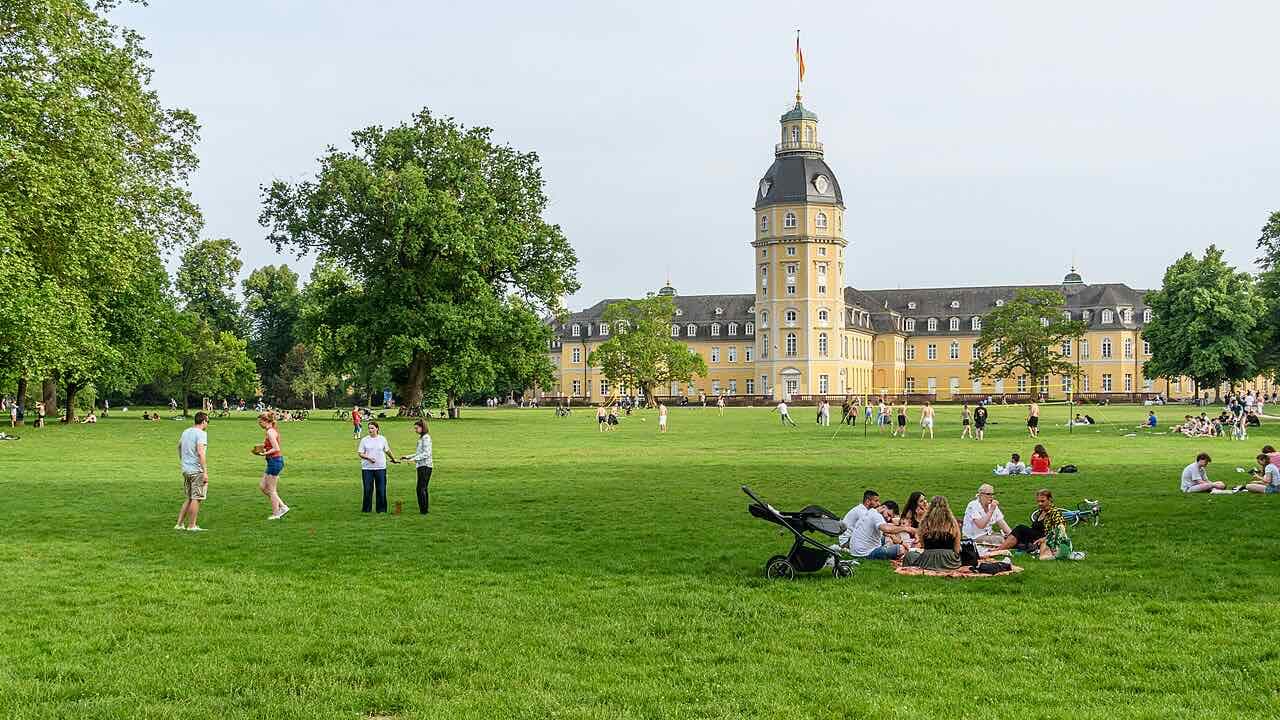
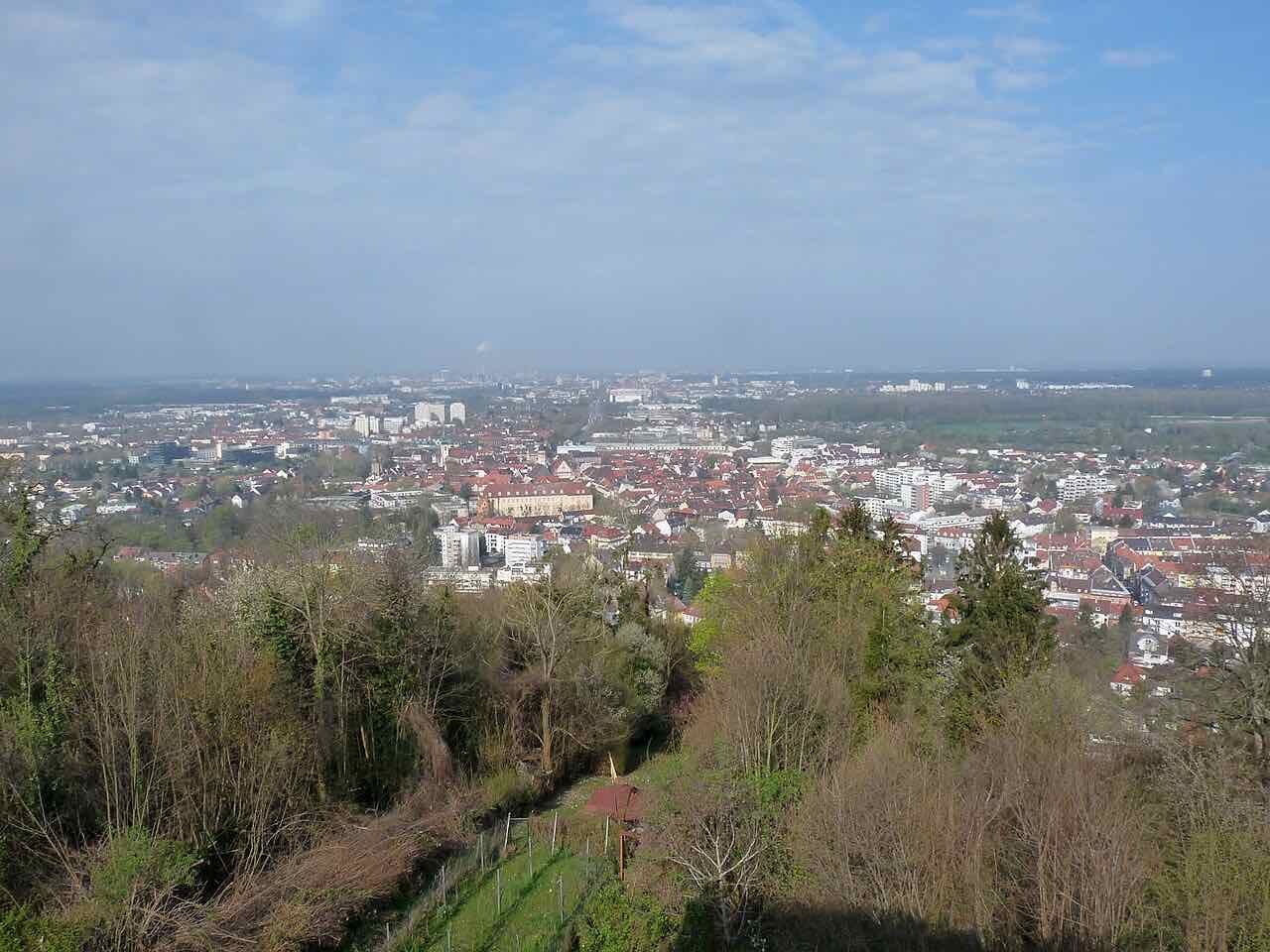
The Schlossgarten behind the palace is the city's living room. It is open grass and old trees, and it has a botanical garden at its edge. The zoo is in the Stadtgarten. For a longer walk, the forest starts at the end of the palace garden, as you can see in the aerial photo at the top of this page.
The Rhine forms the western border of the city. Rappenwört is a stretch of Rhine bank with a swimming area, the Rheinstrandbad. In the east, the Durlach hills belong to the Black Forest nature park (Naturpark Schwarzwald Mitte/Nord), and from the Turmberg you can see across the Rhine plain towards the Palatinate forest. The Turmbergbahn railway goes up from Durlach.
Karlsruhe is twinned with Nancy in France, and the Centre Culturel Franco-Allemand in the city runs exhibitions, readings, films and language courses. The other partner cities are Nottingham, Halle, Krasnodar and Timișoara.
Getting around and getting out
The Karlsruhe Stadtbahn is a tram that also runs on regional rail lines, so the same vehicle takes you from the city centre to towns around it, and seven tram lines cover the city itself. A tunnel under the centre opened on 11 December 2021, and Campus South has its own stop. The KVV ticket system also has night lines: on Friday to Saturday and Saturday to Sunday nights and on public holidays, ten numbered night routes run, some of them on-demand services that you order 30 minutes ahead.
Students at the Karlsruhe universities pay a semester contribution that includes the Deutschland-Semesterticket. The KVV page for students lists it with the other student tickets; look up the current price on your own university's fee page when you enrol.
The central station is a stop on the European high-speed network, with direct ICE trains to Berlin, Hamburg, Cologne and Munich and to Frankfurt Airport, and some TGV trains to Paris, Zurich and Milan. Karlsruhe/Baden-Baden Airport lies south-west of the city, in Rheinmünster.
What it costs
- Studierendenwerk single room, cheapest
- 192 EUR (Rudolfstraße 20)source
- Studierendenwerk single room, dearest
- 644 EUR (Englerstraße 14)source
- Studierendenwerk apartments
- 311 to 540 EUR depending on the residence, e.g. Tennesseeallee 14 and Willy-Andreas-Alleesource
- Mensa main dish for students
- from 3.60 EUR (guest price 5.20 EUR for the same dish)source
- Blocked account for a student visa
- 11,904 EUR per yearsource
- Minimum wage (since January 2026)
- 13.90 EUR per hoursource
All of these figures come from the sources named on each row. Rents are per month for a room, not a flat.
Jobs and employers
Karlsruhe is a significant European centre for information and communication technology. Companies with their main office in the city include the drugstore chain dm and the energy company EnBW. United Internet, the owner of 1&1, WEB.DE and GMX, runs a large data centre here. Siemens has one of its biggest sites in Karlsruhe, with about 4,500 employees, and is the largest private employer. Michelin has its German head office and a tyre plant in the city, and L'Oréal runs its only German factory here.
Two Rhine ports and Germany's largest oil refinery sit on the western edge, and the Messe Karlsruhe trade-fair grounds lie just south in Rheinstetten. For students, the engineering and IT firms and the research institutes in the city (FZI and Fraunhofer IOSB are listed below) are the obvious places to look. Rules for how much you may work are in the student-life section below.
Part 2
Student life in Karlsruhe
Where you can study
Karlsruhe Institute of Technology (KIT) ↗
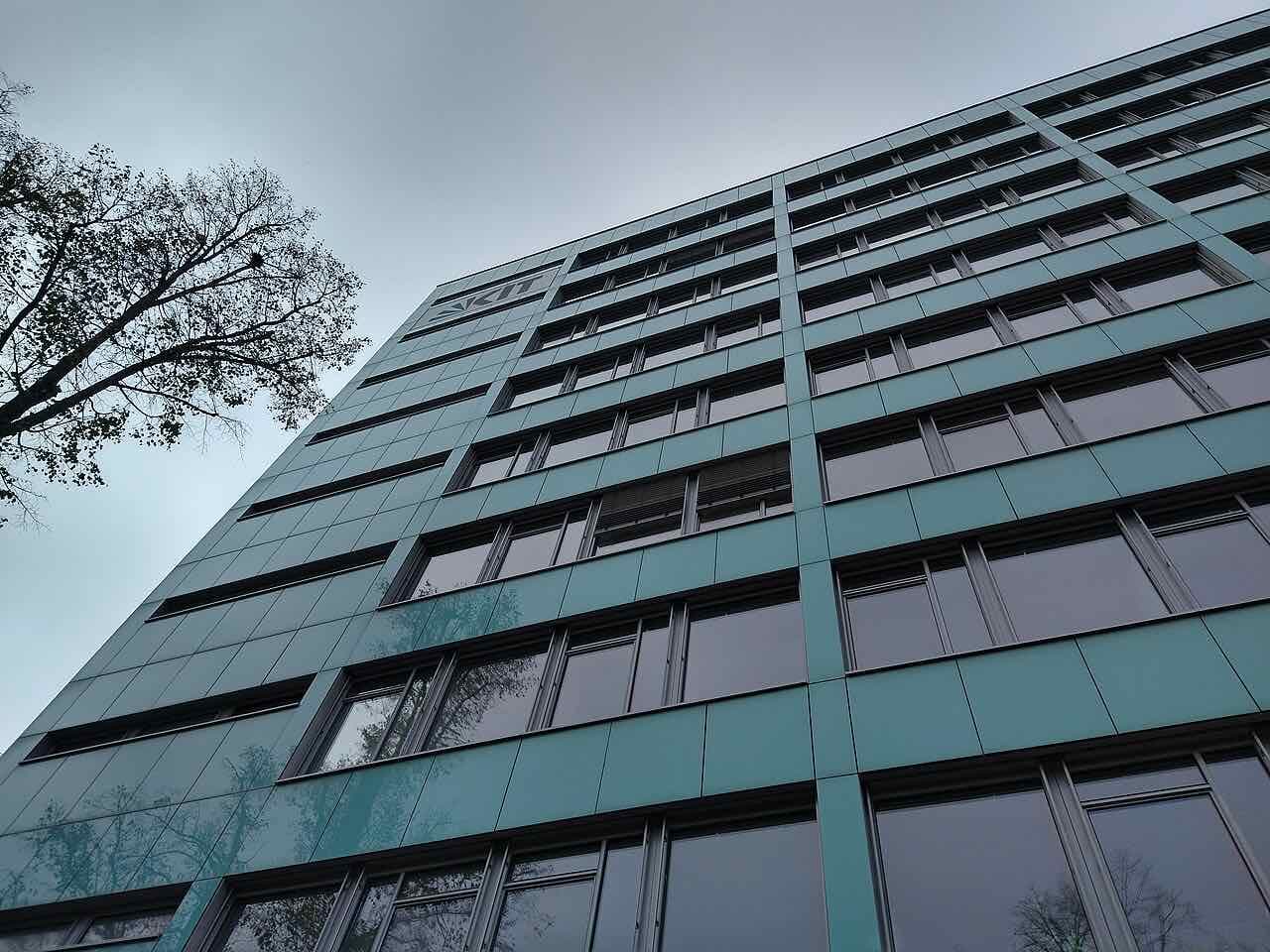
The oldest and largest institution in the city, with about 23,000 students and two campuses: Campus South next to the city centre, and Campus North, the former nuclear research centre. It started in 1825 as a polytechnic school, became a university in 1967 and merged with the Karlsruhe Research Center in 2009. It is a member of the TU9 group of technical universities and one of eleven Excellence Universities since 2019. It set up Germany's first computer science faculty in 1972, and Germany's first email arrived here in 1984.
International office ↗Six faculties: architecture and civil engineering, electrical engineering and information technology, computer science and business information systems, information management and media, mechanical engineering and mechatronics, and management science and engineering. Four degrees are taught fully in English: the Bachelor in electrical engineering and information technology, and the Masters in Geomatics, Sensor Systems Technology and the Tricontinental Master in Global Studies. Exchange students can join an International Program in summer or winter, and the Welcome & Career Services (WeCare) look after degree-seeking international students.
International office ↗Duale Hochschule Baden-Württemberg (DHBW) Karlsruhe ↗
Erzbergerstraße 121. You study in blocks of theory at the university and practice at a partner company, and finish with one degree. It offers 19 bachelor programmes in health, technology and business. Companies, the dual partners, offer the study places.
International office ↗Karlshochschule International University ↗
A state-recognised private university at Karlstraße 36 to 38, with campuses in Karlsruhe, Potsdam and Chemnitz. Bachelor's degrees take six semesters and Master's four. Programmes include International Business, Business Psychology, International Relations, Creativity and Management, Politics Philosophy and Economics, Computer Science and Mechatronics, taught in English and German. Check the language of each programme before applying.
International office ↗Karlsruhe University of Arts and Design (HfG Karlsruhe) ↗
Founded in 1992 together with the ZKM, and housed in the same building complex. Five departments: exhibition design and scenography, communication design, product design, art research and media philosophy, and media art. Its website has an English version with pages for exchange students and free movers.
International office ↗Staatliche Akademie der Bildenden Künste Karlsruhe ↗
The state art academy at Reinhold-Frank-Straße 67. It teaches Freie Kunst (fine art), art teacher training and artistic research, with 23 professors, and it has its own International Office and scholarship office.
International office ↗Hochschule für Musik Karlsruhe ↗
Based in Schloss Gottesaue (Am Schloss Gottesaue 7), with a concert and theatre complex and library on the campus. It has institutes for music informatics and musicology, music theatre, music journalism and new music, and it takes Erasmus students.
International office ↗FZI Forschungszentrum Informatik ↗
An applied computer science research centre in Karlsruhe that works with industry and offers thesis topics to students. It is not a university and does not award degrees.
The Fraunhofer Institute of Optronics, System Technologies and Image Exploitation. Its work covers sensors, data processing and decision support, and Karlsruhe is one of its sites. It is a research institute, not a university.
Student unions, services and groups
The student services organisation for the Karlsruhe universities: dorms, 15 dining halls and cafeterias across Karlsruhe and Pforzheim, BAföG advice, free psychological and social counselling, legal advice and Nightline.
International Student Center (ISC) at the Studierendenwerk ↗
In the Studentenhaus at Adenauerring 7. It runs international evenings, a language tandem board, mentors who go to the local authorities with you, and confidential social counselling.
The Karlsruhe section of the Erasmus Student Network, the student organisation for exchange students.
The Studierendenwerk's board where students post which language they offer and which they want to learn, for example English and German with Chinese or Spanish.
Evangelische Studierendengemeinde (ESG) ↗
A congregation for students of the Karlsruhe universities, part of the Protestant church in Baden. It holds community evenings and services, and a semester-opening party on 27 October 2026.
Katholische Hochschulgemeinde (KHG) ↗
The Catholic university parish, with Bible evenings, Taizé prayers with songs in several languages, and weekend trips.
A Christian student group with a weekly open house group that starts with a shared meal.
Deutschsprachiger Muslimkreis Karlsruhe (DMK) ↗
A Muslim community of young Karlsruhe residents, active since 1989, with German-language Friday sermons and the Muslimische Kulturtage im Fächer, held from 20 September to 11 October in 2026.
Campus and study culture
Karlsruhe is a technical city. KIT dominates, and the other universities are small enough that you will meet students from the others at the Mensa, in the dorms and at sports and church groups. KIT's Campus South sits next to the city centre and has a 24-hour library. Campus North is the former nuclear research centre and is a separate site outside the centre. The DHBW, Hochschule Karlsruhe and the Karlshochschule are also in the city, as are the art, design and music schools, so you can find a flat-share with a mechanical engineering student and a music student at the same time.
The Studierendenwerk Karlsruhe serves nine universities in the area, among them the ones listed above and the Hochschule Pforzheim, plus the Pädagogische Hochschule Karlsruhe. That means the same dorms, canteens and counselling serve students from every school, not only KIT students.
Housing
The Studierendenwerk Karlsruhe runs 18 student residences in the city, from Adenauerring 7, next to KIT, to Tennesseeallee, Nancystraße, Willy-Andreas-Allee and Zähringerstraße. Single rooms cost between 192 and 644 euros a month, apartments between 311 and 540, and each residence page lists what the rent includes. Applying is online and free of any deadline: the application is valid for 12 months and you can apply before you have your admission letter. If no room is free, you go on a waiting list and have to confirm your interest every month by email.
Demand is highest at the start of the winter semester, so a longer wait is likely then, and your chances are usually better during the semester. You cannot view a room before you move in, but the website has 360-degree tours. While you wait, the Studierendenwerk runs a free private-room service, a sublet listing, housing partnerships and tips on youth hostels for the first nights. The Studierendenwerk also has tips on the private market, including the newspapers BNN and Karlsruher Anzeiger, which print room ads.
Food and eating out
Around 9,000 meals are cooked here on a lecture day. There is a pasta factory, a pizza oven, a curry sausage stand with a vegan option, and a vegan line. On 21 October 2026 a main dish, chili, cost 3.60 EUR for students (guests pay 5.20 EUR).
Other dining halls and cafeterias ↗
There are halls and cafes at Schloss Gottesaue, Moltkestraße, Erzbergerstraße, Bismarckstraße, Engesserstraße and the Tiefenbronner Straße in Pforzheim, with opening hours on the overview page.
On 20 and 21 October 2026 the Mensa am Adenauerring served Chinese dishes cooked by Chinese and German chefs, together with Shanghai Jiao Tong University.
Nights out and culture
Student life in Karlsruhe is built around events, not one nightlife street. The Studierendenwerk's international evenings are one of the best ways for German and international students to meet over music and food from a different country each time. The city also has cinemas that show films in the original language, notably the Schauburg and the Kinemathek, and the Europäische Kulturtage, Folkloria and Mondo series.
In summer, Das Fest in July has a lot of free programme, and in late summer the Schlosslichtspiele light the palace for a month.
Your first weeks
- 1
Week 1, within two weeks of moving in
Register your address (Anmeldung). Karlsruhe lets you register online or at an appointment booked through the city. Bring your passport and a confirmation from your landlord, such as the rental contract. You receive a Meldebescheinigung; keep it safe, because the foreigners' office asks for it.
- 2
Week 1 to 2
Visit the International Student Center at the Studierendenwerk, join the language tandem board and ask for a mentor, who will go to offices with you.
- 3
Week 2 to 4
Non-EU students: apply for the residence permit at the Ausländerbehörde (Kaiserallee 8, 76133 Karlsruhe). The city accepts the application by email to abh@oa.karlsruhe.de or by post; after you get the decision you book the fingerprint and photo appointment online or by calling 115. The city advises applying at least two months before your current permit ends.
- 4
Before the first exam period
Check the work rules before you take a job (see next section), and tell the Ausländerbehörde if you change your field of study or university.
Part-time work
Students from outside the EU may work 140 full days or 280 half days a year. Working beyond that needs approval from the Agentur für Arbeit and the foreigners' office, and is given only for special financial need. Academic assistant jobs at your university have no day limit, but you must still tell the foreigners' office. The statutory minimum wage has been 13.90 euros an hour since January 2026. The Studierendenwerk has a job board for student jobs in the area.
Where you come from matters here
Pick your home country: food, faith, community groups and the consulate that serves you, checked 21 October 2026.
🇮🇳 Living in Karlsruhe as an Indian student
Karlsruhe has an India society, a yearly India festival and a consulate general you can reach in Munich.
Deutsch-Indische Gesellschaft Karlsruhe ↗
Founded in 1953 to keep up ties between India and Germany. It reports more than 60 members and more than 15 events a year, with a Neu in Karlsruhe page for newcomers; student membership is 10 EUR a year. Its listed address is in Stutensee, just north of Karlsruhe.
India Summer Days at Das Fest ↗
An Indian village at the Günther-Klotz-Anlage park with food, dance, music, yoga and cricket, part of Das Fest each July.
Consulate General of India, Munich ↗
Karlsruhe has no Indian consulate. The consulate in Munich covers Bavaria and Baden-Württemberg, for passports, OCI cards and attestations, with online appointments.
🇳🇬 Living in Karlsruhe as a Nigerian student
The city's list of migrant associations and the tenant list of the International Centre (IBZ) name no Nigerian association. Nigeria has an embassy in Berlin and a consulate general in Frankfurt, and the ESG is a church community for students of all Karlsruhe universities.
Neue Jakobstraße 4. Passport renewal needs a National Identity Number, appointments are booked through the Nigeria Immigration website, and visa applications go through VFS in Berlin. The page also lists a Consulate General in Frankfurt/Main.
Evangelische Studierendengemeinde Karlsruhe ↗
A church community for students of the Karlsruhe universities, with community evenings and services.
🇻🇳 Living in Karlsruhe as a Vietnamese student
The city's list of migrant associations names no Vietnamese association. The Vietnamese Embassy in Berlin handles passports and legalisation, and the Studierendenwerk's mentor programme can go with you to offices.
Vietnamese Embassy, Berlin: consular unit ↗
Passport and document services; the embassy has been issuing electronic passports since 1 April 2026 and warns about phone scams that pretend to be embassy staff.
Students can ask for a mentor who helps with the first steps in Germany and goes to the local authorities with them.
🇧🇩 Living in Karlsruhe as a Bangladeshi student
The city's list of migrant associations names no Bangladeshi association. Consular matters go through the Bangladesh embassy in Berlin, and the Studierendenwerk's International Student Center is the local place to ask.
Deutschsprachiger Muslimkreis Karlsruhe (DMK) ↗
A Muslim community with German-language Friday sermons, open to all, in the Rintheimer Straße.
International Student Center, Studierendenwerk ↗
In the Studentenhaus on Adenauerring 7, open Monday to Friday 10:00 to 14:00. They offer social counselling that you can use anonymously and in confidence.
🇳🇵 Living in Karlsruhe as a Nepali student
The city's list of migrant associations names no Nepali association. The Embassy of Nepal in Berlin offers document and passport services, and the language tandem board helps you find a German partner.
Guerickestraße 27. Services include passport, visa, travel document, power of attorney and document attestation.
Students post the language they offer and the one they want to learn.
🇵🇰 Living in Karlsruhe as a Pakistani student
Karlsruhe has a Deutsch-Pakistanische Gesellschaft and a mosque community that holds its Friday sermon in German. For passports and papers you deal with the Pakistani embassy in Berlin.
Deutsch-Pakistanische Gesellschaft Karlsruhe e.V. ↗
A German-Pakistani society in the city's list of migrant associations, with a contact person and an address in the Vorholzstraße.
Deutschsprachiger Muslimkreis Karlsruhe (DMK) ↗
A Muslim community with a German-language Friday sermon, open to all. In the Rintheimer Straße.
🇨🇲 Living in Karlsruhe as a Cameroonian student
The city's list of migrant associations names no Cameroonian association. The Embassy of Cameroon in Berlin is the official office, and the Catholic student parish is a place to meet other students.
The embassy site in English, French and German; it also covers Austria, Poland and several other countries.
Katholische Hochschulgemeinde Karlsruhe ↗
The Catholic university parish, with weekly evenings and weekend trips.
🇨🇳 Living in Karlsruhe as a Chinese student
The Chinese embassy is in Berlin and there is a consulate general in Munich; check their sites for which office handles your documents. In the city, the Studierendenwerk works with Shanghai Jiao Tong University.
Chinese Food Culture Days at the Mensa ↗
Chinese and German chefs cook two Chinese menus on 20 and 21 October 2026 at the Mensa am Adenauerring, with Shanghai Jiao Tong University.
Chinese Embassy in Germany, consular services ↗
The embassy's page for passports, notarisations, visas and consular notices.
Chinese Consulate General in Munich ↗
The consulate general in Munich, with its own consular services and contact pages.
English-taught programmes in Karlsruhe
Soonest open deadline first. Every entry links to its official source.
- Water Science and EngineeringKarlsruhe Institute of Technology · Karlsruhemaster30 Nov 2026Closing soon
- Remote Sensing and GeoinformaticsKarlsruhe Institute of Technology · Karlsruhemaster30 Nov 2026Closing soon
- Computational Modelling in Engineering - CMEKarlsruhe Institute of Technology · Karlsruhemaster15 Jan 2027Open
- Industrial Engineering and ManagementKarlsruhe Institute of Technology · Karlsruhemaster15 Jan 2027Open
- GeomaticsKarlsruhe University of Applied Sciences · Karlsruhemaster15 Jan 2027Open
- Master of Science in PhysicsKarlsruhe Institute of Technology · Karlsruhemaster15 Jan 2027Open
- MSc Applied Geosciences: Sustainable Energy, Resources & Storage (ERS)Karlsruhe Institute of Technology · Karlsruhemaster15 Jan 2027Open
- International Master's in GeophysicsKarlsruhe Institute of Technology · Karlsruhemaster31 Mar 2027Open
- BSc in Mechanical Engineering (International)Karlsruhe Institute of Technology · Karlsruhebachelor30 Apr 2027Open
- Information Systems Engineering and Management (MSc, Executive) at HECTOR SchoolKarlsruhe Institute of Technology · KarlsruhemasterRollingApply anytime
- Management of Product Development (MSc, Executive) at HECTOR SchoolKarlsruhe Institute of Technology · KarlsruhemasterRollingApply anytime
- Energy Engineering & Management (MSc, Executive) at HECTOR SchoolKarlsruhe Institute of Technology · KarlsruhemasterRollingApply anytime
- Mobility Systems Engineering & Management (MSc, Executive) at HECTOR SchoolKarlsruhe Institute of Technology · KarlsruhemasterRollingApply anytime
- Production & Operations Management (MSc, Executive) at HECTOR SchoolKarlsruhe Institute of Technology · KarlsruhemasterRollingApply anytime
- Financial Engineering (MSc, Executive) at HECTOR SchoolKarlsruhe Institute of Technology · KarlsruhemasterRollingApply anytime
- Sensor Systems Technology (SSTM)Karlsruhe University of Applied Sciences · KarlsruhemasterSee sourceCheck source
- ERASMUS Mundus Master's Programme EUROPHOTONICSKarlsruhe Institute of Technology · KarlsruhemasterNo tuitionSee sourceCheck source
- Master of Science in Meteorology and Climate PhysicsKarlsruhe Institute of Technology · Karlsruhemaster30 Sept 2026Deadline passed
- Electrical Engineering and Information TechnologyKarlsruhe University of Applied Sciences · Karlsruhebachelor15 Sept 2026Deadline passed
- Master of Science in Optics & Photonics at the Karlsruhe School of Optics & Photonics (KSOP)Karlsruhe Institute of Technology · Karlsruhemaster15 Sept 2026Deadline passed
Is Karlsruhe right for you? Ask us. Free.
Tell us your passport, grades and budget. We compare Karlsruhe with the other places you could study, then apply for you. You never pay us.
Get my free plan