Studying in Saxony-Anhalt, Germany
Magdeburg
A mid-sized Elbe city with two universities, a large English-taught master's offer, dorm rooms from about 195 EUR and a student community that already counts people from over 90 countries.
Magdeburg is the capital of Saxony-Anhalt, about 244,000 people on the Elbe, roughly halfway between Hannover and Berlin. It is not Germany's best-known student city, and that is part of the case for it. Otto von Guericke University (OVGU) lists 24 degree programmes taught in English, including engineering, computer science, economics and neuroscience, and has more than 3,500 international students. The Studentenwerk's twelve Magdeburg dorms charge about 195 to 500 EUR a month with utilities and internet included, the semester fee includes a Deutschland-Ticket, and a Gothic cathedral, a Hundertwasser building, the Elbe meadows and a ship canal crossing the river all sit within a tram ride of campus. The trade-off is just as real: it is a quieter city than Berlin or Leipzig, German is needed for daily life and for most programmes at the Hochschule, and Saxony-Anhalt has a documented problem with racist violence, which this page covers plainly further down.
- OVGU
- about 13,000 students, more than 3,500 international students from over 90 countries (2021 figure)
- English-taught degrees at OVGU
- 24 programmes: 4 bachelor's, 20 master's
- Semester fee (2026)
- 329.30 EUR, of which 226.80 EUR is the Deutschland-Ticket
- Studentenwerk dorm rooms
- 194 to 499 EUR a month including utilities, internet and TV (rents from 1 Feb 2026)
- Blocked account for a student visa
- 11,904 EUR per year, with up to 992 EUR a month released
Part 1
Living in Magdeburg
A river city that has been rebuilt more than once
Magdeburg dates to 805, when it appears as Magadoburg. Emperor Otto I is buried in the cathedral, the city became a Hanseatic League member, and its town law, the Magdeburg rights, was copied by towns across Central and Eastern Europe. In 1631, during the Thirty Years' War, the city was sacked. Otto von Guericke, a later mayor and the scientist behind the Magdeburg hemispheres experiment, gave his name to the university.
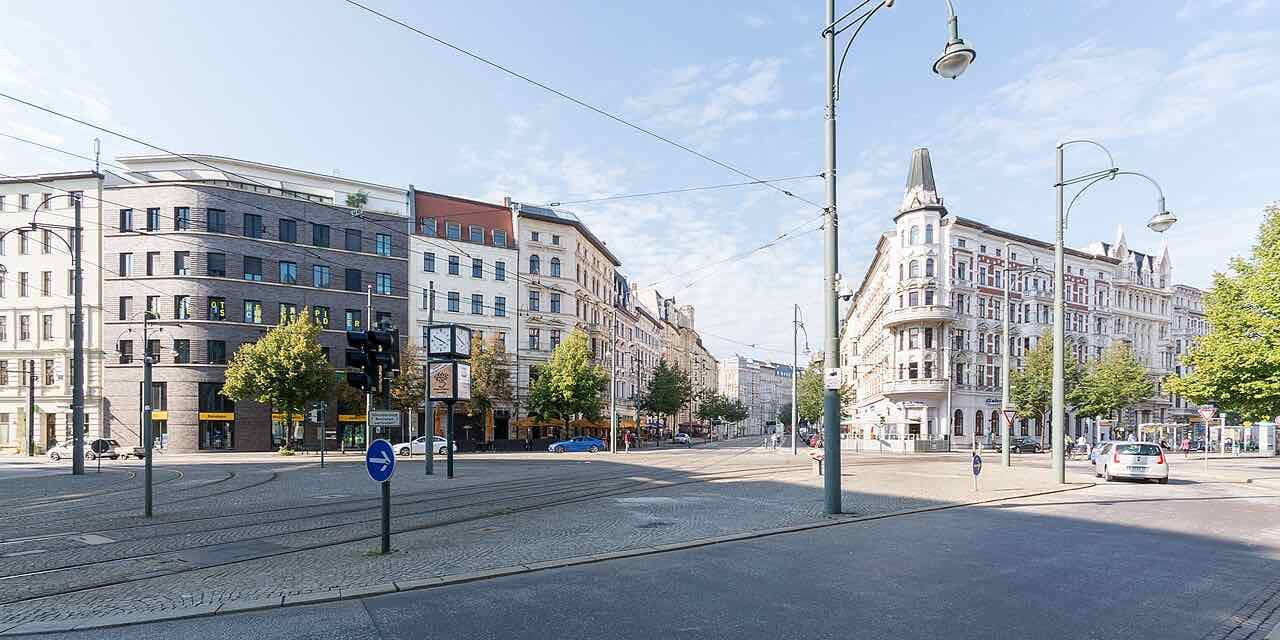
Most of the old city was destroyed by bombing in the Second World War, and Magdeburg then belonged to East Germany from 1949 to 1990. You see this in the streets: a few very old landmarks, post-war housing, and older apartment buildings such as those around Hasselbachplatz. It is a city that has been rebuilt more than once, not a postcard old town.
What it gives a student is space. The Elbe runs through the middle, there are parks and meadows in the city, dorm rooms are cheap, and the two universities together bring a lot of students into a city of 244,000. If you want a compact medieval centre, look elsewhere. If you want a normal, workable city where a master's in English is affordable, this is a serious option.
What to see, mostly within a tram ride of campus
These are the places Magdeburg people take visitors to.
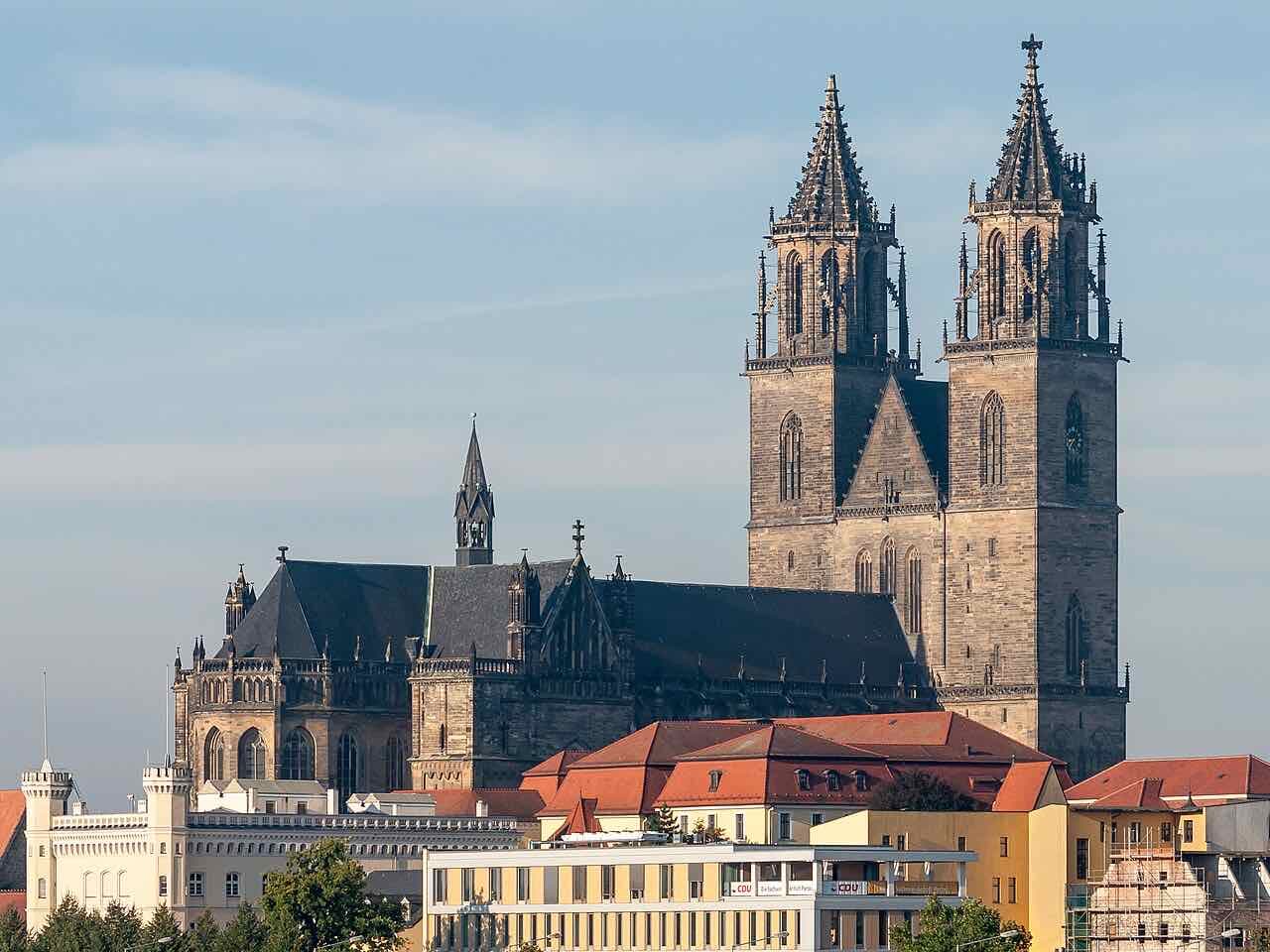
Building began in 1209 after a fire destroyed the earlier church. It is regarded as the oldest Gothic cathedral in Germany, and its towers are about 100 m high. Otto I's tomb is inside.
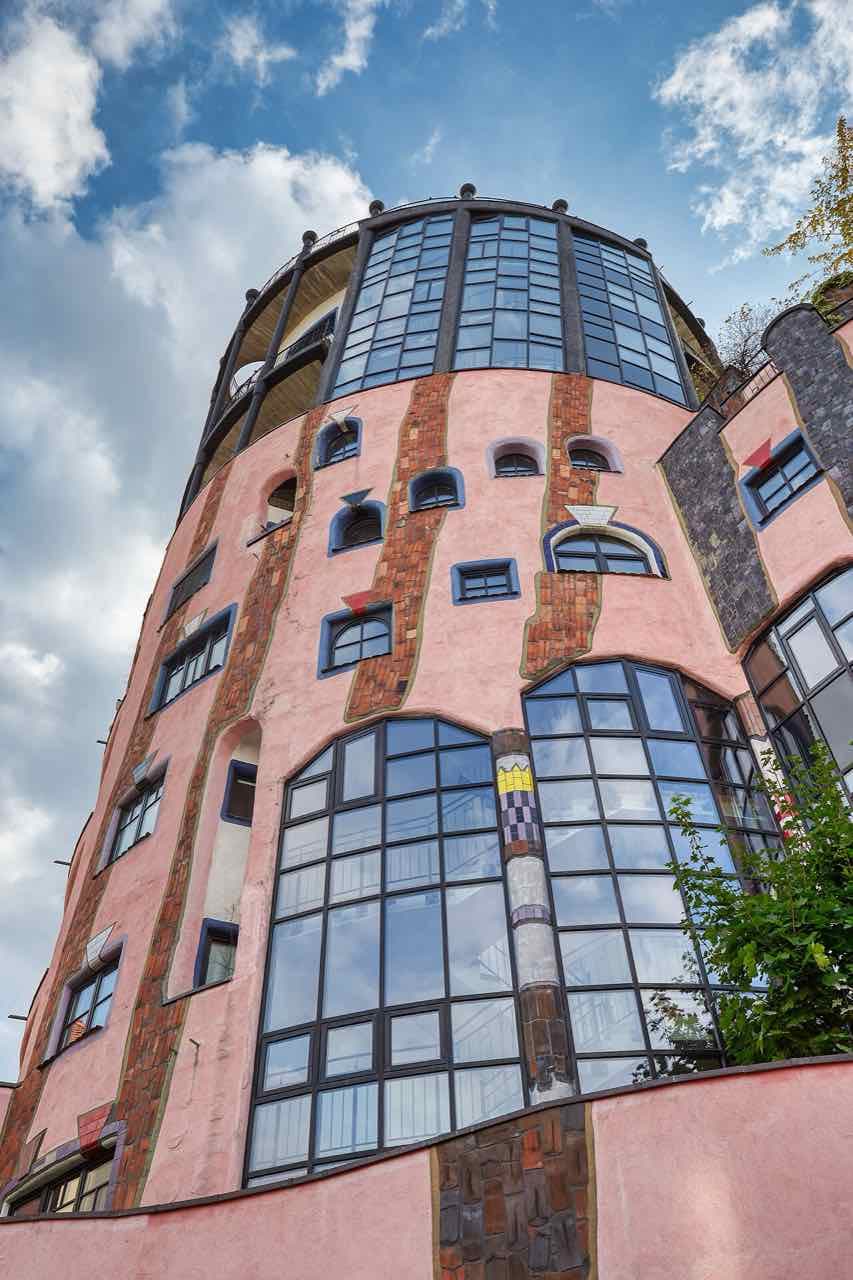
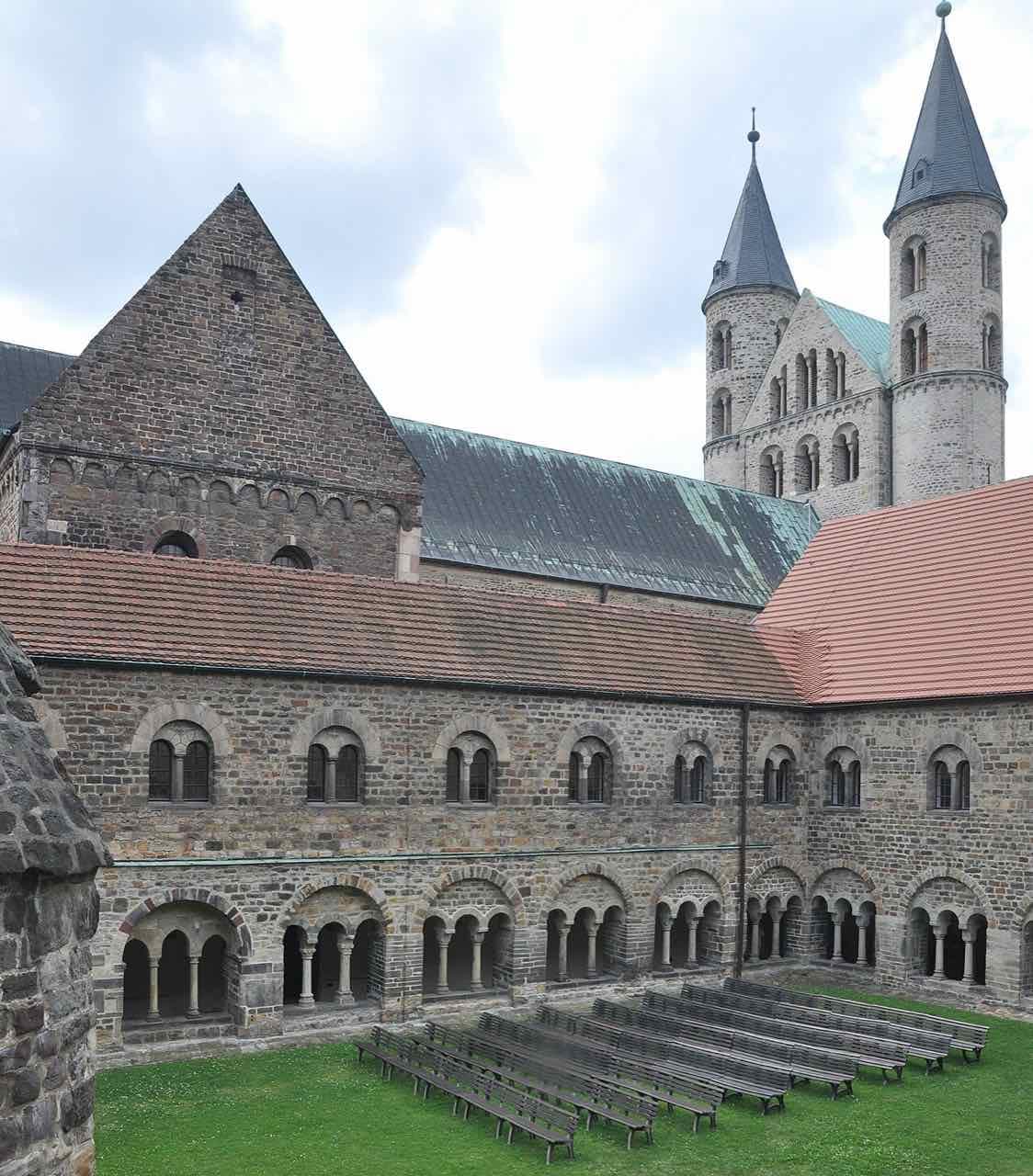
Hundertwasser's last building: apartments, shops, restaurants, a hotel, a theatre and rooftop gardens at Breiter Weg 8-10. Guided tours of about 70 minutes include a 33 m tower with a view over the city.
Kunstmuseum Kloster Unser Lieben Frauen ↗
The main venue for contemporary art and sculpture in Saxony-Anhalt, in a monastery the museum calls Magdeburg's oldest surviving building, at Regierungsstraße 4-6. Closed Mondays; reduced entry is 4 EUR.
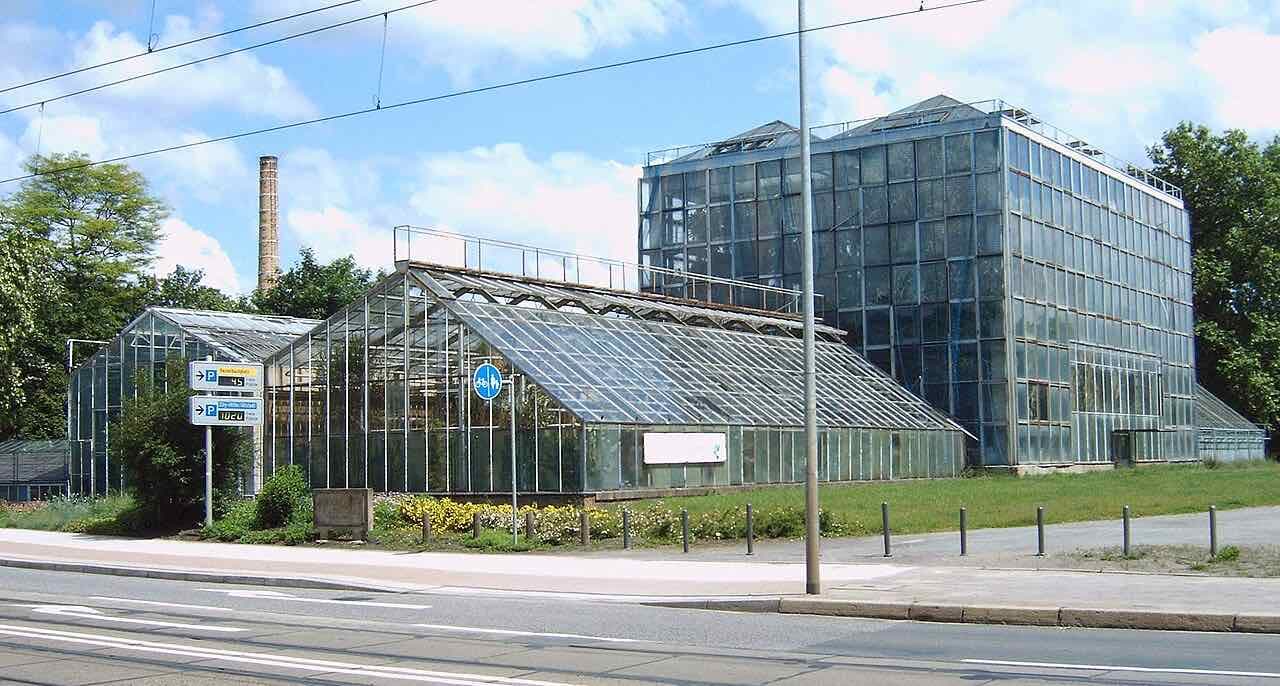
A tropical botanical garden run by the city, with a palm house, a mountain rainforest house, a fern house, an aquarium, and animals including caimans and poison dart frogs. Open Tuesday to Sunday, 10:00 to 18:00, at Schönebecker Straße 129 b.
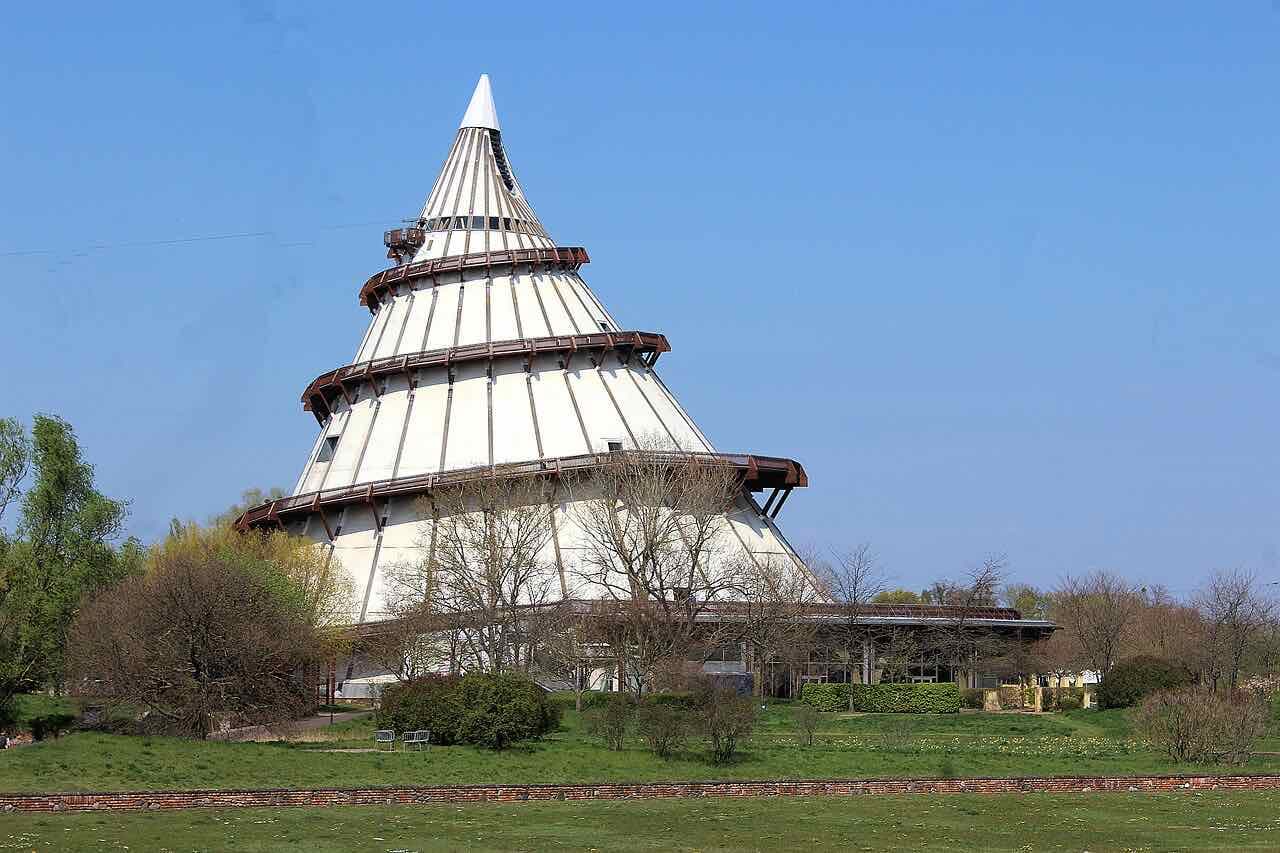
About 100 hectares of park created for the 1999 Federal Garden Show, with the Jahrtausendturm tower, a butterfly house, a 400 m summer toboggan run, a high-ropes course and an open-air stage for 1,600 people.
A 918 m canal bridge, opened in 2003, that carries ships over the Elbe. Pedestrians and cyclists can cross it.
The city's theatre company.
Elbe, parks and old stone
Weekends: the river, the park and handball
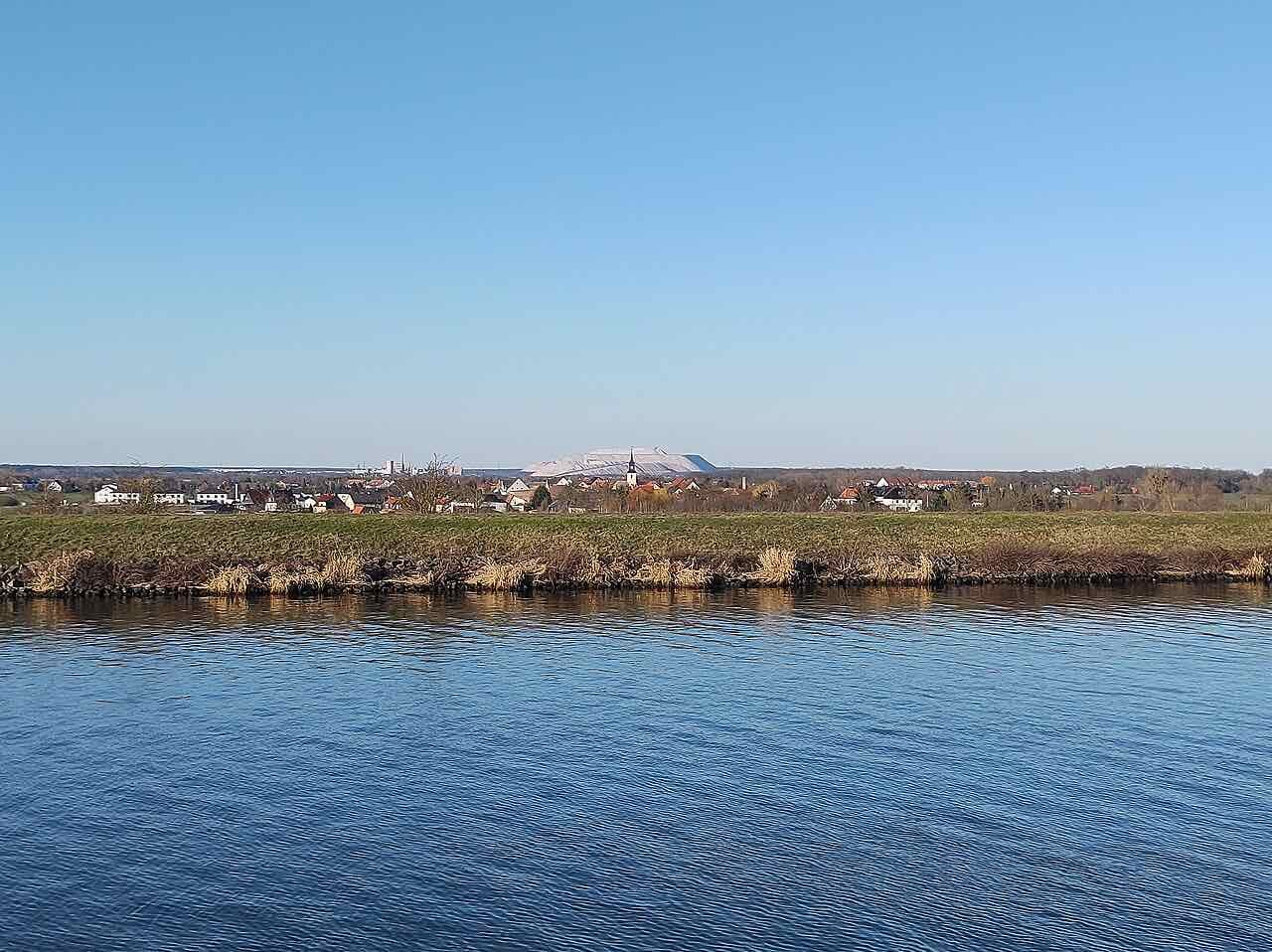
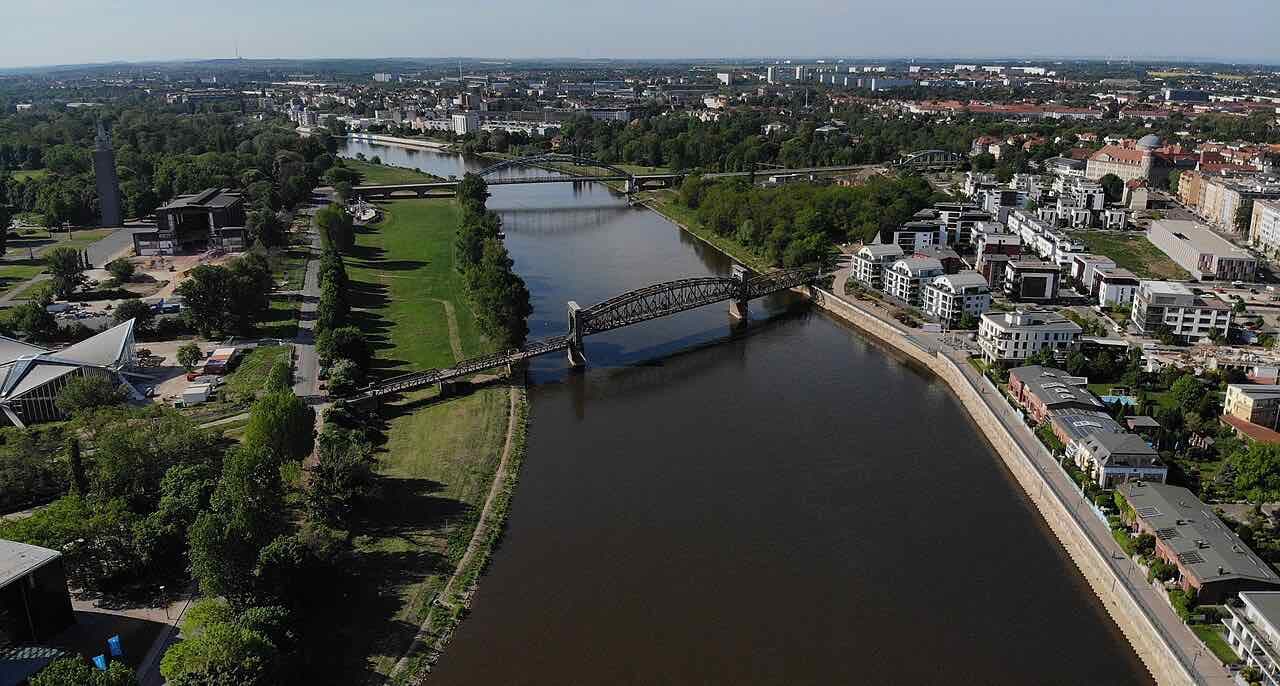
The Elbe is the weekend. The steel Hubbrücke crosses it near green riverbanks, as the photo below shows, and the Elbauenpark has sports fields, a skate park and a Frisbee golf course on top of the attractions listed above.
Sport is a fixed point in the city calendar. SC Magdeburg, the handball club, has won several German titles and the EHF Champions League, and 1. FC Magdeburg plays in the 2. Bundesliga and is the only East German club to have won a European Cup Winners' Cup. Both are a quick way to see the city at its loudest.
For bigger trips: Berlin Brandenburg Airport is about 160 km east of the city centre, Hannover about 155 km northwest and Leipzig/Halle about 109 km southeast, so all three are realistic for visitors and flights home.
What it costs
- Studentenwerk dorm room
- 194 to 499 EUR a month, including utilities, internet and TV. A room in a shared dorm apartment runs from about 194 to 364 EUR; a one-room dorm apartment from about 257 to 499 EUR, depending on dorm and furnishing.source
- Private shared flat (WG)
- from about 250 EUR; small furnished apartments from about 300 EURsource
- Example: 59 m2 flat, three rooms
- 310 EUR cold rent plus 135 EUR extras (heating included) is 445 EUR total, shared between flatmatessource
- Other monthly costs
- electricity about 25 to 30 EUR per person, broadcasting fee 18.36 EUR, phone and internet about 15 to 25 EURsource
- Semester fee
- 329.30 EUR: 90.00 to the Studentenwerk, 226.80 for the Deutschland-Ticket, 12.50 for the student councilsource
- Canteen lunch
- the Mensa UniCampus menu of 21 Oct 2026 charged students 3.40 EUR for a chicken dish and 4.20 EUR for a pork dish, and 2.00 EUR for herb quark with potatoessource
- Blocked account for a student visa
- 11,904 EUR a year, with up to 992 EUR released per monthsource
- City welcome bonus
- up to 160 EUR (70 + 50 + 40) if you register your main residence in Magdeburg and study here at least two yearssource
Prices are what the named offices published; they change, so treat them as a guide.
Getting around
Trams are how you move around. The Foreigners' Authority, for example, is reached on lines 1 and 9 to the stop Bebertaler Straße. Your semester fee includes a Deutschland-Ticket, so trams, buses and regional trains across Germany are covered without buying a separate pass, and the ticket is the biggest single part of the 329.30 EUR fee.
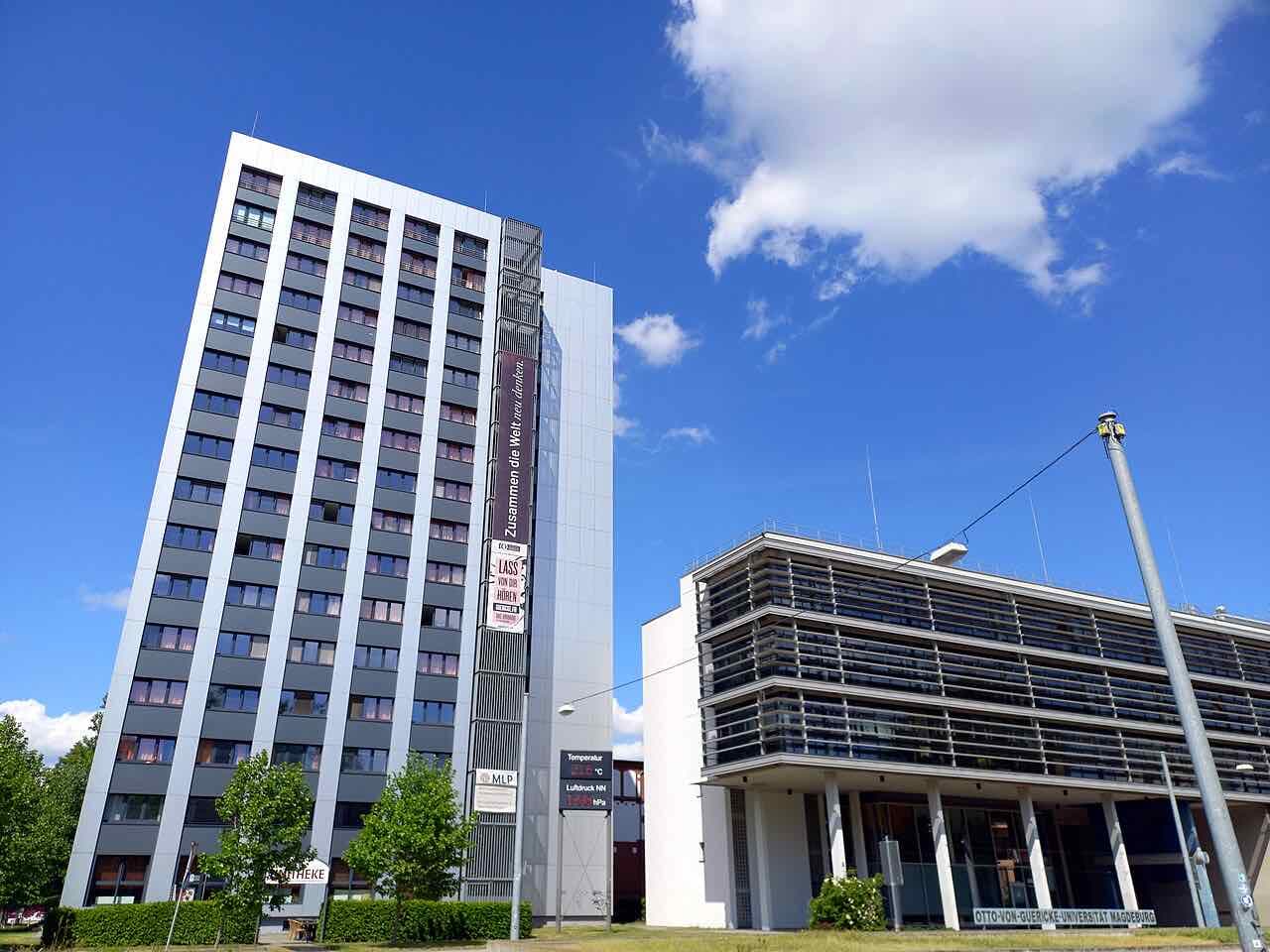
The main OVGU campus is in the Alte Neustadt district at Universitätsplatz 2, with the Zschokkestraße campus and the medical faculty (Fermersleber Weg) elsewhere in the city, and the Hochschule's departments are at Breitscheidstraße in Herrenkrug. The university's FAQ names Neue Neustadt, Werder, Altstadt, Stadtfeld Ost and Nordwest as the districts near the main campus, and says Alte Neustadt, Altstadt and Stadtfeld Ost tend to be more expensive.
Work and research employers
Magdeburg is an engineering and research city more than a corporate one. The following are named and checkable.
The Fraunhofer Institute for Factory Operation and Automation works on digital twins of production plants and collaborative-robot workplaces. It was one of the first institutions at the Wissenschaftshafen research site and opened its Elbfabrik extension there in 2023.
Max Planck Institute for Dynamics of Complex Technical Systems ↗
One of the research institutes in Magdeburg that OVGU cooperates with on its research priorities.
The university's careers service for students.
Safety, and where to turn
The question deserves a direct answer. The state's specialist service for victims of right-wing, racist and antisemitic violence, the Mobile Opferberatung, counted 233 politically right-wing attacks in Saxony-Anhalt in 2023, and 168 of them had a racist motive. Those are figures for the whole state, not for Magdeburg alone, and they are the reason a counselling service exists here. The numbers below are the ones to keep.
If something happens, you do not have to report it to the police to get help. The Mobile Opferberatung has an office in Magdeburg at Erich-Weinert-Straße 30. Its advice is free, confidential and, if you wish, anonymous. It can bring in interpreters and publishes information in English and several other languages, including a leaflet on what to do after a racist attack.
At the university, the Studentenwerk's social counselling is free for all students, including on problems of international students, and the Studentenwerk's lawyers give a free first consultation to students of both universities, held in English on Wednesdays in even calendar weeks. Police are 110 and fire and ambulance 112.
Part 2
Student life in Magdeburg
Where you can study
Otto von Guericke University Magdeburg (OVGU) ↗
Founded in 1993, with about 13,000 students, of whom more than 3,500 come from over 90 countries. The main campus is at Universitätsplatz 2 in the Alte Neustadt, with the medical faculty and more buildings around the city. It is strongest in engineering, computer science, natural sciences, medicine, economics and management. Its English-taught list has 4 bachelor's degrees (Bilingual Computer Science, Biomedical Sciences, Engineering Science, International Business and Economics) and 20 master's degrees, among them Data and Knowledge Engineering, Digital Engineering, Visual Computing, Integrative Neurosciences, Financial Economics, Operations Research and Business Analytics, Peace and Conflict Studies and Advanced Semiconductor Nanotechnologies. Its International Office is at Universitätsplatz 2, and a Campus Welcome Center helps new arrivals.
International office ↗Magdeburg-Stendal University of Applied Sciences (Hochschule Magdeburg-Stendal) ↗
Campuses in Magdeburg (departments on Breitscheidstraße in Herrenkrug) and in Stendal, with five departments: Applied Human Sciences; Engineering and Industrial Design; Social Work, Health and Media; Water, Environment, Construction and Safety; and Business and Management. It lists 20 bachelor's and 16 master's programmes, from engineering and water management to journalism, social work and sign language interpreting. Be clear before applying: the university says the language of instruction is German in nearly all programmes, and foreign applicants must prove adequate German, for example with the DSH-2 test. It has contacts with over a hundred universities and takes part in about sixty exchange programmes.
International office ↗Student unions, services and groups
The student services body for Magdeburg, Stendal, Halberstadt and Wernigerode: dorms, canteens, BAföG, social, financial, legal and psychosocial counselling, and the international coordinator.
Studentenwerk counselling for internationals ↗
The Studentenwerk's international coordinator gives first advice and runs info events, with a Zoom hour on Wednesdays 13:00 to 15:00 and an in-person hour on the last Tuesday of the month in the canteen. All counselling is free and confidential, in German or English.
IKUS and the InterKultiTreff ↗
Intercultural Students: a volunteer team of OVGU and Hochschule students, coordinated with the Studentenwerk and the university, that runs game nights, karaoke, barbecues and trips, and helps newcomers with first steps. Its meeting place, the InterKultiTreff, is in the ground floor of dorm 9 at Walther-Rathenau-Straße 19.
OVGU Studierendenrat (StuRa) ↗
The student council of the whole university: 15 elected students, funded through the semester fee (12.50 EUR of the 2026 fee). It sits on university committees, funds student initiatives and pays for a free first legal consultation for every student.
Studierendenrat of Hochschule Magdeburg-Stendal ↗
The student body of the Hochschule is a public-law body run by the Studierendenrat and department councils. Its statute lists the integration of international students among its tasks.
The mentoring network of OVGU's Faculty of Economics and Management, for students in English-taught programmes: new students apply as Newbies, higher-semester students as Buddies. Contact isp@ovgu.de.
Pairs international students at Hochschule Magdeburg-Stendal with a student mentor for a semester, with events and trips in Magdeburg and Stendal. You register online and the team matches you.
OVGU university sport (SPOZ) ↗
The Sportzentrum in building 18 at Universitätsplatz 2: course programme for winter 2026/27, a CampusFIT gym, a bowling alley and competitive sport. Booking is online.
Hochschule sports and health centre ↗
More than 250 sport activities a semester, from climbing and sailing to breakdance, capoeira and Zumba. Enrolment needs a university email address.
Evangelische Studierendengemeinde (ESG) ↗
The Protestant student community at Neustädter Straße 6, near the main campus. Members cook, eat, discuss, make music and hold services, and the community says it also learns about other cultures and religions.
Katholische Studierendengemeinde (KSG) ↗
The Catholic student community meets every Thursday at 19:00 for a service, followed by dinner in the parish house next to the university church St. Petri.
A youth organisation focused on intercultural exchange and volunteer or work placements abroad, listed among OVGU's student initiatives.
OVGU's Formula Student team, where students design, build and race a car. It has competed since 2008 and looks for business students as well as engineers.
The university's LGBTQIA* group, which runs political and social actions and education on queer topics.
Campus life and how study works here
OVGU runs on a main campus around Universitätsplatz, with the Zschokkestraße campus and the medical faculty close by, so most of your day happens inside one compact, walkable area. Student life outside lectures goes through a long list of initiatives: OVGU's own page lists 18 of them, from a stock-market club and a student consultancy to a Formula Student team, a game-development group, an eSports club, a choir called Acafin and a climate group.
For students in English-taught master's programmes, the faculty-level buddy and mentoring networks do much of the work of getting you started. SIMP-SON at the Faculty of Economics and Management pairs newcomers with higher-semester students from the first day. The Studentenwerk's dorm tutors, who are themselves international students, hold open hours on Mondays 15:00 to 16:00 and Thursdays 17:00 to 18:00 at the InterKultiTreff.
At the Hochschule the picture is different: almost all programmes are taught in German, and students come with the DSH-2 or an equivalent certificate. Its Buddyprogramm and International Office are built around that group.
Before each semester the International Office and IKUS run International Welcome Weeks. The autumn 2026 edition ran from 28 September to 10 October with information events on registration and housing, language courses, campus, library and city tours, pub tours, barbecues and a trip to Berlin.
Housing: dorms first, then the private market
The Studentenwerk says plainly that demand for dorm places is clearly higher than the number of rooms, so many students end up on the private market. Apply early either way.
Twelve dorms in Magdeburg: most on the UniCampus (Hohepfortestraße, J.-G.-Nathusius-Ring, Walther-Rathenau-Straße), plus Zschokkestraße, Fermersleber Weg (medical campus) and Breitscheidstraße (Herrenkrug). Rents from 1 Feb 2026 include utilities, internet and TV: shared-apartment rooms cost about 194 to 364 EUR and one-room apartments about 257 to 499 EUR, depending on dorm and furnishing. Dorm 9 has 280 furnished one-room apartments of 20 m2 at 336 EUR. You can apply up to six months ahead.
Housing advice for internationals ↗
Housing advisers answer at housing@studentenwerk-magdeburg.de in September to October and March to April, or by appointment or Zoom.
A Studentenwerk project in which students live cheaply with a host and help in the household, for example with cleaning, the garden or babysitting.
International students who help in the dorms with everyday questions and conflicts and organise activities, coordinated by the Studentenwerk and the university.
Shared flats and small apartments are listed on WG-Gesucht and Kleinanzeigen. Warm rent includes extra costs, cold rent does not; a deposit of two to three months' rent is common. The university's FAQ also lists hostels and hotels for the first days.
Food, nights out and sport
The main canteen at Hohepfortestraße 25, opposite the library, open Monday to Friday during term (10:45 to 14:00, the upper hall also 16:00 to 19:30). Prices are tiered for students, staff and guests, and the Studentenwerk aims to offer vegan lunch dishes daily. Other canteens are at Zschokkestraße 32, Herrenkrug (Breitscheidstraße 2) and Stendal.
The Studentenwerk's student bar and event space.
The pub area the Hochschule names among Magdeburg's sights, and the transport hub where trams meet.
Festival of Cultures and Indian Night ↗
Campus and city events where students present their countries. Hundreds of students took part in the 2018 Festival of Cultures.
Your first weeks
- 1
Before you travel
Visa, residence permit, housing and health insurance have to be arranged before you start. Check before you go: the blocked account amount (11,904 EUR a year) and your visa route on the OVGU international students page.
- 2
Week 1: housing and bank
Collect your room key, and ask your landlord for the Wohnungsgeberbescheinigung (landlord confirmation form); a rental agreement alone does not work. Most banks offer free student accounts; non-EU students can use a blocked account.
- 3
Within two weeks of moving in: register your address
Book an appointment at terminvergabe.magdeburg.de and go to any BürgerBüro: Mitte (Leiterstraße 2a), Nord (Lübecker Straße 32), West (Bruno-Beye-Ring 50) or Süd (Salbker Chaussee 67). Non-EU citizens must go in person with passport, visa and the landlord form. Registration is free. A mobile BürgerBüro also comes to the OVGU campus at the start of each semester.
- 4
Enrolment: pay the semester fee
Pay the semester fee (329.30 EUR for 2026) and bring proof to enrol. It includes your Deutschland-Ticket.
- 5
Residence permit at the Ausländerbehörde
The Foreigners' Authority is at Lübecker Straße 53-63, tram 1 or 9 to Bebertaler Straße. You can apply online for a study residence permit, and you receive an appointment after your documents are checked. Check before you go: the office's current opening hours (Monday to Friday 8:00 to 12:00, Tuesday also 14:00 to 17:00 at the time of writing) and your appointment date.
- 6
Welcome Weeks and counselling
Join the International Welcome Weeks and visit the InterKultiTreff. The Studentenwerk's social counselling in dorm 7 (Wednesday 14:00 to 16:00 and Thursday 10:00 to 12:00, no appointment) covers problems of international students, student jobs, the semester ticket and health insurance.
Working next to your studies
Students from outside the EU and EEA may work 140 full days or 280 half days a calendar year, according to the guidance universities publish on the residence permit rules. Check the exact conditions on your own permit.
OVGU's own advice is not to rely on a part-time job to cover your living costs. Students can talk to the Studentenwerk's social counselling about student jobs, and the OVGU Career Service helps with CVs and internships.
The Hochschule's international office is also the home of the Foreigners Officer, who advocates for international students and staff.
Where you come from matters here
Pick your home country: food, faith, community groups and the consulate that serves you, checked 21 October 2026.
🇮🇳 Living in Magdeburg as an Indian student
Magdeburg has a student-run group for Indian students, which OVGU's engineering faculty lists under international support. Ask the group what it currently runs, since its website was last updated with events in 2023.
A non-profit run by Indian students in Magdeburg. It offers help before arrival (visa procedures, flights, accommodation) and after arrival (airport pickup, temporary lodging, longer-term accommodation, help with health insurance and SIM cards), a freshers' meeting and a WhatsApp group where seniors answer questions. It lists an address at Listemannstraße 18, 39104 Magdeburg. The site's last dated event is from November 2023, so write to them to confirm what they offer now. OVGU's faculty pages also list it under international support.
At Tiergartenstraße 17, 10785 Berlin. Its site has a student visa page, a link for registering Indian students and researchers in Germany, and online appointment booking for consular services.
OVGU names the Indian Night alongside the Festival of Cultures as a campus and city event where students present their countries.
🇻🇳 Living in Magdeburg as a Vietnamese student
Magdeburg has a Vietnamese community organised around a friendship association that has existed since 1992. No Vietnamese temple is listed in the city.
Germany-Vietnam friendship association in Magdeburg ↗
Founded in 1992 and among the first such groups in Germany after the fall of the Berlin Wall, it helps Vietnamese with daily problems such as work and housing. In 2022 it reported about 1,000 Vietnamese living in the city.
Embassy of Vietnam in Germany ↗
The consular section in Berlin handles passports and legalisation. Its notices say electronic passports are issued from 1 April 2026.
🇧🇩 Living in Magdeburg as a Bangladeshi student
A 2019 report counted almost 170 Bangladeshi students in Magdeburg. No Bangladeshi association with its own website is listed here, so the practical help is the mentoring that already exists and the city's mosque.
Mentoring programme for Bangladeshi students ↗
A Financial Express editorial from November 2019 describes a mentor team of 24 senior students from 10 English-taught master's courses at OVGU and a seminar run by Bangladeshi students on assistantships and scholarships. The students named accommodation, bank accounts, insurance and part-time work as the hard parts of starting.
Islamic Community Magdeburg (IsGeMa) ↗
A non-profit association founded in 2001 that runs a mosque in central Magdeburg, listed at Max-Otten-Straße 10a, 39104. A December 2019 report put the mosque, a former heating plant in the old town occupied since 2016, at room for about 500, with up to 1,000 at Friday prayers.
The intercultural student group, which holds country nights and helps newcomers with authorities and everyday questions.
🇵🇰 Living in Magdeburg as a Pakistani student
No Pakistani student association is listed in Magdeburg. The closest real places are the city's mosque and the networks that already serve every international student here.
Islamic Community Magdeburg (IsGeMa) ↗
The association behind the city's mosque, founded in 2001. It describes itself as non-profit and politically independent, and asks for donations to keep the building.
City list of migrant organisations ↗
Magdeburg's welcome portal says the city has more than twenty migrant organisations and initiatives, and links to the list.
The state umbrella network for migrant organisations in Saxony-Anhalt, based in Halle (Saale), with over a hundred member organisations.
🇨🇳 Living in Magdeburg as a Chinese student
A Chinese cultural association exists in the city, and the embassy runs the consular services.
Association for Traditional Chinese Culture in Magdeburg ↗
Based in the Eine Welt Haus at Schellingstraße 3-4. It runs seminars on traditional Chinese culture, Chinese calligraphy, Chinese lessons for children and adults, and Tai Chi, and helps with exchange between Germans and Chinese. The listing says it was still in formation, so write before visiting.
Märkisches Ufer 54 in Berlin, with a consular hall at Brückenstraße 10 open Monday to Friday 9:00 to 12:00. The site links a Study in Germany page.
English-taught programmes in Magdeburg
Soonest open deadline first. Every entry links to its official source.
- Digital Engineering (DigiEng)Otto von Guericke University Magdeburg · MagdeburgmasterNo tuition15 Nov 2026Closing soon
- Water EngineeringMagdeburg-Stendal University of Applied Sciences · MagdeburgmasterNo tuition30 Nov 2026Closing soon
- Economics / VolkswirtschaftslehreOtto von Guericke University Magdeburg · MagdeburgmasterNo tuition15 Jan 2027Open
- Process Safety and Environmental EngineeringOtto von Guericke University Magdeburg · MagdeburgmasterNo tuition15 Jan 2027Open
- European Studies (MA)Otto von Guericke University Magdeburg · MagdeburgmasterNo tuition15 Jan 2027Open
- MSc Integrative NeuroscienceOtto von Guericke University Magdeburg · MagdeburgmasterNo tuition15 Mar 2027Open
- Visual ComputingOtto von Guericke University Magdeburg · MagdeburgmasterNo tuition15 May 2027Open
- MSc in Data & Knowledge Engineering (MDKE)Otto von Guericke University Magdeburg · MagdeburgmasterNo tuition15 May 2027Open
- International Master's in Performance Analysis of Sport (IMPAS)Otto von Guericke University Magdeburg · MagdeburgmasterNo tuition15 May 2027Open
- Biomechanical Engineering (BiME)Otto von Guericke University Magdeburg · MagdeburgmasterNo tuition15 Jun 2027Open
- International Management, Marketing, Entrepreneurship (IMME)Otto von Guericke University Magdeburg · MagdeburgmasterNo tuition15 Jun 2027Open
- Operations Research and Business Analytics (ORBA)Otto von Guericke University Magdeburg · MagdeburgmasterNo tuition15 Jun 2027Open
- Systems Engineering in Manufacturing (SEM)Otto von Guericke University Magdeburg · MagdeburgmasterNo tuition15 Jun 2027Open
- International Business and Economics (IBE)Otto von Guericke University Magdeburg · MagdeburgbachelorNo tuition15 Jul 2027Open
- Financial Economics (FINEC)Otto von Guericke University Magdeburg · MagdeburgmasterNo tuition15 Jul 2027Open
- Engineering Science (EngSci)Otto von Guericke University Magdeburg · MagdeburgbachelorNo tuition15 Jul 2027Open
- Electrical Engineering and Information TechnologyOtto von Guericke University Magdeburg · MagdeburgmasterNo tuition15 Jul 2027Open
- Computational Methods in Engineering (CoME)Otto von Guericke University Magdeburg · MagdeburgmasterNo tuition15 Jul 2027Open
- Chemical and Energy EngineeringOtto von Guericke University Magdeburg · MagdeburgmasterNo tuitionSee sourceCheck source
- AI and Engineering for Medical Applications (MSc)Otto von Guericke University Magdeburg · MagdeburgmasterSee sourceCheck source
- Sustainable Resources, Engineering and Management (StREaM)Magdeburg-Stendal University of Applied Sciences · MagdeburgbachelorNo tuitionSee sourceCheck source
- Entrepreneurship & Innovation Management (MEsIM)Magdeburg-Stendal University of Applied Sciences · MagdeburgmasterNo tuitionSee sourceCheck source
- International Technical and Vocational Education and TrainingOtto von Guericke University Magdeburg · MagdeburgmasterSee sourceCheck source
- Master of Arts in Peace and Conflict StudiesOtto von Guericke University Magdeburg · MagdeburgmasterNo tuitionSee sourceCheck source
- Medical Systems Engineering (MSE)Otto von Guericke University Magdeburg · MagdeburgmasterNo tuitionSee sourceCheck source
Is Magdeburg right for you? Ask us. Free.
Tell us your passport, grades and budget. We compare Magdeburg with the other places you could study, then apply for you. You never pay us.
Get my free plan