Studying in Baden-Württemberg, Germany
Mannheim
A grid-plan city where the Rhine meets the Neckar, with a business-school university in a Baroque palace and half of its residents of immigrant descent.
Mannheim is the second-largest city in Baden-Württemberg, with about 320,000 people, and its centre is laid out as a chessboard of blocks that carry letters and numbers instead of street names. You will learn to say "I live in C 4" within a week. The city sits where the Rhine and the Neckar join, across the river from Ludwigshafen and its BASF chemical works, and it is a place of invention: Karl Drais built the first bicycle here in 1817 and Karl Benz patented the first motor car in 1886. For a student the pitch is concrete. The University of Mannheim has its main building in the old Electoral palace and is ranked among the top three in Germany for economics and social sciences. The Technische Hochschule, the Popakademie and a dual university are all within the same tram network. About half of the people in the city have roots in one of 168 nationalities, so arriving from Lagos, Dhaka or Hanoi means arriving in a place that already expects newcomers. Frankfurt Airport is 65 km to the north and the main station has fast trains to Frankfurt, Stuttgart, Karlsruhe and Munich.
- Population
- 319,536 (31 Dec 2025)
- Residents with roots in other countries
- 49.4% of inhabitants have descent from 168 nationalities; India is the 11th largest foreign nationality with 3,435 residents (end of 2024)
- Nearest airport
- Frankfurt Airport, about 65 km north
- Students at the University of Mannheim
- 11,972 (July 2026)
- Semester contribution (University of Mannheim)
- 194 EUR per semester (80 administration, 100 Studierendenwerk, 14 student body)
- Tuition fee for students from outside the EU/EEA
- 1,500 EUR per semester at the University of Mannheim, on top of the contribution
- Blocked account for a student visa
- 11,904 EUR per year, with up to 992 EUR withdrawable a month
Part 1
Living in Mannheim
A planned city on two rivers
Mannheim received its city rights from Frederick IV on 24 January 1607 and was built as a fortified town on a grid. That grid is why locals call it the Quadratestadt, the square city. Blocks on the west side of the centre are lettered A to K and those on the east side L to U, each numbered 1 to 7. Addresses read like a board game coordinate: the University of Mannheim's International Office is at L 1, 1, the Catholic student community is at D 6, 15, and the Protestant one is at R 3, 3.
The Electoral Palatinate moved its capital here from Heidelberg in 1720, which is why the centre has a Baroque palace the size of a small town. The Nationaltheater was founded in 1779 and is described as the oldest stage in Germany, and Schiller's play Die Räuber had its first night there in 1782. The city was heavily damaged in the Second World War, so most of what you see between the palace and the main station was rebuilt after 1945. It is practical rather than pretty, and the pretty parts are the palace, the Wasserturm and the parks.
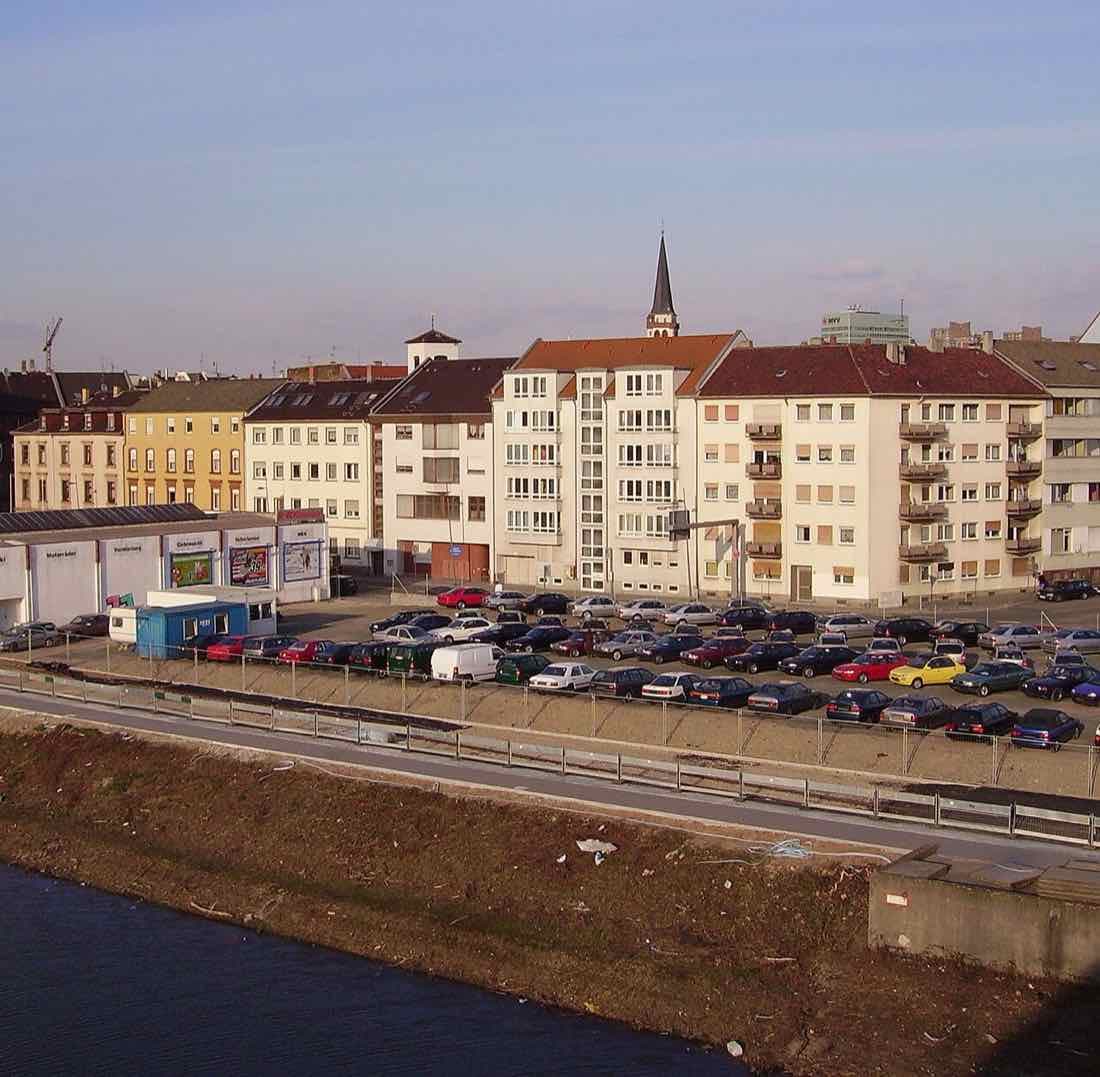
The industrial side is still there. The Mannheim harbour is the second-largest river port in Germany, covers 1,131 hectares and has about 500 companies with roughly 20,000 employees. Students who like working things, ships, trains and chimneys across the river will find them here at walking distance. Students who want a small old town like Heidelberg should know that Heidelberg is a short train ride away, and that Mannheim is the cheaper, more mixed and less polished neighbour.
What to see and do
Most of this is reachable by tram from the centre. Check prices on the linked pages before you go.
Wasserturm and Friedrichsplatz ↗
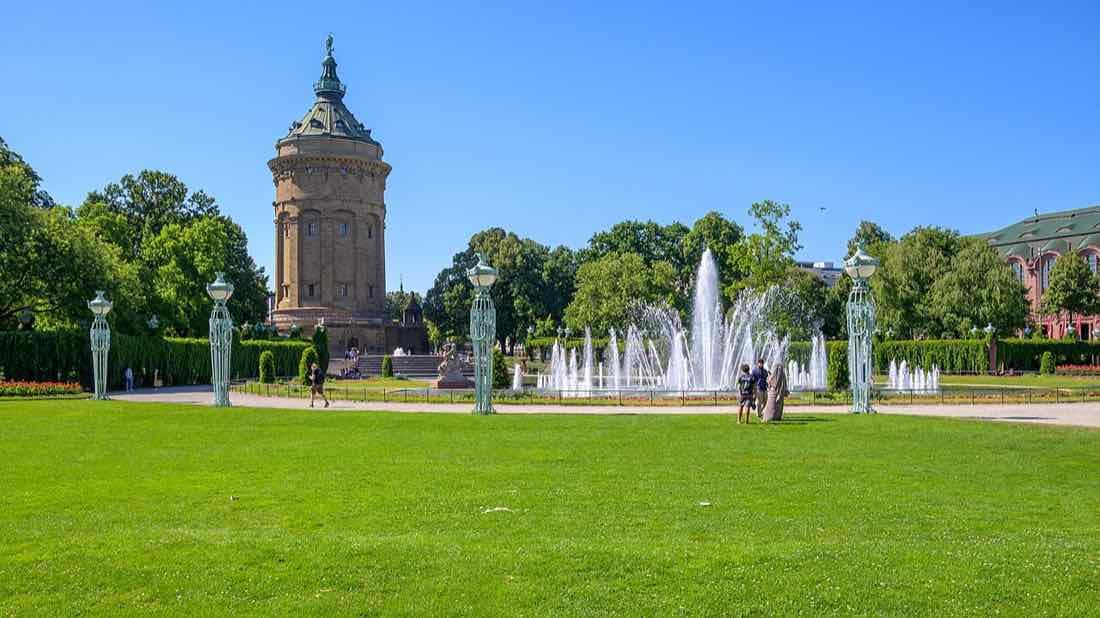
The water tower is the civic symbol of Mannheim and stands on Friedrichsplatz, next to the Kunsthalle. The Planken is one of the main shopping streets.
A city park open 365 days a year, with the largest original Chinese tea house in Europe, a peony collection, a camellia garden, a South America greenhouse for rainy days, flamingos, pelicans and penguins. Penguin feeding is at 11:00 and 14:45.
The state museum of technology and work: 200 years of technical and social history with experiment stations. Museumsstraße 1. Adults pay 12 EUR and the reduced ticket is 9 EUR; ask the museum whether student ID qualifies.
Modern and contemporary art at Friedrichsplatz 4, open 10:00 to 18:00. Autumn 2026 shows include Dürer to Piranesi prints until 8 November and DANCE! from 13 November.
Opera, drama and a young-audience stage. The box office phone is 0621 1680 150, and note that the box offices do not accept credit cards, only EC card and cash.
Willy-Brandt-Platz 5 at the main station side of the centre. Open Monday to Saturday 9:00 to 17:00 and Sunday 10:00 to 15:00. The site also covers the parks and nature reserves that grew out of the 2023 Bundesgartenschau.
Getting around and getting out
Local transport is run by RNV (Rhein-Neckar-Verkehr), which covers Mannheim, Heidelberg and Ludwigshafen. Mannheim alone has eleven tram lines, and RNV also sells the Deutschland-Ticket. Check what your semester ticket already includes before buying anything: the University of Mannheim page on fees lists the semester contribution but does not itemise a ticket, so ask the Studierendenwerk or your AStA.
The main station is the end of the Mannheim to Stuttgart high-speed line and ICE trains run on Frankfurt to Berlin, Karlsruhe to Basel and Stuttgart to Munich. Frankfurt Airport is 65 km to the north. That makes Mannheim a good base if you want to visit another German region on a Saturday, and it makes flights home straightforward. The city also has a bicycle tradition worth taking seriously: the AStA of the university and the student body at the Technische Hochschule both run bike services (see student life below), and VRN nextbike rental bikes are linked to the student unions.
Neighbourhoods students actually live in
The harbour-side district next to the centre. It has the Popakademie music school, a mosque at Luisenring 28 to 30, the Protestant student community's urban garden and a Studierendenwerk residence on the Verbindungskanal. The tram stop Dalbergstraße is next to the mosque.
The grid itself. Studierendenwerk residences sit at B 6, B 7, G 7, L 8, N 6 and on the Parkring, and the University of Mannheim's palace is on the edge of it.
Neckarstadt-Ost and Neckarstadt-West ↗
Across the Neckar from the centre. The Studierendensiedlung Ludwig Frank is in Neckarstadt-Ost. Neckarstadt-West has the highest share of residents with an immigrant background in the city, 68.9%.
Quieter districts with the Eastsite residence (Neuostheim) and the Hans-Sachs-Ring and Steubenstraße residence (Niederfeld).
What things cost
- Semester contribution, University of Mannheim
- 194 EUR per semestersource
- Tuition fee for non-EU/EEA students
- 1,500 EUR per semestersource
- Studierendenwerk room, Ludwig Frank settlement
- single room 320 to 330 EUR, single apartment 360 to 410 EURsource
- Studierendenwerk room, Carl-Zuckmayer-Straße
- single room 320 EUR, shared flat for two 340 EURsource
- Studierendenwerk room, inner city (B 7, L 8, B 6)
- single room 360 to 410 EUR; apartments 410 to 540 EURsource
- Studierendenwerk room, Augartenstraße
- single room 370 to 460 EUR, single apartment 470 to 560 EURsource
- Technoseum ticket
- 12 EUR adult, 9 EUR reducedsource
- Blocked account for the student visa
- 11,904 EUR per yearsource
Only figures from the pages linked beside each row. Rents are monthly and utilities are included in Studierendenwerk residences.
Jobs, employers and your career
Mannheim is a business city. These are employers and sectors that appear on the city's profile, not a promise of an internship.
The Mannheim harbour handled 6.9 million tonnes in 2016 and hosts about 500 companies with around 20,000 jobs.
Employers named for the city include Roche (division headquarters), ABB, Siemens, John Deere, Daimler's engine and bus operations, and MVV Energie, the largest municipal energy supplier in Germany. BASF is across the Rhine in Ludwigshafen.
University Hospital Mannheim ↗
A major employer and the teaching hospital of Heidelberg University's Mannheim medical faculty.
Student consulting, finance and start-up clubs ↗
The University of Mannheim lists 51 accredited student organisations, many of them career-oriented: student consultancies such as INTEGRA and 180 Degrees Consulting, the stock-market club AKB, and start-up groups such as thinc!.
Graduates can apply for a residence permit of up to 18 months to look for work, during which they may work without restriction, according to the University of Mannheim.
Part 2
Student life in Mannheim
Where you can study
11,972 students (July 2026) in six schools: Law, Economics, Business School, Social Sciences, Humanities, and Business Informatics and Mathematics. Times Higher Education places it in the top three in Germany for economic and social sciences. The main building is Mannheim Palace, so lectures happen in a Baroque residence. The university lists several English-language master's programmes, for example the Mannheim Master in Data Science, in Finance, Accounting and Taxation, in Operations and Supply Chain Management and in Social Data Science, plus the Master of Comparative Business Law and LL.M. programmes. It is part of the ENGAGE.EU alliance of European universities. Students from outside the EU/EEA pay 1,500 EUR tuition per semester. Check each programme's language on the programme list before you apply.
International office ↗Technische Hochschule Mannheim (Mannheim University of Applied Sciences) ↗
About 5,200 students on one campus at Paul-Wittsack-Straße 10, with nine faculties: biotechnology, electrical engineering, design, computer science, information technology, mechanical engineering, social work, process and chemical engineering, and industrial engineering. Its English site lists international programmes including Electrical Engineering, International Engineering, a BSc in Engineering Management, an MSc in Biotechnology and a German-French Study Center. The university says it has shaped education for more than 125 years. Check the language of each programme on the programme page.
International office ↗Medical Faculty Mannheim of Heidelberg University ↗
One of two independent medical faculties of Heidelberg University, based at Theodor-Kutzer-Ufer 1 to 3 beside the University Hospital Mannheim. It teaches medicine in the MaReCuM model curriculum and runs the master's programmes Biomedical Engineering (BME) and Translational Medical Research (TMR). The faculty has pages for incoming students and a tandem programme.
Duale Hochschule Baden-Württemberg (DHBW) Mannheim ↗
Dual study: you alternate every three months between the university and a partner company. DHBW Mannheim counts about 5,700 students, around 1,900 partner companies and 50 bachelor's courses in business, engineering, IT, healthcare and media. You need a training contract with a partner company, which you apply for directly, so it suits students who already have a German-speaking route into a company. The site has an International Office section and an internship platform.
International office ↗Popakademie Baden-Württemberg ↗
A higher-education institution for the music and creative industries at Hafenstraße 33 in Jungbusch. Bachelor's programmes: Pop Music Design, Music Business and Global Music. Master's programmes: Popular Music and Music and Creative Industries. The website has an International section; ask the school about the language of instruction and the entrance exam.
International office ↗Hochschule für Musik und Darstellende Kunst Mannheim ↗
The music and performing-arts university at N 7, 18 in the grid, with bachelor's and master's music programmes, ensembles, an opera studio and the Bläserakademie Rhein-Neckar. Admission goes through an entrance exam; the application deadline for the winter semester 2027 is 15 November 2026. It has its own AStA and an International Office page.
Hochschule der Bundesagentur für Arbeit (HdBA), Mannheim campus ↗
A state university with campuses in Mannheim (Seckenheimer Landstraße 16) and Schwerin. It offers two dual bachelor's programmes in economics, law and social sciences, plus a master's in labour-market-oriented counselling. The bachelor's programmes train people for a career at the Federal Employment Agency and applications run through the agency's recruitment portal, so this is a route for people who plan to work for it, not an open degree. About 500 students start each year across both campuses.
Hochschule der Wirtschaft für Management (HdWM) ↗
A state-approved private business school at Oskar-Meixner-Straße 4 to 6. English-language programmes listed on its site: B.A. Management in International Business, M.A. Business Management & Digital Leadership and an MBA in International Business. Erasmus+ semesters are possible and over 30 partner institutions host its students. Private universities charge their own fees, so read the fee page before you apply.
Student unions, services and groups
AStA of the University of Mannheim ↗
The elected student representation. It offers free legal advice, social counselling, a student job board, nextbike rental bikes with VRN, a bicycle workshop and cultural tickets.
Fachschaftsrat of the University of Mannheim ↗
The council of the student subject groups across the university's ten departments, a separate body of student self-government.
Verfasste Studierendenschaft of TH Mannheim (AStA and Studierendenrat) ↗
The student body of the Technische Hochschule: AStA, Studierendenrat and nine Fachschaft representations. It runs a campus bike repair stand (RepaRadel), quiz nights and study-start events. The AStA office is in building W, room 413.
Housing in 14 residence halls, the canteen Mensaria am Schloss, BAföG advice, psychological counselling and a coordination point for international students (international@stw-ma.de). Its office hours for international students are in the Mensaria am Schloss and in building J at TH Mannheim.
Studierendenwerk international services ↗
The first stop for international students: it works with the International Offices of the partner universities and helps with everyday questions. Phone +49 621 49072-531.
University sports (Hochschulsport) Mannheim ↗
Courses booked online, a T1 fitness gym, a CrossGym, a yoga studio, a sport-buddy matching service and the Uni League football season. The Institute of Sports is at L 10, 12.
The Erasmus Student Network section. It runs the buddy programme that pairs international students with local students, plus cultural events.
Pan-European student network with events and summer universities.
Student initiative giving free German lessons to women with refugee or migrant backgrounds, with a children's playgroup.
Weekly debates in English on current issues and rhetoric workshops.
Katholische Hochschulgemeinde (KHG) Mannheim ↗
Catholic student community at D 6, 15 with a choir, student services and a quiz night. It is open to everyone, not only Catholics.
Evangelische Studierendengemeinde (ESG) Mannheim ↗
Protestant student community at R 3, 3 with an urban garden in Jungbusch, an emergency-fund advice service and student telephone counselling. It describes itself as open to Protestant, Catholic, free-church, agnostic and questioning people, and names LGBTQIA+ people, BPoC and people with refugee backgrounds as welcome.
Campus life and study culture
The University of Mannheim is a campus university in the middle of a city. Its main building is the palace, and its Schneckenhof courtyard is a student event space; the AStA sells Schneckenhof tickets. The offices that matter most to a newcomer are in the grid: the Akademisches Auslandsamt at L 1, 1, the sports institute at L 10, 12, and the Studierendenwerk's Mensaria am Schloss at Bismarckstraße 10. You can walk between them in minutes.
The university runs 51 accredited student organisations, and the list is mostly about careers and causes. There are student consultancies, finance and accounting clubs, Model United Nations, a debating union, a student radio station for the Rhine-Neckar region, a student magazine, and volunteer groups such as Rock Your Life and the tutoring initiatives for children. Business and economics are the centre of gravity, and the culture is project-driven. If you are a first-year international student, join one club in your first month: it is how you meet people outside your course.
At the Technische Hochschule, the student body meets on Mondays at 19:00 and runs events from a quiz night to a bike repair stand. For students at the Popakademie, the Musikhochschule or the DHBW, the groups above that are open to every Mannheim student, ESN and the faith communities, are the main way to meet students from other schools.
Housing: what the Studierendenwerk offers, and how to find a room
The Studierendenwerk lists 14 residence halls. Rents below are from its page; utilities are included in every hall. Apply early. The University of Mannheim tells international students to organise housing as early as possible.
Studentensiedlung Ludwig Frank (Neckarstadt-Ost) ↗
Single room 320 to 330 EUR, single apartment 360 to 410 EUR, and parent-and-child flats at 570 EUR.
Carl-Zuckmayer-Straße (Herzogenried) ↗
Single room 320 EUR, shared flat for two 340 EUR, single apartment 380 EUR.
B 7 has a single room for 360 EUR and apartments from 410 EUR; L 8 has single rooms at 410 EUR.
Shared flat for two at 450 EUR and single apartments at 500 EUR.
The Studierendenwerk keeps a board for private accommodation and for sublets, with a housing FAQ.
Food, sport and evenings
The Mensaria am Schloss is the Studierendenwerk's canteen at Bismarckstraße 10. At least one menu every day is fully vegan. Menus are in the StudiPlus app and on the Studierendenwerk site, and the Studierendenwerk is piloting cashless payment with an app at the University of Mannheim and DHBW Mannheim canteens. The Technische Hochschule has its own Mensaplan.
Sport is organised through the Hochschulsport: you need a SportsCard, then you book courses online. The T1 FitnessGym, 55 CrossGym, C7 YogaStudio and N6 SkyStudio are university venues, and there is a competitive Uni League for football.
For evenings, Jungbusch is where the music is: the Popakademie sits on the harbour and the Katholische Hochschulgemeinde runs a quiz night in a bar. The Nationaltheater and Kunsthalle are in the centre. Ice-hockey fans can go to Adler Mannheim at the SAP Arena, which has won the German championship eight times.
Your first weeks
- 1
Before you fly
Apply for the visa at the German embassy or consulate in the country where you live as soon as the university confirms it has received your documents. For the blocked account, the figure is 11,904 EUR per year. Pay the semester contribution (194 EUR) and, if you are from outside the EU/EEA, the 1,500 EUR tuition; bank transfers from abroad take at least two weeks, and enrolment happens only when the full amount arrives.
- 2
Arrival week
Download the Integreat Mannheim app for housing, health insurance and residence-permit information. Go to the International Stammtisch and the welcome events the International Office holds in early September. Walk-in advice for international degree students is on Tuesdays 9 to 11 at the Akademisches Auslandsamt, L 1, 1.
- 3
About two weeks after arrival
Register your address. Mannheim has 15 Bürgerservice locations, and registration is possible with or without an appointment; the opening-hours list is on the city page.
- 4
Within the first weeks
Apply online for your residence permit at the Ausländerbehörde Mannheim, K 7, 68159 Mannheim, second floor, phone 0621 293-3221. You get an appointment only after the application; the university says to apply 4 to 6 weeks before your visa expires. Bring passport, enrolment certificate, proof of finances, proof of health insurance and your rental contract.
- 5
Semester one
Join one club or the buddy programme through VISUM (ESN). If you want to earn, remember the rule below.
Part-time work and the work-hour rules
With a residence permit for study you can generally work up to 140 full days or 280 half days per calendar year. Student jobs at the university and compulsory internships do not count toward that limit. The AStA of the University of Mannheim runs an online job board for students. Stay inside the limit: working more can put your residence permit at risk, and the Ausländerbehörde and the International Office can confirm your own case.
After your degree, a residence permit for job-seeking of up to 18 months is available, during which you may work without restriction.
Where you come from matters here
Pick your home country: food, faith, community groups and the consulate that serves you, checked 21 October 2026.
🇮🇳 Living in Mannheim as an Indian student
India is the 11th largest foreign nationality in Mannheim, with 3,435 residents at the end of 2024. For worship and community life, ask the association below or the consulate; this page lists only places with a public page.
Consulate General of India, Frankfurt ↗
Friedrich-Ebert-Anlage 26, 60325 Frankfurt. The consulate site has a Studying in Germany section and a brief on education in Germany.
An association that held an Ugadi celebration in Mannheim at the Kulturhalle Feudenheim on 13 April 2025 with about 400 guests from Mannheim, Ludwigshafen and the region. A newspaper report names the association.
🇳🇬 Living in Mannheim as a Nigerian student
The Embassy of Nigeria is in Berlin. For church life in English, Mannheim has one international community.
Neue Jakobstraße 4, 10179 Berlin. Passport appointments are booked through the Nigeria Immigration website, and visa applications go through VFS, Zimmerstraße 68, Berlin.
ICF Mannheim, International Church ↗
English-speaking small groups, an interpreted Sunday celebration and lunch afterwards with leaders of the international community.
🇻🇳 Living in Mannheim as a Vietnamese student
The Embassy of Vietnam is in Berlin.
Consular section with passport and legalisation procedures. The embassy started issuing electronic passports on 1 April 2026.
🇵🇰 Living in Mannheim as a Pakistani student
Pakistani citizens apply for passports and register with the Consulate General in Frankfurt. Mannheim has a large mosque.
Consulate General of Pakistan, Frankfurt ↗
Eschenbachstraße 28, 60596 Frankfurt, phone 069 698 678 549 (weekdays 9:00 to 12:00). The site has a student registration page and a guide to legal procedures for study and immigration in Germany.
Yavuz-Sultan-Selim-Moschee (DITIB Mannheim) ↗
Mosque and community centre at Luisenring 28 to 30 in Jungbusch, next to the tram stop Dalbergstraße. It is run by the Turkish-Islamic community, so services are not in Urdu; the site offers guided tours for visitors.
🇨🇲 Living in Mannheim as a Cameroonian student
The Embassy of Cameroon is in Berlin. The English-speaking church below is the community in Mannheim that has a public page.
Ulmenallee 32, 14050 Berlin. Services include passports with pre-enrolment, consular cards and power of attorney; appointments can be booked on the Contact page.
ICF Mannheim international small groups ↗
English-speaking groups tagged internationals, plus international dinners and bowling evenings; participants pay their own costs.
🇺🇸 Living in Mannheim as an American student
The U.S. consulate for this region is in Frankfurt. Two places in the region work in English.
ICF Mannheim, International Church ↗
An English-speaking community in a church whose Sunday celebration is interpreted into English. It holds international dinners, small groups tagged internationals and social events, with a Telegram channel for updates.
Deutsch-Amerikanisches Institut (DAI) Heidelberg ↗
A cultural centre in Heidelberg with a library, an events programme, an International Ladies' Brunch and a language school with courses for university life.
🇨🇳 Living in Mannheim as a Chinese student
The Chinese consulate that serves this region is in Frankfurt, and Mannheim has a piece of China in the Luisenpark.
Chinese Consulate General, Frankfurt ↗
The consulate's own site carries notices and consular services in Chinese. Check there for passport and document procedures.
Chinese garden and tea house, Luisenpark ↗
The park contains what it calls the largest original Chinese tea house in Europe, plus a peony collection and a camellia garden. It is open every day of the year.
English-taught programmes in Mannheim
Soonest open deadline first. Every entry links to its official source.
- International Engineering (BSc)Technische Hochschule Mannheim · Mannheimbachelor15 Nov 2026Closing soon
- Master of Science in Translational Medical ResearchHeidelberg University · Mannheimmaster15 Mar 2027Open
- Master of Science in Biomedical EngineeringHeidelberg University · Mannheimmaster15 Mar 2027Open
- Mannheim Master in Operations and Supply Chain ManagementUniversity of Mannheim · Mannheimmaster15 May 2027Open
- Master's in Political ScienceUniversity of Mannheim · Mannheimmaster15 May 2027Open
- Master of Science in EconomicsUniversity of Mannheim · Mannheimmaster15 May 2027Open
- Mannheim Master in Finance, Accounting and TaxationUniversity of Mannheim · Mannheimmaster15 May 2027Open
- Mannheim Master in ManagementUniversity of Mannheim · Mannheimmaster15 May 2027Open
- Master of Comparative Business Law (M.C.B.L.)University of Mannheim · Mannheimmaster31 May 2027Open
- Engineering and Management (BSc)Technische Hochschule Mannheim · Mannheimbachelor15 Jul 2027Open
- Master of Arts in SociologyUniversity of Mannheim · MannheimmasterSee sourceCheck source
Is Mannheim right for you? Ask us. Free.
Tell us your passport, grades and budget. We compare Mannheim with the other places you could study, then apply for you. You never pay us.
Get my free plan