Studying in Bavaria, Germany
Munich
Germany's strongest technical university, a very large international student crowd, the Alps an hour or two away, and the hardest room hunt in the country.
Munich is the capital of Bavaria, a city of more than 1.5 million people inside a region of about six million, about 50 km north of the Alps. Two of Germany's best-known universities sit here: the Technical University of Munich (TUM), which expects around 53,800 students this winter, and Ludwig-Maximilians-Universität (LMU), with about 52,700. Add Hochschule München, the Bundeswehr university, three art, music and film schools and a ring of private colleges, and LMU counts roughly 100,000 students in the city. BMW, Siemens, Allianz and Munich Re have their headquarters here, and Intel and Texas Instruments run their European headquarters from the region, so the job market for engineers, computer scientists and business graduates is a real reason to come. The price is housing. A private room costs around 750 euros a month on average, a dorm room 330 to 580 euros, and a dorm place can take from one to six semesters to get. If you can handle that, you get the Isar, the English Garden, the Olympic Park and mountains for your weekends. Read the money section before you apply: TUM charges tuition to students from outside the EU.
- Students in Munich
- roughly 100,000, of whom about 13% live in university housing
- Hochschule München
- 19,133 students, 101 degree programmes (51 bachelor, 50 master)
- Semester contribution (TUM and LMU)
- 97 EUR basic contribution to the Studierendenwerk; it does not include a transit ticket
- Tuition, TUM, non-EU newcomers
- usually 2,000 or 3,000 EUR per semester (bachelor), 4,000 or 6,000 EUR per semester (master)
- Blocked account for a student visa
- 11,904 EUR per year
Part 1
Living in Munich
What kind of city this is
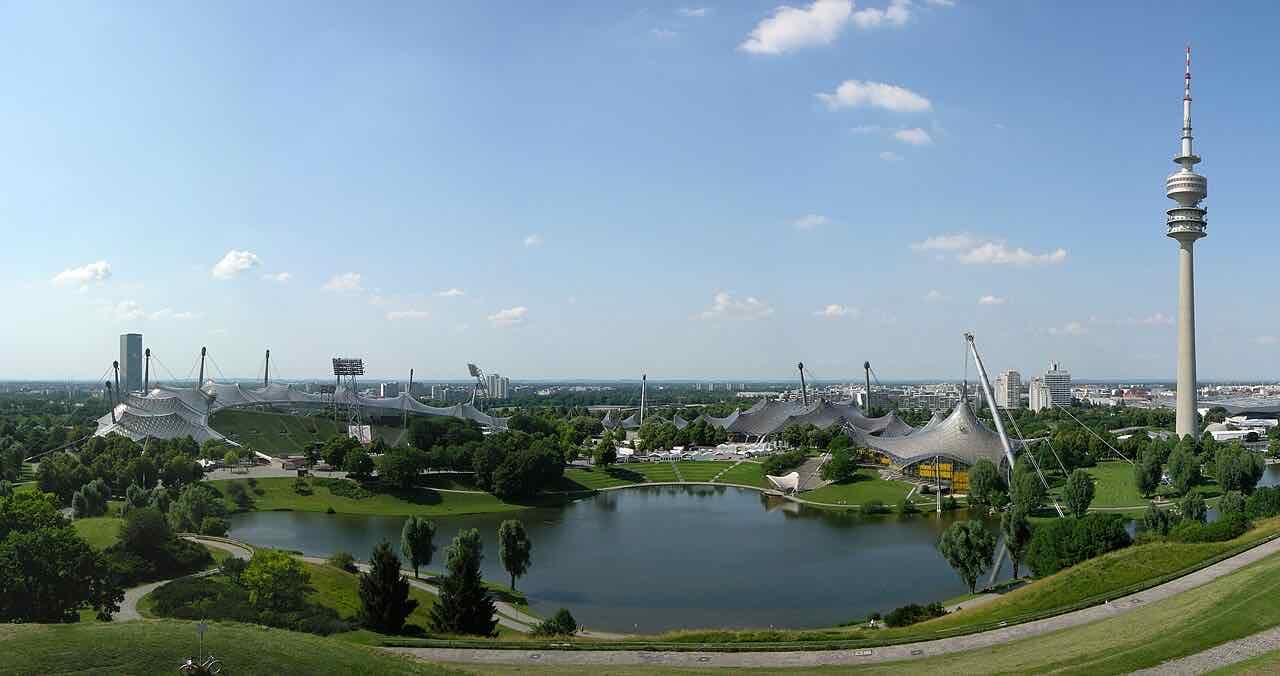
Munich was first recorded in 1158 and became the capital of the Kingdom of Bavaria in 1806. The Oktoberfest goes back to a beer festival in October 1810. The city was heavily bombed in the Second World War and US troops took it on 30 April 1945, and in 1972 it hosted the Summer Olympics. You can still see that last chapter: the Olympiapark is a working sports and concert park, and its former Olympic Village now houses students.
It is a city of money and engineering rather than of cheap student bars. BMW, Siemens, Allianz and Munich Re are headquartered here, and the city's own business pages count more than 900 US companies and over 80 Indian companies with offices in the area. For a student that means a job market with international employers on your doorstep, and a housing market priced for their salaries.
The weather is continental. January days reach about 4 C and drop below freezing at night, July days about 25 C, and it rains around 940 mm a year, with July the wettest month. Plan for a proper winter coat and for the fact that the Alps, 50 km to the south, make the weather change quickly.
What to see and do
Most of this is walkable or one U-Bahn ride from the main university area around Königsplatz, Maxvorstadt and Schwabing.
The 1972 Olympic site: the tent-roof stadium, the Olympic Tower, the Olympic Swimming Pool, the Ice Sport Centre, a park railway, boat hire, a Walk of Stars and concerts all year. Tower and guided tours are ticketed, and the university sports centre trains on the same grounds.
A very large science and technology museum on the Museumsinsel (Museumsinsel 1, 80538 Munich), open daily 9:00 to 17:00. It is the obvious rainy-day trip for an engineering student, and it has branches at Verkehrszentrum and Flugwerft Schleißheim.
A cultural centre founded by the US military administration in 1945. It runs free English-language evenings, for example a board-game night and a book swap in October 2026, plus exhibitions.
The 2026 festival is over. The next one, the 192nd, runs from 18 September to 3 October 2027 on the Theresienwiese.
Marienplatz and the Neues Rathaus ↗
The central square, with the neo-Gothic town hall, the Frauenkirche close by and an S-Bahn and U-Bahn station underneath.
Munich in pictures
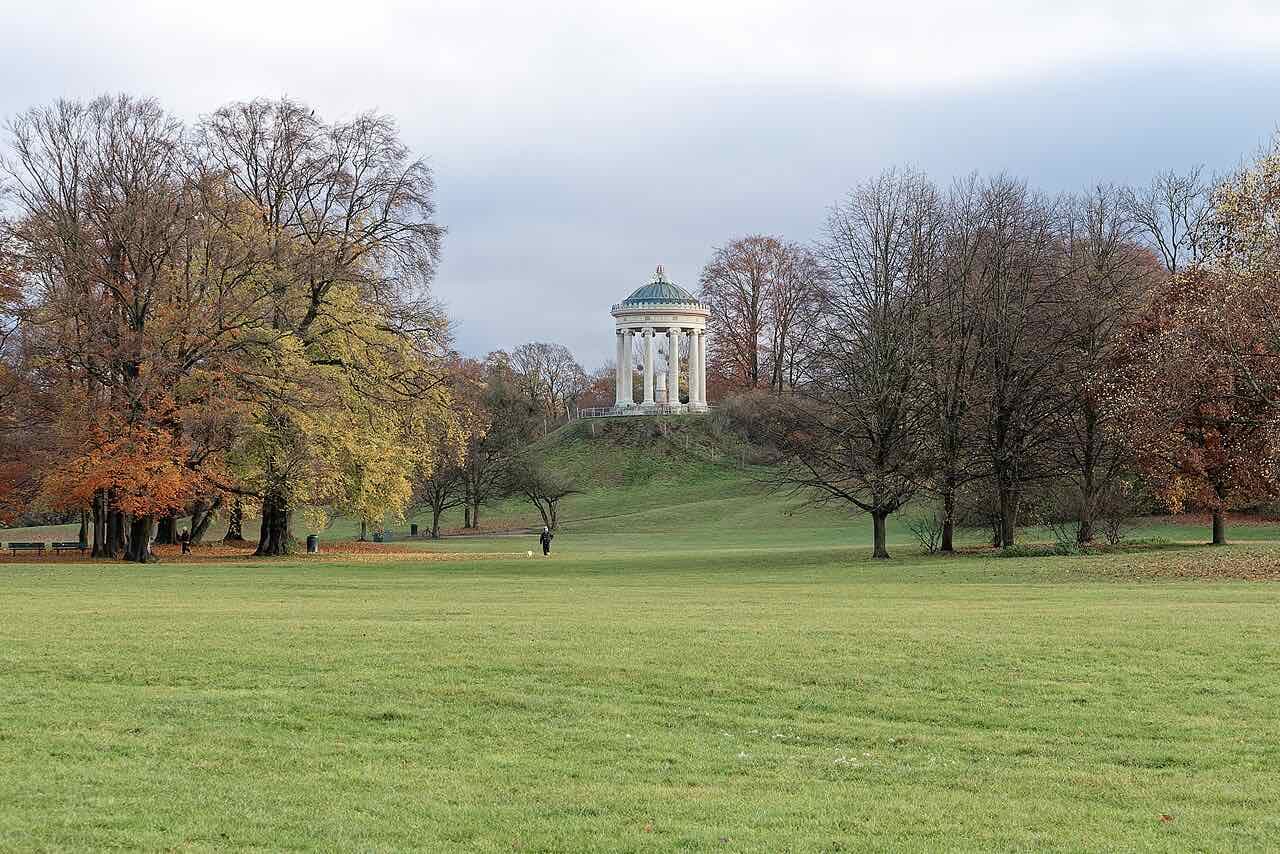
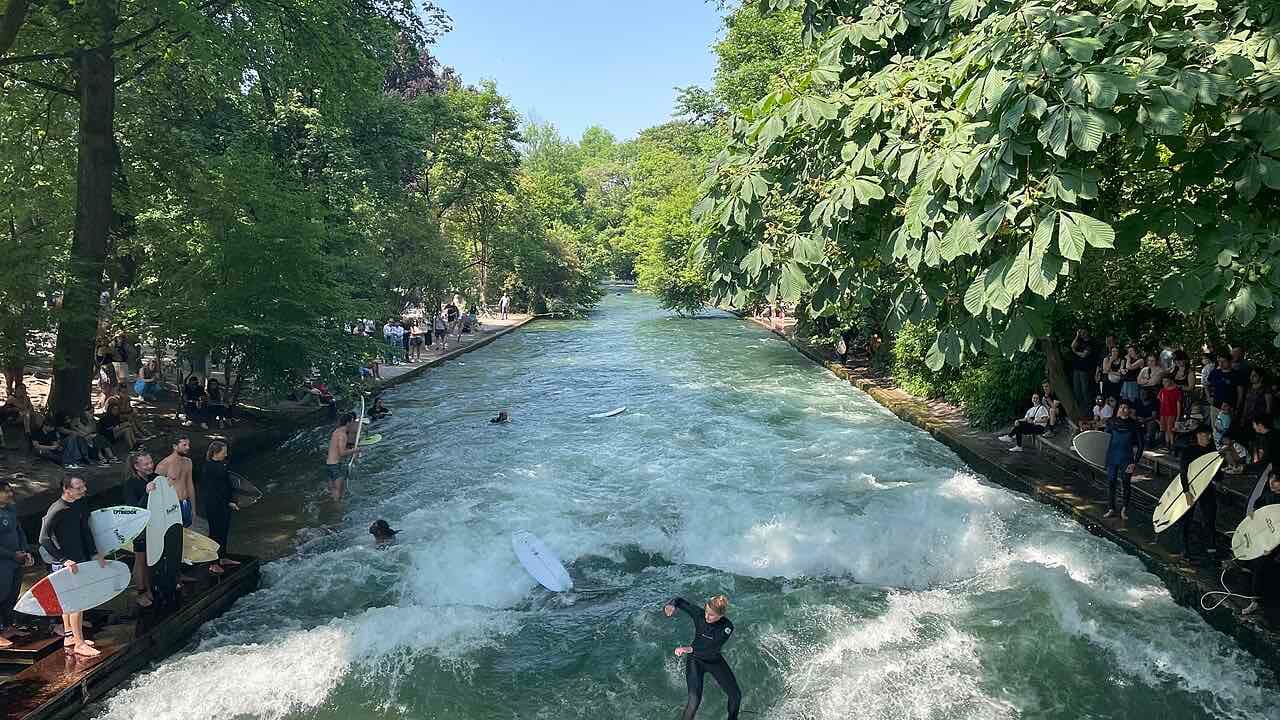
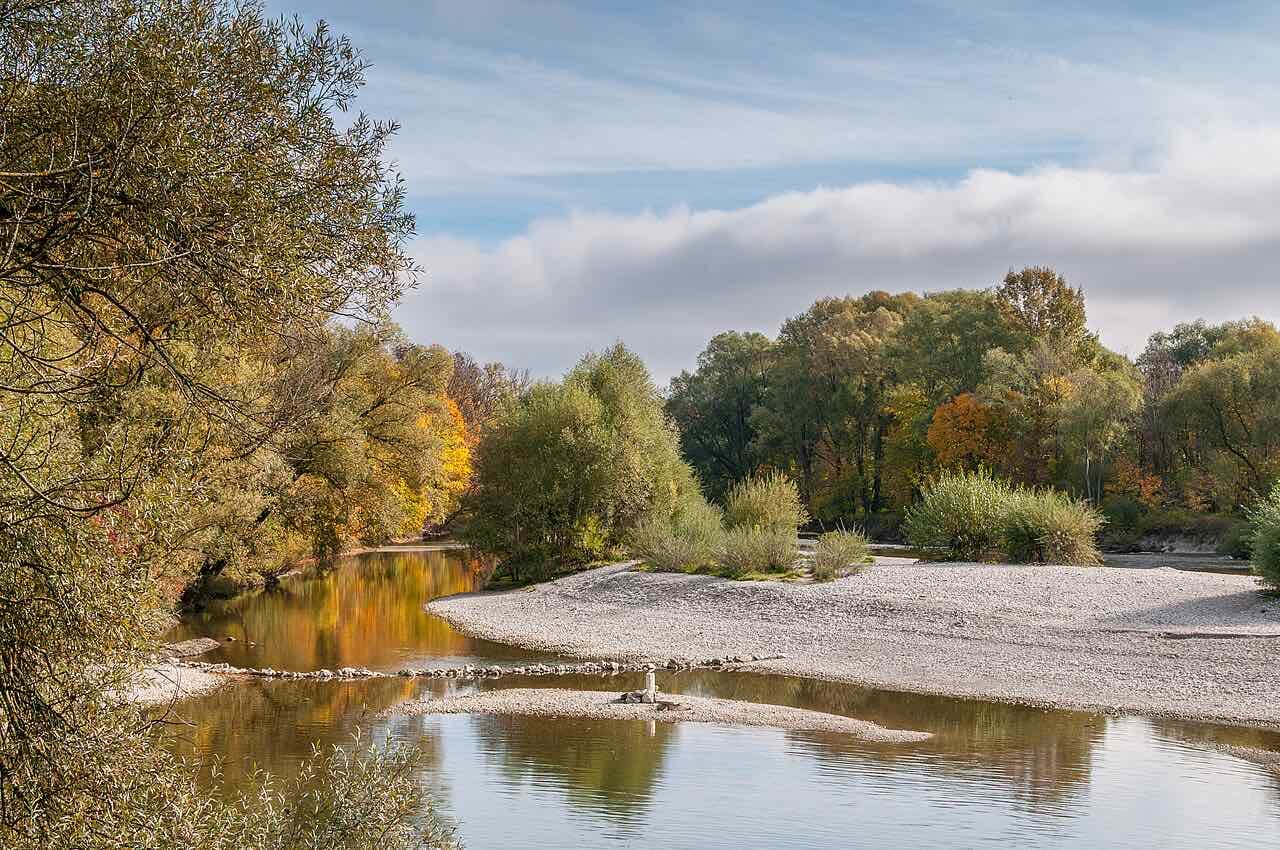
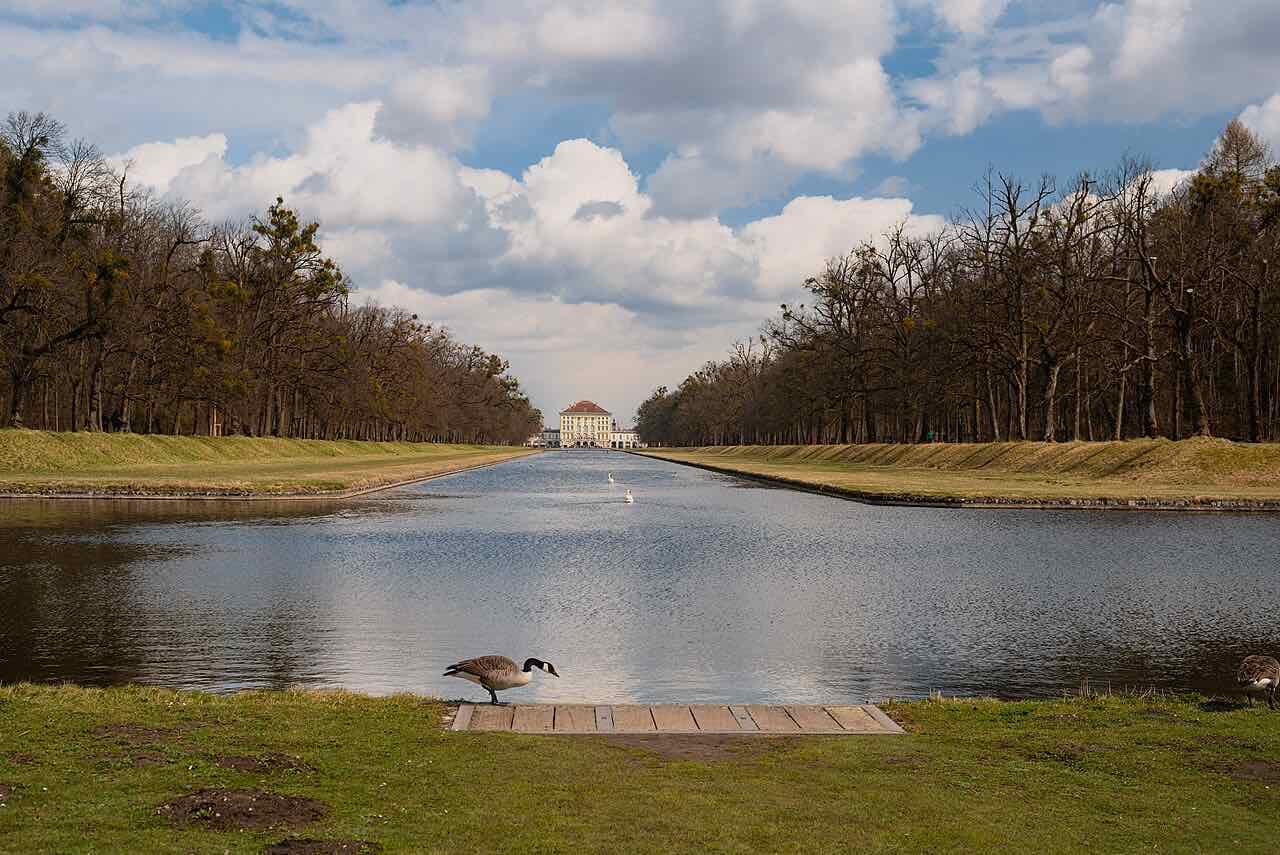
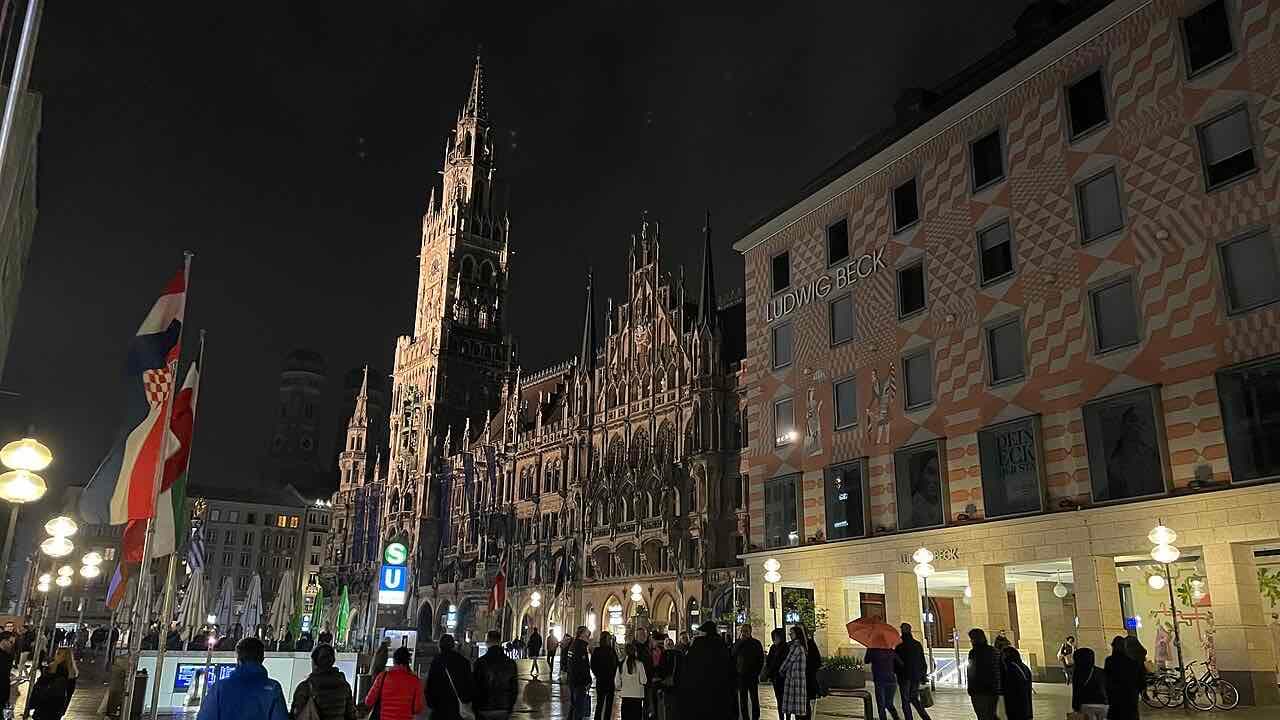
Weekends: the river, the lakes and the mountains
Munich sits about 520 m above sea level and about 50 km north of the Alps. In a normal week you will not need to leave the city for nature: the Englischer Garten, the Isar with its gravel banks at the Flaucher and the Olympiapark are all inside the city. For longer trips, the university sports centre (ZHS) is the cheapest way in. Its course list covers climbing and mountain sports, winter sports, sailing and water sports on Lake Starnberg, and it has sites outside Munich, including Starnberg. Winter-sport bookings for the 2026/27 season open on 2 November 2026 at 9:00, and the other courses of the winter semester started on 12 October.
Even a first winter in the city is easier with a ZHS course: it gives you a fixed weekly appointment and people to meet.
Getting around, and what has changed on student tickets
Public transport is run by the MVV: U-Bahn, tram, bus and S-Bahn, with the S-Bahn lines S1 and S8 going to the airport. LMU also points out that within about five kilometres a bike is faster than anything else, with around 1,200 km of marked bike lanes and some 22,000 bike stands, and that you do not need a car.
The important change for a newcomer: Munich has no cheap semester ticket built into your fees at the moment. The semester-ticket contract with the Studierendenwerk has been suspended since winter semester 2023/24, so the extra solidarity contribution no longer applies and the LMU student card no longer works as a travel pass on the MVV. LMU's living-costs page budgets 43 euros a month for the student Deutschlandticket. The MVV says that Bavaria has a reduced-price, Germany-wide discount ticket for students, trainees and volunteers. Check the current price on the MVV page before you buy, because ticket prices change at the turn of the year.
What Munich costs
- Room in private housing, utilities included
- 700 to 1,000 EUR a monthsource
- Average private room (LMU housing page)
- about 750 EUR a month; shared flats and single flats 600 to 1,100 EURsource
- Room in a Studierendenwerk hall, utilities included
- roughly 324 to 576 EUR for a single room in a shared flat, studios 363 to 538 EURsource
- Food, health insurance, leisure
- about 500 EUR a monthsource
- Student Deutschlandticket (LMU's budget figure)
- 43 EUR a monthsource
- Semester contribution
- 97 EUR per semester at TUM and LMUsource
- Visa blocked account
- 11,904 EUR per year, which is less than a year in Munich really costssource
LMU budgets about 1,500 euros a month for a student in Munich. The line items below are LMU's own, and the dorm range comes from the Studierendenwerk's October 2026 price list.
Tuition: read this before you pick Munich
Since winter semester 2024/25, TUM charges tuition to new bachelor's and master's students from outside the EU and EEA. TUM states it is usually 2,000 or 3,000 euros per semester for a bachelor's and 4,000 or 6,000 euros per semester for a master's, depending on the programme, and the exact figure is on each programme page under Program details. From winter semester 2027/28 the amounts rise to 2,300 or 3,400 euros (bachelor's) and 4,600 or 6,800 euros (master's). Students who began earlier keep the rate they started with.
There are exits. TUM does not charge doctoral candidates or exchange students, and a master's student who finished a bachelor's at TUM or at another German university is exempt, provided the degree is proven by the enrolment deadline. TUM also offers waiver scholarships and a study grant of 500 to 1,800 euros per semester for international students, decided case by case.
This profile can only confirm TUM's rules. LMU's fee page says no tuition has been charged since winter semester 2013/14 and does not mention non-EU students, so check the fee page of your own programme at LMU, Hochschule München and any private college before you apply.
Jobs and employers around Munich
The employers you will see on student job boards, with the facts the City of Munich and the companies themselves publish.
BMW and Siemens are headquartered in Munich. Intel and Texas Instruments Deutschland run their European headquarters from the Munich area, and General Electric has research activity there.
Allianz and Munich Re are headquartered in Munich, which is why business, actuarial and data profiles are in steady demand.
Microsoft, Google, Amazon, Apple, Intel, IBM and Oracle all have offices in the Munich area, and OpenAI has a branch office. They work closely with TUM and LMU.
More than 80 Indian companies have branches or offices in Bavaria, and the state counts about 1,500 business relationships with India.
START Munich is a student entrepreneurship community that works with the Munich universities.
Part 2
Student life in Munich
Where you can study
Technical University of Munich (TUM) ↗
Founded in 1868 as a polytechnic school, TUM has seven schools: Computation, Information and Technology; Engineering and Design; Natural Sciences; Life Sciences; Medicine and Health; Management; and Social Sciences and Technology. Campuses are in central Munich, Garching, Weihenstephan (Freising), Heilbronn, Straubing and Singapore; the Garching campus is on the U6 line. The Hochschule für Politik München is part of TUM. About 53,800 students are expected this winter, and 48.8% of the 16,750 new students are international, so you will not be the only newcomer in the room. TUM is one of the German universities of excellence. New non-EU students pay tuition, see the money section.
International office ↗Ludwig-Maximilians-Universität München (LMU) ↗
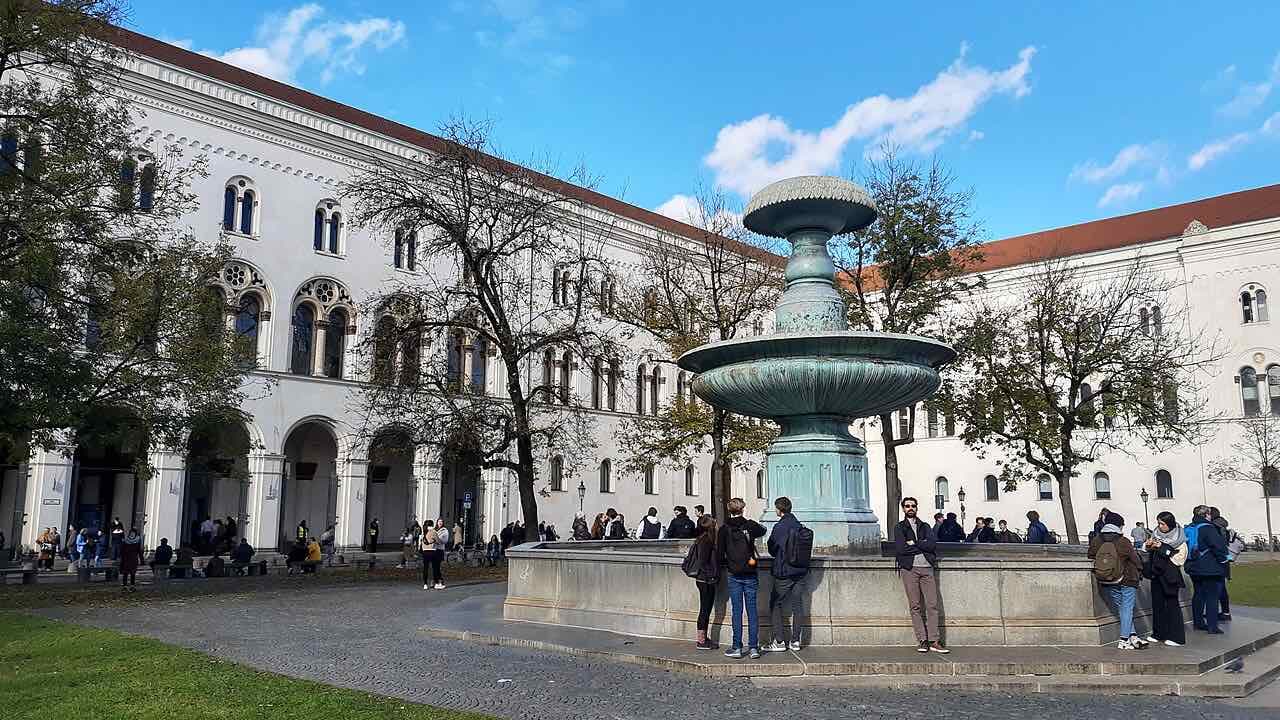
LMU has a history of more than 500 years and the main building at Geschwister-Scholl-Platz 1 in the middle of Maxvorstadt, with other campuses in and around Munich. 52,658 students were enrolled in winter semester 2025/26, taught by about 840 professors. Research and teaching cover the humanities and the sciences, and LMU has its own university hospital. International degree applicants apply through the International Office, the Registrar or the Foundation for University Admissions, depending on nationality and school, by 15 January for the summer semester and 15 July for the winter semester. You need an Abitur-equivalent certificate and, unless you apply to an English-taught master's, double degree or doctorate, proof of German.
International office ↗HM is the big applied-sciences university in the city: 19,133 students, 101 degree programmes (51 bachelor's and 50 master's), 14 departments and two interdisciplinary schools, MUC.DAI (digital sciences and AI) and MUC.HEALTH. Its main address is Lothstraße 34. It offers more than 100 lectures and seminars in English, so check each programme page for the language of instruction. Applications run through HM itself, so use the international office page.
International office ↗Universität der Bundeswehr München ↗
A campus university at Neubiberg, just outside Munich, with small study groups and residential facilities on campus. It offers a long list of bachelor's and master's programmes, among them aerospace engineering, computer science, cyber security, mathematical engineering, civil engineering, psychology, sports science and political and social sciences, plus continuing-education MBAs. It is a Bundeswehr university, and its website has a separate page on study for civilians, so read its admission rules before you plan on it.
International office ↗Hochschule für Musik und Theater München ↗
The state music and theatre university. Its English site has an international section for full-degree international students, an international office and information on scholarships. Start from the International Office page for application rules.
International office ↗Akademie der Bildenden Künste München ↗
The Munich fine-arts academy organises its teaching in classes (Klassen) and has an international section on its website.
International office ↗Hochschule für Fernsehen und Film München (HFF) ↗
The Munich film and television school. Its departments cover media studies, technology, cinema and TV fiction, documentary and television journalism, production and media business, screenwriting and cinematography including VFX, and it teaches a master's in serial storytelling. It also runs summer schools, and has an international office.
International office ↗Munich School of Philosophy (Hochschule für Philosophie München) ↗
A Jesuit university a few metres from the English Garden, in the university quarter, with a very favourable student-teacher ratio. Its English site has a welcome page for international students and an international office. Think of it for philosophy and social-ethics degrees rather than for engineering.
International office ↗Katholische Stiftungshochschule München (KSH) ↗
A Catholic university of applied sciences with campuses in Munich (Preysingstraße 95) and Benediktbeuern. Its degrees cover social work, childhood education, nursing, midwifery, healthcare management, business psychology and religious education, with several master's programmes. It has an international office and an English version of its site.
International office ↗Macromedia University of Applied Sciences, Munich campus ↗
A private university with a campus in Nymphenburg. Its bachelor's subjects include art and design, digital technologies and coding, fashion, film, management, media and journalism and psychology, plus master's programmes in business, media and an MBA. The university advertises programmes taught fully in English and runs a student advisory service for international applicants. Look up its tuition before you compare costs with a public university.
International office ↗A private business school in the middle of Munich offering an international business bachelor's with a pre-bachelor year, master's programmes in international business, international marketing and brand management, sports management and media, and finance, plus MBA and DBA. Applications for spring and autumn 2027 are open. It is a private school, so look up its fees.
HDBW Hochschule der Bayerischen Wirtschaft ↗
A private university of applied sciences on a campus in Munich-Riem, with business, engineering, digital and AI programmes in full-time, dual and part-time form and small study groups.
A state-recognised private school for languages, translation and business communication with students and lecturers from more than 70 countries, partnerships with universities abroad and its own student apartments.
Hochschule Fresenius, Munich campus ↗
A private university with a Munich campus teaching psychology and business psychology, business administration, real estate, business law, nutrition and fitness, physician assistance and osteopathy, among others.
Hochschule Weihenstephan-Triesdorf, Freising ↗
Freising, just north of Munich near the airport, is home to this applied-sciences university and the TUM School of Life Sciences. The programmes are in the green sciences, agriculture and biotechnology. Nepali students who spoke to the Kathmandu Post say Freising has fewer international students and a smaller social scene than central Munich.
Student unions, services and groups
Studierendenvertretung (StuVe) at LMU ↗
The elected student representation of LMU's more than 54,000 students, made up of over 350 volunteers in faculty councils, departments and committees. It sits on the university's committees and publishes its decisions and positions.
Studentische Vertretung at TUM (AStA and Fachschaften) ↗
TUM's student government. The AStA office is in the Mensa building at Arcisstraße 17 (room 0005) and is open Monday to Friday 10:30 to 16:30. The AStA meets on Tuesdays at 18:30 and anyone can come and help. A student general assembly is planned for 10 November 2026.
Studierendenwerk München Oberbayern ↗
The student service organisation for the Munich universities: halls of residence, canteens in Munich, Garching, Freising, Pasing and other sites, BAföG advice, psychological and social counselling, legal advice and help for students with children or disabilities. It also runs a private accommodation service for the room hunt.
Zentraler Hochschulsport München (ZHS) ↗
The shared sports centre for the Munich universities, with about 600 sports events per semester in ball sports, climbing and mountain sports, fitness, martial arts, dance, water sports and winter sports. Its base is the 34-hectare former training ground of the 1972 Olympics, with 19 new halls and rooms.
The Erasmus Student Network group at TUM, with nearly 400 events a year for international students: tutors, trips, parties and the first-week programme.
MESA, Munich Erasmus Students Association ↗
Run by LMU students who have studied abroad. It welcomes everyone, not only Erasmus students, with a big welcome party each semester, pub crawls, castle tours and help in the first months.
A tutoring and community programme run through LMU's International Office, with events in the city and trips around Germany.
More than 250 student initiatives at TUM, from engineering teams to cultural and country clubs. A Student Club Fair is held on 21 October 2026 in Garching.
Supports students in finding an internship or voluntary work abroad.
Association of Iranian Students in Munich (AIS) ↗
A support group for international students in general and for Iranian students in particular, with orientation and events.
Protestant Student Community (ESG) Munich ↗
The Protestant student parish for the Munich universities, with religious and academic support, including help with language.
Catholic University Community KHG Leo 11 ↗
The Catholic student community at LMU. It welcomes students of all disciplines and cultures.
Islamic Association of Universities (IHV) Munich ↗
A group of Muslim students and graduates from HM, LMU and TUM, founded in 2010, that answers questions about Islamic topics at the universities and builds a network for study and career. It invites contact by e-mail.
Enactus Munich and START Munich ↗
Two student groups for people who want to build things: Enactus works on social and environmental ventures, START Munich is the student entrepreneurship community.
Study culture and campus life
At TUM the weight is on engineering, informatics and natural sciences, and the Garching campus north of the city is where many of those programmes live. TUM's Student Clubs list over 250 initiatives, and the TUM Student Club Fair on 21 October 2026 in Garching is the quickest way to find a team. LMU is more central and more mixed: its main building on Geschwister-Scholl-Platz is a few minutes from the English Garden, and its student groups range from Amnesty and Arbeiterkind to law, finance and start-up clubs. HM is smaller, with fixed timetables and a stronger link to industry placements.
All three of the large public universities have elected student governments, and it is worth knowing them early. LMU's StuVe has over 350 volunteers, TUM's Studentische Vertretung runs the AStA office in the Mensa building, and both run events, advise on exams and speak for students in the senate and faculties. Both also publish what they decide, so you can see who is working for what.
Housing: the honest version
Housing is the hardest part of Munich. LMU says the majority of the roughly 100,000 students in the city live in private rooms, shared flats and single flats, and only about 13% live in university housing, which is mostly run by the Studierendenwerk. LMU puts the average private room at about 750 euros a month, with rooms and flats between 600 and 1,100 euros depending on location, and says the hunt is hardest in September, October and November.
The Studierendenwerk manages more than 9,000 rooms and apartments in Munich, Freising and Rosenheim. Its price list of October 2026 shows rents with utilities from about 324 euros up to roughly 576 euros for a single room in a shared flat, and studios between about 363 and 538 euros. The catch is the queue: the average waiting period is given per hall and runs from one to seven semesters, and the clock starts the day you apply. Examples from the list: Chiemgaustraße, 248 single rooms at 335 to 444 euros, one to two semesters; Felsennelkenanger, 198 single rooms at 378 to 390 euros, one to two semesters; Garching II, rooms around 340 euros, four semesters; the Olympic Village, 1,879 studios at 391 to 487 euros, four to five semesters; Oberschleißheim, 399 to 420 euros, one semester. Apply on the day you have your admission letter, and apply to several halls.
Because you will probably start in a private room, learn the rules. Advertised prices are usually the basic rent (Kaltmiete) without utilities, and rent that includes them is the Warmmiete. Expect a deposit (Kaution) of one to three months of basic rent. LMU warns about agents who charge up to 2.3 months of basic rent in commission and about agencies that charge a fee for special lists. The Studierendenwerk and LMU both warn that scammers offer cheap rooms and ask for money in advance: never transfer a deposit or send a copy of your ID before you have seen that the room exists. The Studierendenwerk runs a private accommodation service that helps with the hunt.
Where to look: Nepali students interviewed by the Kathmandu Post recommend Giesing (cheaper, older flats, 5 to 7 km from the campuses, with parks like the Ostpark), Sendling (residential, good connections), Moosach in the north-west (calm and family-friendly, longer commute) and Maxvorstadt next to the universities (most expensive, noisy, but with Indian and Nepali restaurants and shops). Freising is cheaper but has fewer international students.
Dorm halls to know
- Chiemgaustraße (U1 St.-Quirins-Platz)
- single rooms 334.80 to 444.40 EUR; wait 1 to 2 semesterssource
- Felsennelkenanger (U2 Dülferstraße)
- single rooms 378.10 to 390.30 EUR; wait 1 to 2 semesterssource
- Garching I and II (U6 Garching)
- single rooms 340.00 to 403.90 EUR; wait 3 to 4 semesterssource
- Olympic Village (U3 Olympiazentrum)
- studios 391.10 to 487.10 EUR; wait 4 to 5 semesterssource
- Stiftsbogen (U6 Haderner Stern)
- single rooms 357.20 to 393.40 EUR; wait 3 semesterssource
- Lothstraße 62 (mostly HM students)
- single rooms 491.10 to 576.60 EUR; wait 4 semesterssource
- Notburgastraße and Volksgartenstraße (mainly music students)
- single rooms 324.20 to 376.70 EUR; wait 2 semesterssource
Rent includes utilities. Waiting times are the Studierendenwerk's own averages and can get longer. List dated October 2026.
Canteens and food
The Studierendenwerk runs the student canteens (Mensa, StuBistro, StuCafé and StuLounge) in Munich, Garching, Freising-Weihenstephan, Großhadern and Martinsried, Pasing, Rosenheim and Benediktbeuern, and has opened a new Mensa in Ottobrunn-Taufkirchen. Prices are posted at each counter and on its website, and in most canteens dishes are self-service and some are sold by weight. You can pay by bank card in selected canteens. There is also a cup-sharing system for take-away drinks.
Outside the canteens, Munich has around 100 Indian restaurants, according to the city, and Maxvorstadt, as Nepali students point out, has Indian and Nepali shops. For special groceries ask your national student group, which will know which shops in Giesing, Sendling and near the main station stock what you miss.
Sport and nights out
The ZHS is the main sports provider for all Munich universities. It lists about 600 sports events a semester, from ball sports and fitness to climbing, dance, martial arts, water sports and winter sports. Booking for the winter semester 2026/27 opened on 28 September and courses began on 12 October. The site has an eligibility page, so check whether your college is covered. TUM also runs a big campus run on the Garching campus and has a sports campus at the Olympiapark.
For nights out, ask your student council or your ESN group, since the best first-week events are organised by them. ESN TUMi organises nearly 400 events a year, MESA throws a big welcome party every semester, and TUM has a choir and a university chamber orchestra. The English Garden and the Isar banks are where Munich meets in summer, and in winter people go to the cinema, the museums, the canteens and the sports halls.
Your first weeks
- 1
Before you travel
Open the blocked account (11,904 EUR per year is the Federal Foreign Office figure for a student visa), get your visa, and book the first nights of accommodation. Apply to the Studierendenwerk halls the day you have your admission letter.
- 2
First 14 days
Register your address at the Kreisverwaltungsreferat (KVR), Ruppertstraße 19, U3 or U6 Poccistraße. You need an appointment, your passport, a visa if you needed one, and your rental agreement. A temporary address such as a hostel or a private room works, but your name must be on the letterbox. You need the registration certificate for enrolment and for opening a bank account.
- 3
First weeks
Open a bank account. Banks ask for your registration certificate or rental contract, your student ID or admission letter and your passport. You need it to pay rent, the deposit and the semester contribution (97 EUR).
- 4
Enrolment
Pay the semester contribution and enrol in TUMonline (TUM) or through your university's registrar. Non-EU students at TUM also pay tuition unless exempt, so keep the proof of any exemption and apply for waivers before the deadline.
- 5
As soon as you are enrolled
Apply for the residence permit at the Ausländerbehörde in the KVR, Ruppertstraße 11. LMU warns that applications and extensions can currently take up to five months, so book the appointment early and keep your visa and passport safe in the meantime.
- 6
Weeks 2 to 6
Go to your university's welcome events, join ESN TUMi or MESA, visit the TUM Student Club Fair or the LMU StuVe, and sign up for a ZHS course.
Working next to your studies
Non-EU students may work up to 140 full days or 280 half days a year without a separate work permit. This is noted on the residence permit. Jobs as a student assistant (Hilfskraft) inside the university have no day limit as long as your studies do not suffer, but the Ausländerbehörde must be told. Compulsory internships that are part of your degree do not count against the 140 days. Non-EU students may not be self-employed or freelance, and working without permission can cost you your residence permit.
The statutory minimum wage is 13.90 euros an hour in 2026. A working-student job at a Munich employer is how many students pay for the extra cost of the city, but the 140-day limit means a job will not cover a Munich room on its own. Plan your budget from savings and family support first.
Countries with no Munich community page here
For Vietnam, Pakistan and Cameroon the Bavarian State Chancellery's list of consular offices shows no consulate in Munich, and no student or community group with its own website is listed here for them. Bangladesh has an honorary consul general at Residenzstraße 18, whose office hours are Monday to Friday 9:00 to 12:00, covering Bavaria and Baden-Württemberg. For all of these, start with the international student groups below and the national groups at TUM and LMU: the TUM Student Clubs gallery lists country and regional clubs, and the Asian-European Society and ESN can introduce you to other students from your part of the world.
Where you come from matters here
Pick your home country: food, faith, community groups and the consulate that serves you, checked 21 October 2026.
🇮🇳 Living in Munich as an Indian student
Munich is one of the Indian community's main hubs in Germany. The City of Munich counts about 17,500 Indian nationals in the city and over 58,400 in Bavaria, and around 100 Indian restaurants. Diwali, Holi and Navratri are celebrated, and an Independence Day Cup in cricket is a yearly fixture. The Consulate General covers Bavaria and Baden-Württemberg.
Consulate General of India, Munich ↗
Widenmayerstraße 15, 80538 Munich. The Bavarian State Chancellery lists the consular district as Bavaria and Baden-Württemberg and the hours as Monday to Friday 9:00 to 12:30.
Munich Indian Students Association (MISA) ↗
A volunteer association of and for Indian students, active since early 2020, for networking, information sharing and cultural integration with Germany. The group runs events and offers a Q&A forum.
Indien-Institut e.V. München ↗
Founded in 1929 as the Institute for Cultural Relations, it is the oldest German organisation for German-Indian cultural exchange, with talks, concerts and events, and the Consul General attended its 2026 Ayurveda Day.
Sivaalayam e.V., Munich Hindu temple ↗
A Shiva temple at Bodenseestraße 228, 81243 Munich. Daily pooja at 8:00 and 18:00 with abhishekam on weekends, and priests available for bookings.
A Krishna temple with a Sunday programme: kirtan from 13:00, a talk from 14:00, Gaura arati at 15:00 and a prasadam meal from 15:30. The community also holds street chanting in the city centre.
🇳🇬 Living in Munich as a Nigerian student
There is no Nigerian consulate in Munich on the Bavarian State Chancellery's list. The Consul General for Nigeria is in Frankfurt. In Munich the main community body is the Nigerian Community Germany Bayern (NCBG) e.V., and the African Courier has reported on it.
NCBG e.V.: new executive elected in Munich (2020) ↗
The African Courier reports that the Nigerian Community Germany Bayern e.V. elected a new chairman at the African Centre in Munich and that he promised to help Nigerian students with employment during and after their studies. The report dates from 2020, so contact the group to find out how active it is today.
NCBG Nigeria Cultural Feast and Meritorious Awards ↗
A Munich event of 20 July 2019 organised by the NCBG with the Nigerian ambassador as guest of honour, and cultural shows, art and products made by Nigerians.
🇳🇵 Living in Munich as a Nepali student
Munich has an honorary consul general of Nepal, and a network for Nepali professionals runs events in the city. Nepali students interviewed by the Kathmandu Post recommend specific neighbourhoods for rent.
A network for Nepali professionals in Germany that runs workshops, webinars and networking events, including a community mixer for newcomers in Munich.
Kathmandu Post: affordable places for Nepali students in Munich ↗
A guide built from conversations with Nepali students: Giesing, Maxvorstadt, Sendling, Freising and Moosach, with the pros and cons of each.
Honorary Consul General of Nepal ↗
Residenzstraße 25, 80333 Munich, for Bavaria and Saxony. The State Chancellery lists the hours as Tuesday 10:00 to 12:00 and Thursday 14:00 to 16:00. Call before you go.
🇬🇭 Living in Munich as a Ghanaian student
Ghana has an honorary consul in Gräfelfing, just west of Munich, and a Ghanaian association, the Asante Union, is active in the city. Munich was one of the local associations that drafted the constitution of the national union of Ghanaian associations in Germany.
Waldstraße 7, 82166 Gräfelfing, for Bavaria and Saxony. The State Chancellery lists the hours as Monday and Wednesday 10:00 to 13:00, and Friday 9:00 to 12:00.
The Ghanaian Times reports that the Asante Union in Munich supports health and education projects in Ghana.
History of the Union of Ghanaian Associations in Germany ↗
An African Courier article on how the national union (UGAG) was formed, naming Munich among the local associations that drew up its constitution in 2003.
🇺🇸 Living in Munich as an American student
The City of Munich counts about 8,000 US citizens in the city and more than 25,000 in Bavaria, mostly students, researchers and expatriates, and over 900 US companies in the greater Munich area. The US Consulate General is at Königinstraße 5, 80539 Munich, and covers Bavaria.
Founded by the US military administration in 1945, now a cultural centre with free English-language events such as a board-game night on 22 October 2026 and a book swap on 25 October 2026, exhibitions and the Bavarian American Academy.
An Anglican (Episcopal) church in English, active in Munich since 1903, with Sunday worship at noon and an international congregation of several hundred adults and children. Check its site for the church where services are held at the moment.
City of Munich: the U.S. community ↗
The city's own overview of the American community, with the transatlantic associations, American-German business club, the Amerikahaus and the consulate.
🇨🇳 Living in Munich as a Chinese student
The Chinese Consulate General at Hofmannstraße 57, 81379 Munich, covers Bavaria and is open Monday to Friday 8:30 to 12:30 and 14:00 to 17:00 according to the Bavarian State Chancellery. At TUM there are student groups for students with Chinese roots and for Asian and European students.
Consulate General of the People's Republic of China, Munich ↗
The Consulate General's official site. Use it for current services and appointment rules.
German Chinese Student Club (TUM) ↗
A club that connects students with Chinese roots and anyone interested in the culture, with spaces to discuss identity, careers and intercultural experiences. It is listed among the TUM Student Clubs and is mainly active on Instagram.
English-taught programmes in Munich
Soonest open deadline first. Every entry links to its official source.
- Master's in Management and Technology (MSc)Technical University of Munich · Münchenmaster30 Nov 2026Closing soon
- Digital Business Modelling and EntrepreneurshipBavarian University of Business and Technology (HDBW) · Münchenmaster15 Jan 2027Open
- Cyber SecurityBavarian University of Business and Technology (HDBW) · Münchenmaster15 Jan 2027Open
- MSc in Micro- and NanotechnologyHochschule München University of Applied Sciences · Münchenmaster15 Jan 2027Open
- Master of Science in PhysicsLudwig-Maximilians-Universität München · MünchenmasterNo tuition15 Jan 2027Open
- Digital Factory and Operational Excellence — Master of Science in Industrial Engineering and ManagementBavarian University of Business and Technology (HDBW) · Münchenmaster15 Jan 2027Open
- MBA – Master of Business AdministrationBavarian University of Business and Technology (HDBW) · Münchenmaster15 Jan 2027Open
- Civil Engineering (MSc)Technical University of Munich · Münchenmaster15 Jan 2027Open
- Master of Science in PhotonicsHochschule München University of Applied Sciences · MünchenmasterNo tuition15 Jan 2027Open
- Master of Science in Environmental EngineeringTechnical University of Munich · Münchenmaster15 Jan 2027Open
- Master of Science in International HealthLudwig-Maximilians-Universität München · Münchenmaster31 Jan 2027Open
- Master's Programme in NeuroscienceLudwig-Maximilians-Universität München · MünchenmasterNo tuition15 Feb 2027Open
- MSc Psychology: Learning Sciences and Human DevelopmentLudwig-Maximilians-Universität München · MünchenmasterNo tuition01 Mar 2027Open
- Master of Arts in Environment and SocietyLudwig-Maximilians-Universität München · MünchenmasterNo tuition10 Mar 2027Open
- Master in Quantitative EconomicsLudwig-Maximilians-Universität München · MünchenmasterNo tuition15 Mar 2027Open
- Master of Science in EconomicsLudwig-Maximilians-Universität München · MünchenmasterNo tuition30 Apr 2027Open
- Master of Science EpidemiologyLudwig-Maximilians-Universität München · MünchenmasterNo tuition15 May 2027Open
- Master of Science in Management and Digital TechnologiesLudwig-Maximilians-Universität München · MünchenmasterNo tuition15 May 2027Open
- Transportation SystemsTechnical University of Munich · Münchenmaster31 May 2027Open
- AI in SocietyTechnical University of Munich · Münchenmaster31 May 2027Open
- Computational MechanicsTechnical University of Munich · Münchenmaster31 May 2027Open
- Data & Society (MSc)Technical University of Munich · Münchenmaster31 May 2027Open
- Finance and Information Management (FIM)Technical University of Munich · Münchenmaster31 May 2027Open
- Geodesy and Geoinformation (MSc)Technical University of Munich · Münchenmaster31 May 2027Open
- Information Technologies for the Built Environment (MSc)Technical University of Munich · Münchenmaster31 May 2027Open
- Land Management and Geospatial ScienceTechnical University of Munich · MünchenmasterNo tuition31 May 2027Open
- Master of Health Science – Prevention and Health PromotionTechnical University of Munich · Münchenmaster31 May 2027Open
- Master of Science in CartographyTechnical University of Munich · Münchenmaster31 May 2027Open
- Master of Science in Communications and Electronics Engineering (MSCE)Technical University of Munich · Münchenmaster31 May 2027Open
- Master of Science in Earth-Oriented Space Science and Technology (ESPACE)Technical University of Munich · Münchenmaster31 May 2027Open
- Master of Science in Sport and Exercise ScienceTechnical University of Munich · Münchenmaster31 May 2027Open
- Master's in Consumer Science (MSc)Technical University of Munich · Münchenmaster31 May 2027Open
- Master's in Management (MSc)Technical University of Munich · Münchenmaster31 May 2027Open
- MSc Microelectronics and Chip DesignTechnical University of Munich · Münchenmaster31 May 2027Open
- Politics & TechnologyTechnical University of Munich · Münchenmaster31 May 2027Open
- Radiation Biology (MSc)Technical University of Munich · Münchenmaster31 May 2027Open
- Responsibility in Science, Engineering and Technology (RESET)Technical University of Munich · Münchenmaster31 May 2027Open
- Risk and Safety (MSc)Technical University of Munich · Münchenmaster31 May 2027Open
- Science and Technology Studies (STS)Technical University of Munich · Münchenmaster31 May 2027Open
- Entrepreneurship and Digital TransformationHochschule München University of Applied Sciences · MünchenmasterNo tuition15 Jun 2027Open
- Engineering Physics and Data ScienceHochschule München University of Applied Sciences · MünchenbachelorNo tuition15 Jul 2027Open
- Elite Master's Programme: Theoretical and Mathematical PhysicsLudwig-Maximilians-Universität München · MünchenmasterNo tuition15 Jul 2027Open
- International Master's Programme in GeophysicsLudwig-Maximilians-Universität München · MünchenmasterNo tuition15 Jul 2027Open
- Master of Engineering in Paper TechnologyHochschule München University of Applied Sciences · Münchenmaster15 Jul 2027Open
- Geodesy and Earth Observation (BSc)Technical University of Munich · Münchenbachelor15 Jul 2027Open
- Bachelor's in Management and Technology (BSc)Technical University of Munich · Münchenbachelor15 Jul 2027Open
- Master of Science in AstrophysicsLudwig-Maximilians-Universität München · MünchenmasterNo tuition15 Jul 2027Open
- Master of Science in MeteorologyLudwig-Maximilians-Universität München · MünchenmasterNo tuition15 Jul 2027Open
- Master of Science in Power Engineering (MSC-PE)Technical University of Munich · MünchenmasterRollingApply anytime
- MBA General ManagementInternational School of Management (ISM) · MünchenmasterRollingApply anytime
- Master of Science in Geobiology and PalaeobiologyLudwig-Maximilians-Universität München · MünchenmasterNo tuitionSee sourceCheck source
- Evolution, Ecology and Systematics (Master of Science)Ludwig-Maximilians-Universität München · MünchenmasterNo tuitionSee sourceCheck source
- Master of Science in Management — International Triple Degree (ITD)Ludwig-Maximilians-Universität München · MünchenmasterSee sourceCheck source
- Executive MBA in Business & ITTechnical University of Munich · MünchenmasterSee sourceCheck source
- Plant Sciences (Master of Science)Ludwig-Maximilians-Universität München · MünchenmasterNo tuitionSee sourceCheck source
- Master's in Materials Science Powered by Large Scale Facilities (MaMaSELF²)Technical University of Munich · MünchenmasterSee sourceCheck source
- Human Biology – Principles of Health and DiseaseLudwig-Maximilians-Universität München · MünchenmasterNo tuitionSee sourceCheck source
- Molecular and Cellular Biology (Master of Science)Ludwig-Maximilians-Universität München · MünchenmasterNo tuitionSee sourceCheck source
- Executive MBATechnical University of Munich · MünchenmasterSee sourceCheck source
- International Communication and BusinessInternational University SDI München · Münchenbachelor15 Oct 2026Deadline passed
- Digital Media ManagerInternational University SDI München · Münchenmaster15 Oct 2026Deadline passed
- Intercultural CommunicationInternational University SDI München · Münchenmaster15 Oct 2026Deadline passed
- International Business ManagementInternational University SDI München · Münchenmaster15 Oct 2026Deadline passed
Is Munich right for you? Ask us. Free.
Tell us your passport, grades and budget. We compare Munich with the other places you could study, then apply for you. You never pay us.
Get my free plan