Studying in Rhineland-Palatinate, Germany
Trier
Germany's Roman city on the Moselle, with two universities, 15 km from the Luxembourg border.
Trier lies in the Moselle valley in the far west of Germany, about 15 km from the Luxembourg border. The Romans founded it around 17 BC as Augusta Treverorum, and it was an imperial residence in the 4th century, so the Porta Nigra gate, the amphitheatre, the imperial baths and the cathedral all stand within walking distance of each other. About 105,000 people live here, and roughly 17,000 of them study at the University of Trier, the Trier University of Applied Sciences and the Theological Faculty. The campuses sit on the hills around the old town, vineyards start at the edge of the city, and Luxembourg, Saarbrücken and Koblenz are all a short train or bus ride away. It is a small city where a student can reach a Roman ruin, a wine festival or a hiking trail in minutes, and where the university is the main reason half the people on the bus are your age.
- Population
- 105,054 (31 Dec 2025)
- Area
- 117.06 km2
- Semester contribution, University of Trier (new students, winter 2026/27)
- 393.80 EUR, of which 226.80 EUR is the semester ticket
- Monthly budget (university's own estimate)
- about 934 EUR including rent
- Studierendenwerk dorm rooms
- 1,095 rooms; e.g. 220 to 230 EUR for a room in a shared flat at Tarforst, all costs included
Part 1
Living in Trier
Germany's Roman city, and a university town since 1473
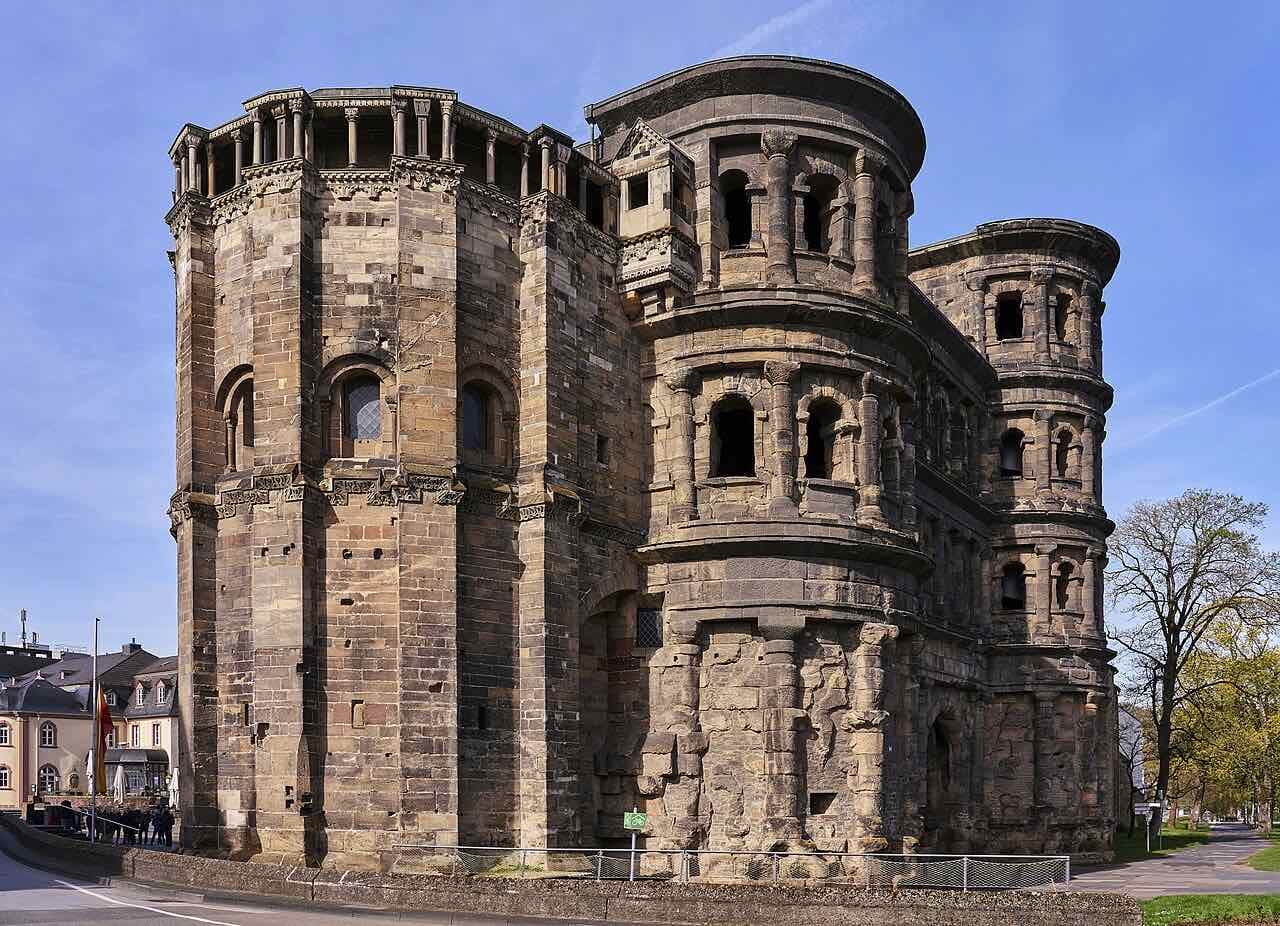
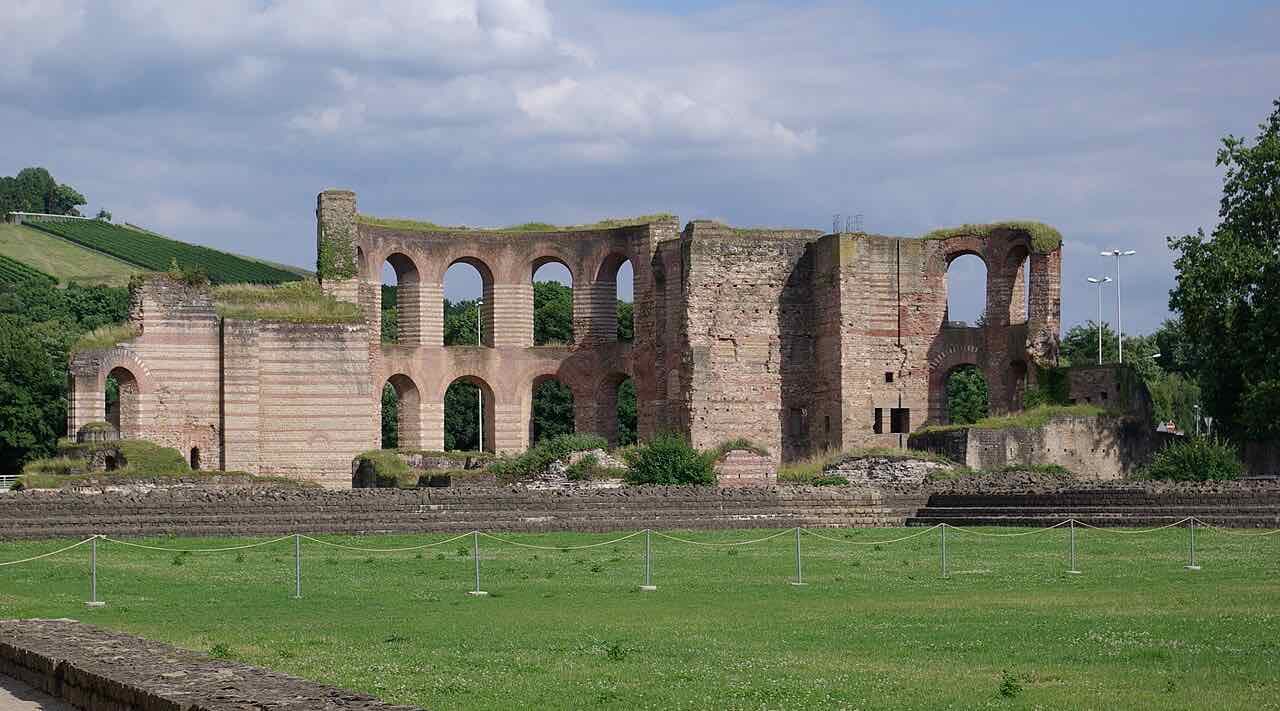
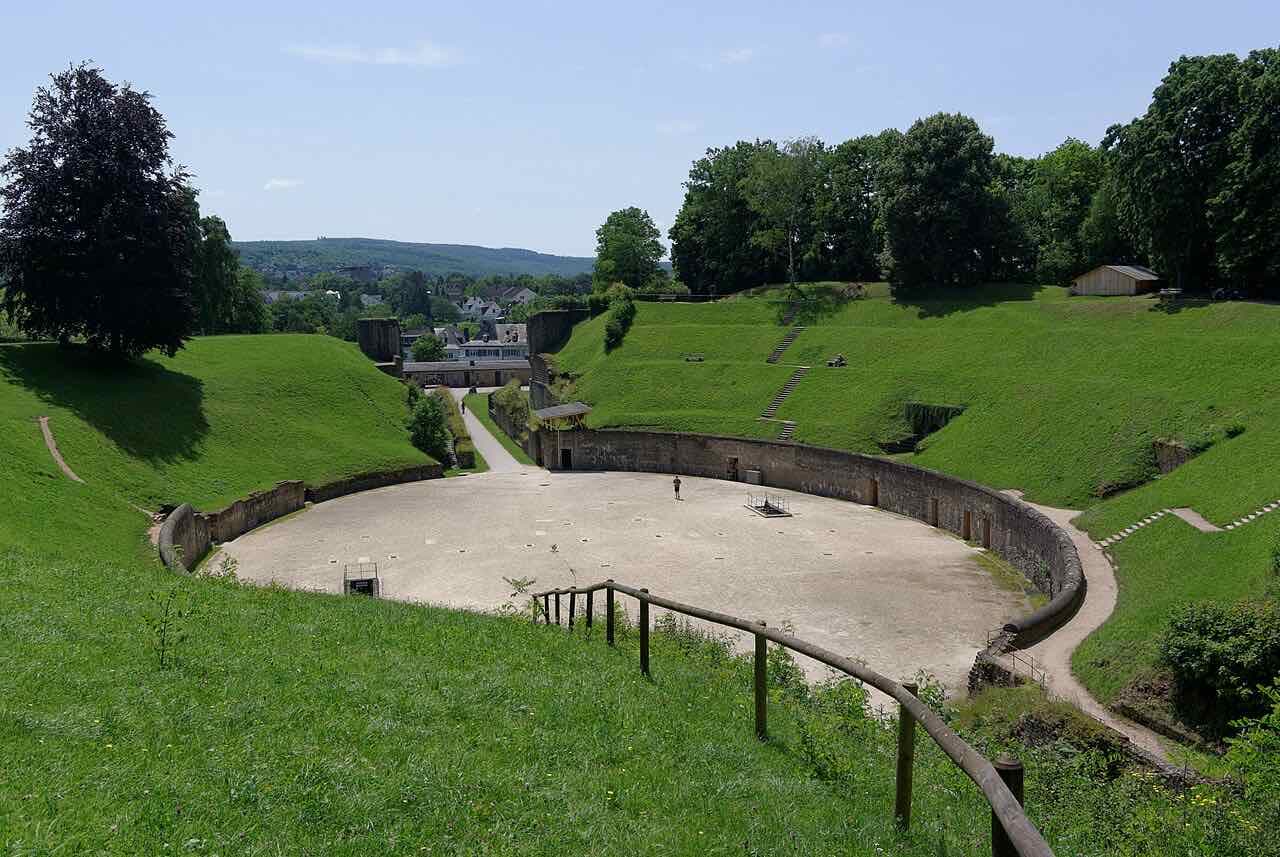
Trier was founded by the Romans around 17 BC and became one of the four capitals of the Roman Empire in the late 3rd and early 4th centuries. Western emperors lived here between 293 and 395. That is why a town of 105,000 has a UNESCO World Heritage listing with eight entries: the amphitheatre, the Barbarathermen, the Kaiserthermen, the Konstantinbasilika, the Porta Nigra and the Roman bridge, plus the cathedral and the Church of Our Lady. They were listed together in 1986.
The first university here was founded on 16 March 1473, closed in 1798 and was re-established in 1970. Karl Marx was born in Trier in 1818, and his birth house is now a museum. What you get today is a compact, walkable city where Roman stone, a Gothic church and 20th-century campus concrete are all part of the same bus ride.
Be realistic about the climate: winters are grey and wet, summers are warm, and the city sits in a valley, so the hills around it matter for views and for walking.
What to see, mostly within a 20-minute walk
The old town is small. Most of this you can do on foot in an afternoon, and the Tourist-Information at the Porta Nigra (Simeonstraße 60) is the starting point for the city's guided tours.
The best-preserved Roman city gate north of the Alps, and the symbol of the city. It stands at the edge of the pedestrian zone.
Kaiserthermen and the amphitheatre ↗
The imperial baths and the amphitheatre are both Roman ruins that you can walk through, and both belong to the UNESCO listing.
Konstantinbasilika (Aula Palatina) ↗
The throne hall of Emperor Constantine from the 4th century. It is now a Protestant church.
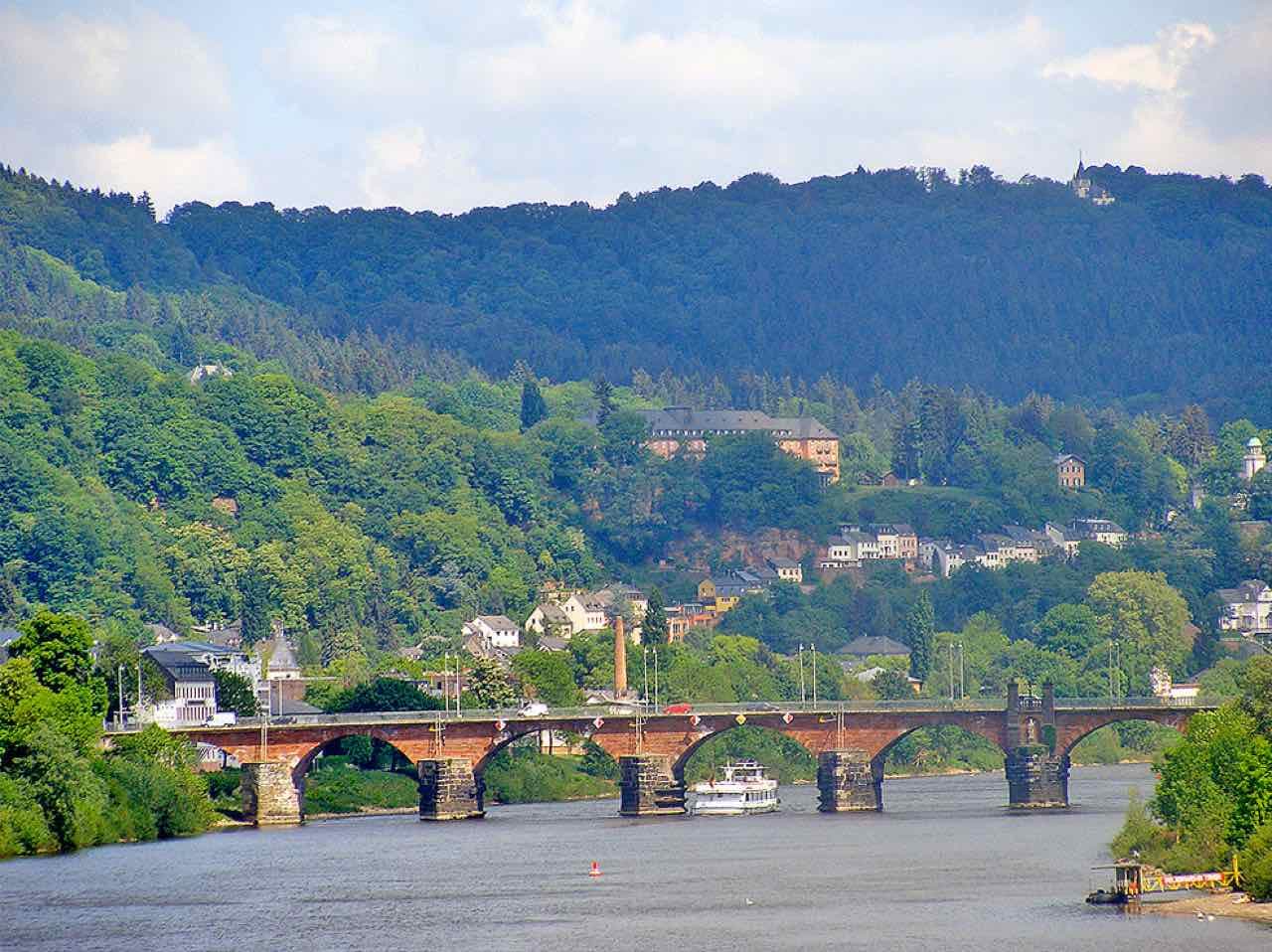
A Roman bridge from the 2nd century AD over the Moselle, the oldest bridge north of the Alps that still carries traffic. The river path next to it is a good place for an evening walk.
Cathedral and Church of Our Lady ↗
Trier Cathedral and the Liebfrauenkirche, one of Germany's most important early Gothic churches, stand next to each other.
The house where Marx was born in 1818 is a museum with letters and first editions.
Hauptmarkt and the old cranes ↗
The market square is where the Christmas market is held. The old crane on the Moselle dates from 1413, and a baroque crane from 1774 stands nearby.
The tourism site lists tours, concerts and shows, and in 2026 a programme for 40 years of World Heritage status.
Wine, river and weekends
Trier is in the Moselle wine region, and the best-known local event is the Olewiger Weinfest, a three-day wine festival in the district of Olewig, usually in August. The Christmas market on the Hauptmarkt and Domfreihof is the biggest winter event.
For weekends, the Moselle valley is the obvious direction. The wooded slopes start immediately outside the centre, and the trains and motorways run on to Luxembourg, Saarbrücken and Koblenz. Luxembourg is the closest foreign capital you can reach for a day trip, about 50 km away, and the border crossing at Wasserbillig is only about 15 km from the city centre.
Luxembourg next door: jobs and what is realistic
In 2019 the city counted 8,340 residents who commute to jobs in Luxembourg, up from about 3,150 in 2002. The city's own statistics office found that Luxembourg's median gross yearly income for these commuters was about 8,900 euros higher than in Trier, and that a third of the German commuters work in academic jobs. It also found that commuters living in Trier are more often in finance and professional services than in the building trades.
What this means for a student: the Luxembourg labour market is a real reason to choose Trier for a degree in business, economics, law, computer science or finance, and a reason to learn French or German alongside English. It does not mean that a student job across the border is easy to get. The study looks at working commuters, not students, so it tells you nothing about student jobs there and you should not plan your budget around one.
What it costs
- Semester contribution, University of Trier, new students, winter 2026/27
- 393.80 EUR: 129.00 Studierendenwerk, 16.00 student body, 226.80 semester ticket, 22.00 student cardsource
- Same, Theological Faculty
- 387.80 EURsource
- Monthly living cost the university plans for
- about 934 EURsource
- Deposit for a private flat
- about 600 EUR in the first monthsource
- Single apartment in the Studierendenwerk's Tarforst halls
- 260 to 365 EUR, 16 to 23 m2, warm rent including utilitiessource
- Room in a 2 or 3-person flat share, Tarforst
- 220 to 230 EUR, 13 to 15 m2source
- Small flat (2 to 3 rooms), Tarforst
- 440 to 621 EUR, 26 to 48 m2source
Figures are from the University of Trier and the Studierendenwerk Trier. Prices change each semester, so check the pages linked before you pay.
Part 2
Student life in Trier
Where you can study
Founded 1473, closed in 1798 and re-established in 1970. About 10,000 students in winter 2025/26, around 17% of them international. The main campus is on the Tarforst heights and opened in 1977, and Campus II is a former French military hospital. It has six faculties: education, philosophy and psychology; linguistics, literature and media; history, archaeology and politics; economics, sociology, mathematics and computer science; law; and geography and geosciences. In the Bachelor's programmes and many Master's programmes nearly all teaching is in German, and some Master's programmes are taught entirely in English, with a separate application route.
International office ↗Trier University of Applied Sciences (Hochschule Trier) ↗
About 7,000 students and around 80 degree programmes, the second largest university of applied sciences in the state. The main campus at Schneidershof has computer science, architecture, business and engineering. The Campus for Design and Art is in the centre of Trier, and the Environmental Campus Birkenfeld describes itself as Germany's only zero-emission campus. International Business (B.A.) is taught entirely in English, and Master's programmes include Interdisciplinary Engineering and International Material Flow Management.
International office ↗An independent Catholic faculty with state-recognised degrees, which works closely with the University of Trier. It teaches Catholic theology towards the Magister Theologiae and Catholic religion for school teaching, and about 300 students are enrolled. Its students can use the university's canteens, library, halls and sports.
Student unions, services and groups
AStA of the University of Trier ↗
The student representation, with departments for finance, university politics, social affairs, culture, sustainability and anti-racism. It also runs RAST, the autonomous department for foreign students, a bike workshop, the Café Kunterbunt in the Studihaus and the campus radio. BAföG, study and social advice are offered here.
Housing for students of the University, the Hochschule and the Theological Faculty, the canteens and cafeterias, and psychosocial, legal and international-student counselling. A social pedagogue advises international students living in the Petrisberg, Tarforst and Martinskloster halls.
University sport with a fitness studio, sports halls, an arena, tennis courts, an outdoor fitness park, a disc-golf course and a running path, sold as semester tickets.
Internationales Zentrum e.V. ↗
A volunteer association at the university that brings international and German students together: a buddy and tandem programme, a weekly language evening on Mondays in the winter semester in the Studihaus, Café International, cooking projects and trips.
Evangelische Studentengemeinde (ESG) Trier ↗
The Protestant student community.
The Christian student mission group, listed among the registered university groups.
A group of Muslim students and academics, listed among the registered university groups.
Studentische Rechtsberatung Trier ↗
Free legal advice run by students, which the AStA points students to.
A local human-rights group among the registered student groups.
A tutoring service listed among the registered groups.
Multikulturelles Zentrum Trier e.V. ↗
Founded in 1991, a self-managed association in the Balduinstraße that works for equal participation of migrants and refugees, with education, culture and politics as its areas.
Campus life and study culture
Trier University has 37 registered student groups, from rowing, baseball, chess and a theatre group to a legal-tech association, a creative-writing circle and a role-playing group. The Internationales Zentrum is the group set up specifically for international students. The university also runs a welcome greeting, a QUICK START seminar for degree students and an orientation programme for exchange students.
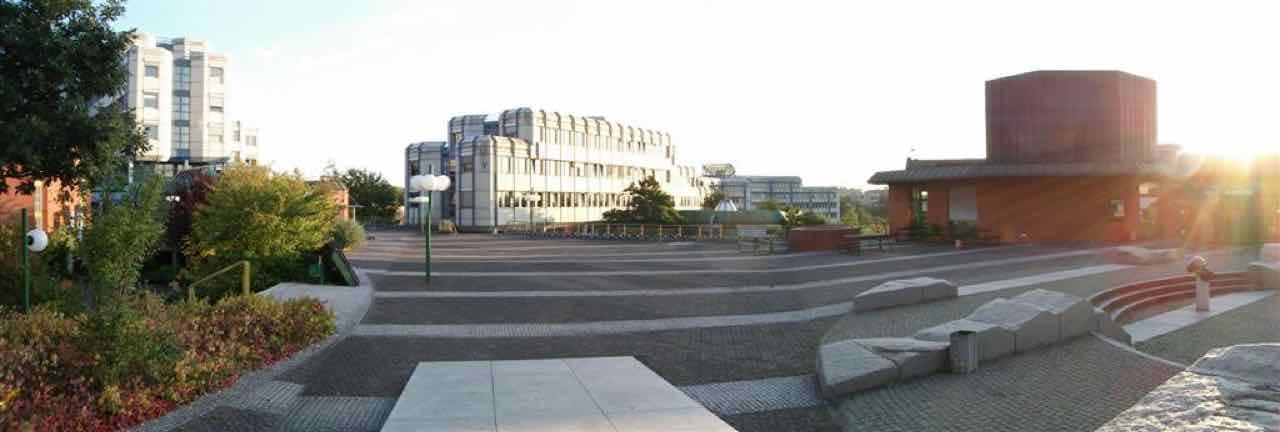
The University has two main sites, the Tarforst heights and Campus II, and the Hochschule has Schneidershof and the Campus for Design and Art, so expect to take a bus or walk uphill every day. The semester ticket is included in your contribution, and the university's housing page notes that it covers free bus travel, which helps if you live in a well-connected town such as Konz or Schweich.
Housing: apply early
The Studierendenwerk manages 1,095 rooms in halls such as Martinskloster, Haus am Baum, Tarforst, Tarforst-Enercase and Petrisberg. You apply online at any time, and applications are handled in the order they arrive, with priority for students with disabilities, students with children and BAföG recipients. Being admitted to the university does not mean you get a room. Exchange students go through the International Office.
On the private market, most rooms and flats are unfurnished and some have no kitchen, rent is usually quoted without utilities, and some landlords ask for a guarantor or a SCHUFA credit check. The university provides a document for international students that stands in for the SCHUFA, based on a blocked account. The AStA has criticised these barriers publicly, so start the search before you arrive and also look at nearby towns such as Konz, Schweich, Pluwig and Gusterath.
Food and canteens
The Studierendenwerk runs the canteens. Hours below are as listed on its site.
Mensaria and Bar Oliva (Campus I) ↗
Monday to Friday 11:30 to 19:30.
Monday to Friday 11:15 to 13:30.
Mensa Schneidershof (at the Hochschule) ↗
In semester Monday to Thursday 11:00 to 13:45 and Friday 11:00 to 13:30.
In semester Monday to Thursday 11:30 to 13:30 and Friday 11:30 to 13:15, closed in semester breaks.
Sport, culture and evenings
Semester tickets for the fitness studio, sports halls, the arena and the tennis courts, and free outdoor offers such as the disc-golf course.
A cultural centre in a former cloth factory in the Wechselstraße. The tourism site lists shows there.
The city theatre at the Augustinerhof.
The public library in the Bildungs- und Medienzentrum at the Domfreihof.
The AStA's own campus cinema and radio.
Your first weeks
- 1
Before you arrive
Apply for a Studierendenwerk room online, and plan for health insurance (compulsory for all students) and proof of funds. The university estimates about 934 EUR a month.
- 2
Within two weeks of moving in
Register your address at the Bürgeramt of the City of Trier. Book an appointment online or by calling 115, and bring your landlord's confirmation (Wohnungsgeberbestätigung) and your passport or ID card.
- 3
In the first weeks, if you are not an EU citizen
Apply for a residence permit at the Amt für Ausländerangelegenheiten of the City of Trier. You must show proof of health insurance, and the permit is needed if you stay more than three months.
- 4
In the first weeks
Open a student bank account. Most banks offer one without a monthly fee, and you need your passport and the registration certificate.
- 5
Once you have your permit
Check how much you may work. For non-EU students with a permit under section 16b of the Residence Act, the current rule at German universities is 140 full or 280 half days a year, or up to 20 hours a week, and your permit records the days. Exceeding this needs the Ausländerbehörde's written approval. Check your own permit and ask the International Office if unsure.
- 6
In the first semester
Go to the International Office's welcome events, sign up for the Internationales Zentrum's buddy programme, and take a German course at the Sprachenzentrum if your degree needs German.
Where you come from matters here
Pick your home country: food, faith, community groups and the consulate that serves you, checked 21 October 2026.
🇮🇳 Living in Trier as an Indian student
No group for Indian students is registered at the University of Trier. The nearest official consulate is in Frankfurt, and the Internationales Zentrum welcomes everyone.
Consulate General of India, Frankfurt ↗
Friedrich-Ebert-Anlage 26, 60325 Frankfurt am Main. Its site has a page on the jurisdiction of the consulate.
Internationales Zentrum e.V. ↗
The buddy and tandem programme, Café International and the Monday language evening are open to every international student.
🇳🇬 Living in Trier as a Nigerian student
No Nigerian student group is registered at the University of Trier. The embassy is in Berlin, and a local association welcomes migrants of every origin.
Neue Jakobstraße 4, 10179 Berlin. Passport services are by appointment, and visa applications for foreigners go through a service provider.
Multikulturelles Zentrum Trier e.V. ↗
A self-managed association in the Balduinstraße that works for equal participation of migrants and refugees.
🇻🇳 Living in Trier as a Vietnamese student
No Vietnamese student group is registered at the University of Trier. The embassy is in Berlin.
Embassy of Vietnam in Germany ↗
The official site has a consular section in Berlin, guidance on consular procedures and a fee list.
Multikulturelles Zentrum Trier e.V. ↗
A self-managed association in the Balduinstraße that works for equal participation of migrants and refugees.
🇵🇰 Living in Trier as a Pakistani student
Trier University lists a Pakistani Students Association and a Muslim students' group among its registered student groups.
Pakistani Students Association ↗
Listed on the university's register of student groups, with a Facebook group linked from that page.
MUSA Trier (Muslimische Studierende und Akademiker) ↗
A registered group of Muslim students and academics at the university.
🇨🇳 Living in Trier as a Chinese student
Trier University has a registered association of Chinese students and scholars. The city's twin town in China is Xiamen, partnered since 2010.
Verein der chinesischen Studenten und Wissenschaftler in Trier (VCSWT) ↗
Listed on the university's register of student groups; contact details are on that page.
Consulate General of the People's Republic of China in Frankfurt ↗
The official site lists the consular district and services. There is no consulate in Trier.
English-taught programmes in Trier
Soonest open deadline first. Every entry links to its official source.
- Master of Science in Data ScienceTrier University · TriermasterNo tuition15 Jan 2027Open
- Master of Science in EconomicsTrier University · TriermasterNo tuition15 Jan 2027Open
- Master of Science in GeoinformaticsTrier University · TriermasterNo tuition15 Jan 2027Open
- Master of Science in Sustainability Management and Economics (MSc)Trier University · TriermasterNo tuition15 Jan 2027Open
- Master of Arts in Anglophone Literatures and MediaTrier University · TriermasterNo tuitionSee sourceCheck source
- Master of Arts in Contemporary Human GeographyTrier University · TriermasterNo tuitionSee sourceCheck source
- Master of Arts in English LinguisticsTrier University · TriermasterNo tuitionSee sourceCheck source
- Master of Science in Applied StatisticsTrier University · TriermasterNo tuitionSee sourceCheck source
- Master of Science in Business MathematicsTrier University · TriermasterNo tuitionSee sourceCheck source
- Master of Science in Environmental Sciences (MSc ES)Trier University · TriermasterNo tuitionSee sourceCheck source
- Master of Science in MathematicsTrier University · TriermasterNo tuitionSee sourceCheck source
- Master of Science in Natural Language ProcessingTrier University · TriermasterNo tuitionSee sourceCheck source
Is Trier right for you? Ask us. Free.
Tell us your passport, grades and budget. We compare Trier with the other places you could study, then apply for you. You never pay us.
Get my free plan